Inflatable track and field games turn classic athletic events into fun, bouncy activities for all ages. These setups are perfect for schools, parties, or corporate events, offering obstacle courses, slides, and more. They’re easy to set up, safe, and create a lively atmosphere without requiring athletic skill. Key highlights include:
- What They Are: Inflatable versions of track events, like sprints, relays, and obstacle courses.
- Why They’re Popular: Quick setup, soft surfaces, and suitability for all ages.
- Planning Tips: Reserve early, measure your space, and ensure power access.
- Safety Measures: Supervise participants, monitor weather, and follow weight limits.
- Game Ideas: Costume relays, obstacle races, and long jump challenges.
Partnering with a rental provider simplifies logistics, ensuring sanitized, insured equipment and professional setup. Whether it’s a backyard party or a large school event, inflatables add energy and fun to any gathering.
Planning and Equipment Basics
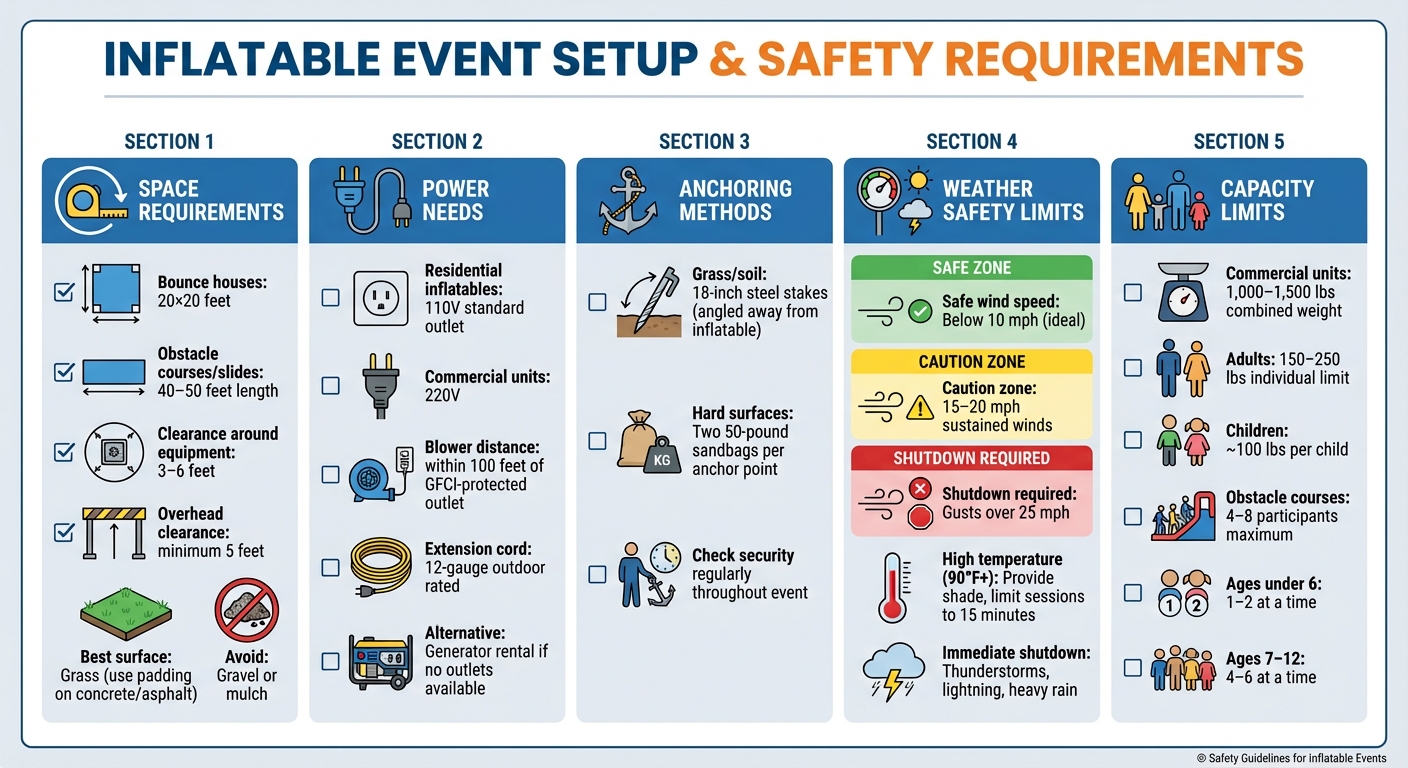
Inflatable Event Setup and Safety Checklist: Space, Power, and Weather Requirements
Start by mapping out your event timeline and reserving inflatables well in advance, especially for popular dates like spring field days or summer weekends. Measure your event space carefully, checking for obstacles like low-hanging branches, power lines, or debris. Allocate enough time for setup based on the number of inflatables you plan to use. These steps help ensure everything runs smoothly and that the equipment functions as expected.
Key Inflatable Equipment
Obstacle courses and combo units are crowd favorites, offering non-stop action for participants. Obstacle courses with multiple lanes let several people race through tunnels, climb walls, and slide down ramps at the same time. Combo units, which combine bounce houses and slides, are perfect for younger kids who love to jump and slide in one go. For older kids or adults, inflatables like jousting games or bungee runs bring a competitive edge to the fun. Choose equipment that suits your audience’s age range, activity level, and the type of challenges they’ll enjoy.
Space and Power Needs
Bounce houses typically require a 20×20‑foot area, while larger inflatables like obstacle courses or slides need 40–50 feet in length. Be sure to leave 3–6 feet of clearance around the equipment and at least 5 feet of overhead space for safety. Grass is the ideal surface for setup, but if you’re using concrete or asphalt, place padding underneath to protect the inflatables. Avoid using gravel or mulch, as these surfaces can cause damage.
When it comes to power, most residential inflatables run on standard 110V outlets, but larger commercial units may need 220V. Place the blower within 100 feet of a GFCI-protected outlet, and use a 12‑gauge outdoor extension cord to handle the power load safely. If your location lacks accessible outlets, you may need to rent a generator or discuss alternative power options with your rental provider.
Working with a Rental Provider
Teaming up with a professional rental provider can simplify the entire process. Companies like Bouncy Rentals USA handle delivery, setup, and safety checks, making event planning much easier. Their inflatables come sanitized and insured, and they secure them with 18‑inch stakes outdoors or 50‑pound sandbags for indoor use. Before the event kicks off, they’ll perform thorough safety inspections. Providers also supply essential extras like repair kits, ground tarps, and safety signage. Once the event wraps up, they’ll deflate, pack, and haul everything away – leaving you free to enjoy the day without any hassle.
Setup, Layout, and Operations
Preparing the Event Site
Before setting up any inflatable, carefully inspect the site to ensure it’s safe and ready. Walk the area and clear away any debris like sticks, rocks, glass, roots, or pet waste to create a smooth, obstacle-free surface. Be mindful of sprinkler heads, utility lines, and low-hanging branches that could pose hazards during setup or use. Measure the space to confirm it fits the inflatable’s footprint, keeping in mind the recommended clearance guidelines mentioned earlier. Use field paint, chalk, or cones to clearly mark areas for active play, entry and exit points, spectator zones, and emergency access. To protect the inflatable and make cleanup easier, place a durable tarp beneath each unit.
Inflatable Setup and Anchoring
Start by placing the rolled inflatable on the tarp, then unroll it completely to expose the seams and anchor points. Make sure all deflation zippers and air-release flaps are securely closed before turning on the blower. Attach the blower to the main inflation tube, tighten the strap around the blower neck, and connect it to a GFCI-protected 110V outlet using a heavy-duty outdoor extension cord (a 12-gauge cord is recommended for distances up to 100 feet). Once the inflatable is fully inflated – its walls upright and no areas sagging or twisting – secure every tie-down point. For grass or soil, use 18-inch steel stakes driven at a slight angle away from the inflatable. On hard surfaces like concrete or asphalt, secure each anchor point with two 50-pound sandbags. Throughout the event, regularly check that stakes and weights remain secure. With the setup complete, you can now focus on managing the event itself.
Running the Event Smoothly
Assign a trained attendant to each inflatable to manage capacity, group participants by age, and maintain a one-way flow of traffic. Use cones, stanchions, and clear signs to mark entrances and exits, ensuring participants follow the designated paths. For activities like relays or obstacle courses, organize participants into teams at start cones, sending them through one group at a time, and guiding them to the next station upon completion. At larger events, a rotation system with announcements every 10–15 minutes can help keep things moving efficiently and prevent overcrowding. Always keep blower intakes and electrical connections clear of obstructions and dry. Monitor weather conditions closely – if winds exceed the manufacturer’s limits or storms approach, stop entries, calmly guide participants out, power down the blowers, and deflate the units in a controlled manner. With Bouncy Rentals USA handling delivery, setup, and safety checks, you can focus entirely on supervising the event on-site.
Popular Inflatable Track and Field Game Ideas
Relay Races and Sprints
Relay races and sprints are a fantastic way to keep participants energized and engaged. To cater to different age groups, adjust the lane lengths: 15–30 feet for kids aged 4–7, 30–60 feet for those aged 8–12, and 60–100+ feet for teens and adults. This ensures every group feels challenged yet comfortable.
To keep things organized, run timed heats with 4–8 participants at a time, avoiding overcrowding on the track. Clearly mark start and finish lines, and have staff stationed at both ends for signaling and safety. Use color-coded vests or wristbands to distinguish teams, and track times with stopwatches or timing apps. Post the results on a visible board to build excitement. If time allows, organize preliminary heats, semifinals, and a final round. For younger kids, focus on fun rather than competition with formats like "first-to-finish" or "beat your last time".
For a twist, try costume relays. Set up a "gear station" at the far end of the track with items like oversized jerseys, helmets, or funny hats. Participants race to the station, put on an item, and then sprint back to tag the next teammate. Another fun option is mixed-skill relays, where each team member tackles a different challenge – sprinting, navigating obstacles, or balancing – making it perfect for multi-age family teams.
Obstacle Challenges
Obstacle challenges add variety and excitement, making them a great complement to relay events. Inflatable obstacle courses can be set up in two main ways. Individual time trials allow one participant at a time to race through the course, with their time recorded for a leaderboard. This format is ideal for younger kids or mixed-ability groups, as it prioritizes safety. On the other hand, head-to-head races use dual-lane courses where two participants compete side by side. This setup is perfect for school field days or teen events, bringing high energy to the crowd – but it’s essential to enforce rules to prevent pushing. For larger events, consider combining both formats: run open time trials in the morning and save the fastest competitors for head-to-head finals in the afternoon.
When designing the course, arrange obstacles from easy to more challenging to help participants build confidence. Include features like inflatable hurdles (12–18 inches for kids, 18–24 inches for adults) to improve coordination. Add crawl tunnels or barrel rolls for agility and spatial awareness, tailoring tunnel sizes to suit different age groups. Climb-and-slide walls with wide steps and high sides add an element of fun while testing balance and leg strength. To slow things down and reduce the risk of falls, place balance logs or inflatable beams after high-energy sections.
For school events, tailor obstacle courses by grade level. Younger kids can navigate a shorter, simpler course, while older students tackle the full layout, possibly carrying a school flag or mascot for added spirit. At corporate events, include team-based challenges at specific obstacles – like requiring two teammates to hold a foam baton through a tunnel – to encourage teamwork and problem-solving.
Jump and Throw Events
Jump and throw activities bring a dynamic edge to the event, offering something for everyone. Inflatable long jump setups combine a bouncy approach lane with a soft landing area marked with distance lines in feet and inches. For kids, set an 8–12 foot run-up, while adults can use 12–18 feet. Participants must take off with both feet from behind a clearly marked line, and landing distances can be displayed immediately. For younger children, focus on "personal bests" and reward participation with stickers or ribbons rather than strict rankings.
Vertical leap challenges are another hit. These use a soft jumping surface paired with a measurement wall featuring preset height markers. Participants jump from a designated spot to touch the highest marker they can reach, with results recorded for fun competition. To ensure safety, enforce two-footed takeoffs, no running starts, and one jumper at a time. For younger kids, use color-coded zones like "Blue Zone: up to 4 feet" to make results more visual and less focused on numbers, while teens and adults can compete with precise inch measurements.
For throwing events, use soft foam balls, foam javelins, or lightweight beanbags to minimize injury risks. Inflatable target walls with printed rings or fun graphics can turn these into point-based accuracy games. Companies like Bouncy Rentals USA offer inflatable obstacle courses and interactive games tailored for these activities, making them perfect for school carnivals, neighborhood gatherings, or even backyard parties. Their equipment is thoroughly sanitized and delivered on time, ensuring a hassle-free experience for organizers.
Safety and Best Practices
Careful planning is just the beginning when it comes to inflatable events. Ensuring safety throughout the event is just as critical for a smooth and enjoyable experience.
Inflatable Safety Standards
In the United States, all inflatable equipment must comply with ASTM F2374-17 standards. These standards ensure inflatables are made from tough materials like durable PVC or vinyl, with reinforced seams (double or triple stitching) to handle impacts. For outdoor events, materials should also meet NFPA 701 fire-retardant standards and have UV-resistant coatings to protect both the participants and the equipment.
Weight limits depend on the size of the inflatable. Commercial units typically support a combined weight of 1,000–1,500 lbs, with individual weight limits ranging from 150–250 lbs for adults and around 100 lbs per child. Obstacle courses require even stricter management, with occupancy limited to 4–8 participants at a time. For younger children, under age 6, it’s best to allow only 1–2 at a time, while kids aged 7–12 can safely participate in groups of 4–6. Always check the manufacturer’s placard for specific weight and occupancy guidelines – exceeding these limits increases the risk of collapses or collisions.
Before using any inflatable, conduct a thorough inspection. Look for tears, loose stitching, or air leaks, and test the blower to ensure it’s functioning properly. Clear a 5–6 foot perimeter around the inflatable, removing any debris or overhead obstacles. Document these checks in a log to maintain accountability and ensure safety standards are met.
Supervision and Rules
Even with top-quality equipment, proper supervision is key to preventing accidents. Supervisors should be trained in inflatable operations and hold CPR/First Aid certification. A 1:10 adult-to-participant ratio is recommended to maintain control, especially during high-energy activities.
Post clear rules at every entry point and explain them to participants before they start. Common rules include prohibiting flips, multiple users on slides, and bringing food, drinks, or sharp objects onto the inflatable. Grouping participants by age and size is also essential. For instance:
- Toddlers (ages 2–5, under 50 lbs): Limit them to low-obstacle sections.
- Kids (ages 6–12, under 100 lbs): Assign them to relay events or smaller inflatables.
- Teens and adults (ages 13+, under 200 lbs): Reserve full obstacle courses for this group.
Keeping younger kids (like 6–8-year-olds) separate from teens during obstacle challenges can significantly reduce the risk of injuries – data shows that proper grouping can lower injury rates by up to 70%. Mixed-age groups should stick to low-impact activities like throwing games under close supervision.
Weather and Environmental Precautions
Environmental factors can greatly influence the safety of inflatable events. Wind, in particular, poses a serious hazard. If sustained winds exceed 15–20 mph, it’s unsafe to operate inflatables. Ideally, keep wind speeds below 10 mph for maximum safety. Use an anemometer to monitor wind conditions regularly. If winds pick up, evacuate participants, unplug the blower, detach tubes, and fold the inflatable from back to front to let the air out. Gusts over 25 mph require a full takedown.
High temperatures also demand extra precautions. When it’s over 90°F, provide shade, encourage hydration, and limit play sessions to 15 minutes. Scheduling events during cooler times of the day can also help. Light-colored inflatables are better for hot conditions, as dark vinyl can heat up to a scorching 140°F.
In case of thunderstorms, lightning, or heavy rain, stop all activities immediately and deflate the inflatable. Keep blowers and electrical equipment away from standing water to avoid shock hazards. Once deflated, store the unit in a dry, shaded area and clean and dry it thoroughly before packing to prevent mold or material damage. Conducting a pre-event site audit can reduce risks by up to 40%, making preparation and ongoing weather checks essential for a safe event.
Conclusion
Inflatable track and field games can bring incredible energy to any event – when planned and executed with care. By focusing on thoughtful preparation, proper setup, and strict safety measures like active supervision, one-at-a-time slide use, and wind shutdown protocols, you can create a safe and enjoyable experience for everyone. Key factors such as ensuring enough space, reliable power sources, and secure anchoring (as outlined earlier) are essential. According to industry data, following these practices can reduce incidents by 85% and even double the lifespan of your equipment. These steps set the foundation for smooth and successful on-site execution.
Beyond safety, inflatable games provide structured, engaging competitions that are fun for participants and entertaining for spectators alike.
Partnering with a professional rental provider takes the stress out of logistics. For example, Bouncy Rentals USA offers a wide range of sanitized, fully insured inflatables, from obstacle courses to interactive games. Their team manages delivery, setup, and anchoring, ensuring everything meets safety standards. Customer feedback highlights the value of professional support. As Dylan Hoy shared about his experience renting for his son’s birthday:
"I rented an inflatable bouncy castle for my young son Gabriel’s birthday, and it was a huge hit! The setup was quick, the castle was super clean, and the team at Bouncy Rentals USA was incredibly professional. Highly recommend them for any kids’ party in Charleston!"
With careful planning, proper setup, and the right team, your inflatable track and field event will be a memorable success. Prioritize safety, rely on experienced professionals, and let the fun take center stage!
FAQs
What are the best ways to keep participants safe during inflatable events?
To keep inflatable events safe, make sure to anchor the equipment firmly and always have someone supervising the participants. Stick to the recommended number of users based on the inflatable’s size and capacity. Before anyone enters, ask participants to take off their shoes, remove sharp objects, and leave any jewelry behind. Promote gentle play and avoid letting the inflatable get overcrowded to minimize the chance of accidents. Also, take time to inspect the inflatable regularly for any signs of wear or damage to ensure it stays in good working order.
How do I choose the right inflatable equipment for different age groups?
When choosing inflatable equipment, it’s important to think about the age and skill levels of the participants. For younger kids, go with smaller inflatables that have soft surfaces and lower heights to keep things safe. Older children and teens, on the other hand, can handle more exciting options like obstacle courses or taller slides.
Safety should always come first. Make sure there’s proper supervision, clear rules are in place, and the equipment is securely set up. Tailor the activities to fit the energy levels and coordination abilities of each group so everyone can have a great time while staying safe.
What do I need to set up an inflatable in terms of power and space?
Most inflatables need between 1,000 and 2,000 watts of power, depending on their size and type. You’ll also need a flat, open area for setup. Smaller inflatables usually require at least 15×15 feet, while larger ones might need 20×20 feet or more. For taller inflatables, ensure there’s enough vertical space – 18 feet or higher is ideal – to allow for safe clearance and proper airflow. Always check the specific setup instructions that come with your inflatable for exact requirements.