In South Carolina, inflatable devices like bounce houses and water slides are not regulated or inspected by the state. Operators must strictly follow safety tips for water slides to prevent accidents. This responsibility falls on rental companies and event organizers, as these devices are excluded from the South Carolina Amusement Rides Safety Code. Here’s what you need to know:
- State Oversight: The South Carolina Department of Labor, Licensing and Regulation (LLR) oversees mechanical amusement rides but does not regulate inflatables.
- Local Enforcement: Cities and counties may have their own rules, requiring permits or inspections, but standards vary widely.
- Rental Company Responsibility: Companies must ensure safety through regular inspections, proper setup, and maintaining liability insurance, even though it’s not required by state law.
- Safety Practices: Operators should follow national guidelines like ASTM F2374-17, monitor weather conditions and wind speeds (e.g., under 20 mph), and educate customers on safe usage.
- Penalties: Non-compliance can lead to fines or shutdowns by local authorities, though state-level penalties don’t apply to inflatables.
Without state-mandated inspections, safety relies on voluntary adherence to best practices and local regulations. Rental companies prioritizing safety not only protect users but also reduce risks to their business.
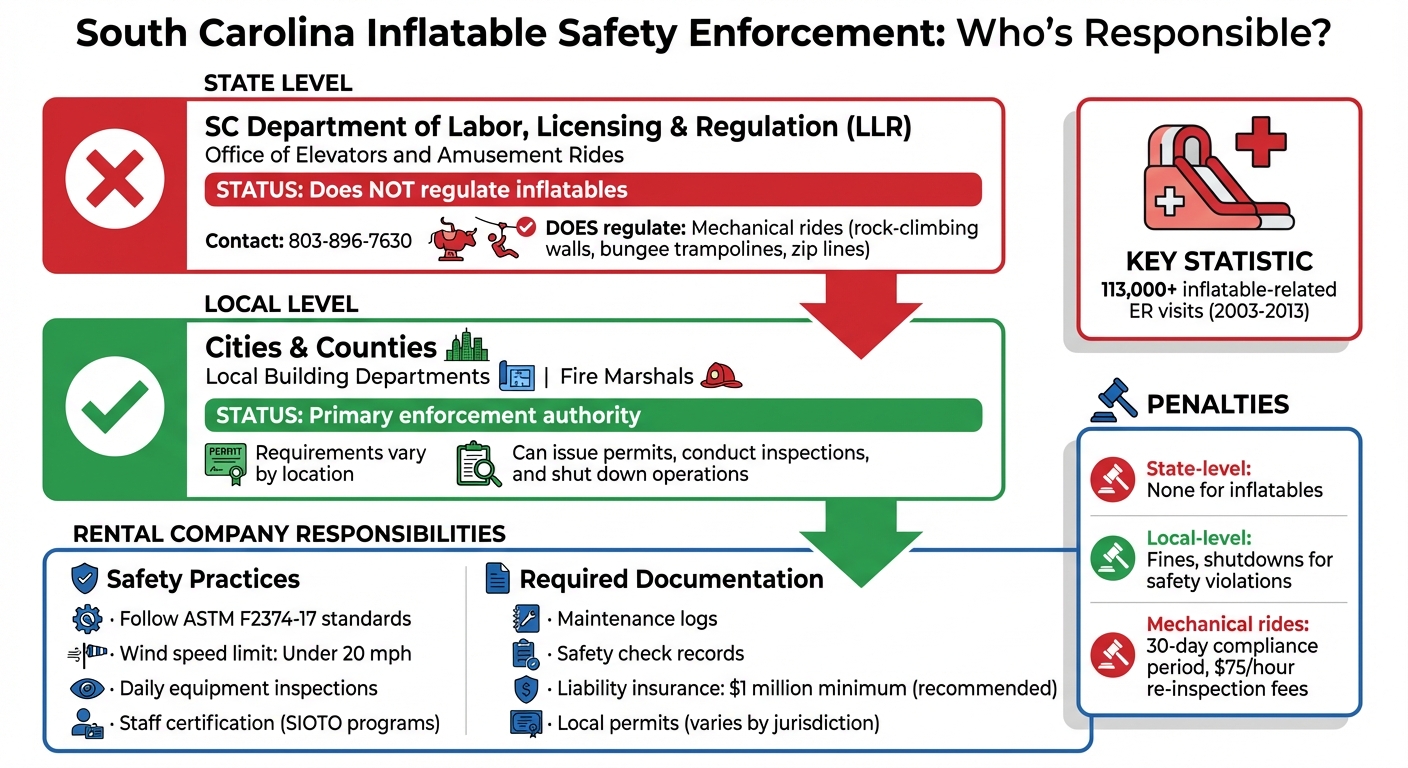
South Carolina Inflatable Safety Enforcement Structure and Requirements
Agencies Responsible for Enforcement
South Carolina Department of Labor, Licensing, and Regulation
The South Carolina Department of Labor, Licensing and Regulation (LLR) is home to the Office of Elevators and Amusement Rides, which oversees the safety of mechanical amusement devices throughout the state. However, inflatable devices like bounce houses are not included in its jurisdiction. According to Section 41-18-40 of the South Carolina Amusement Rides Safety Code, these inflatables don’t meet the legal definition of an "amusement device". Instead, the LLR focuses on mechanical attractions like rock-climbing walls, bungee trampolines, and zip lines, all of which must undergo annual inspections and obtain permits. For rental companies unsure about whether their equipment falls under these regulations, the SC LLR can be reached at 803-896-7630. This separation of responsibilities highlights the LLR’s limited role in inflatable safety, leaving much of the oversight to local authorities.
How Local Governments Support Enforcement
Since state oversight is confined to mechanical rides, local governments have stepped in to address the regulation of inflatables. Cities and counties create their own ordinances to govern the operation of these devices. Local building departments often assign inspectors or work with third-party agencies to ensure compliance. Without state-mandated inspections, local authorities and operators are left to manage critical safety aspects, such as monitoring wind speeds and ensuring proper anchoring. This includes establishing a safety perimeter to prevent accidents. This decentralized approach leads to varying safety standards across different counties.
Inspection and Compliance Requirements
Annual Inspection Process
According to Section 41-18-30(C) of the South Carolina Code, air-supported structures are not subject to annual inspections, a policy confirmed by the Office of Elevators and Amusement Rides, which does not oversee these devices. However, mechanical rides that fall under regulation must undergo annual inspections and obtain permits. This means the duty of ensuring safe operation for air-supported structures largely rests with rental companies. In some areas, local authorities may step in, requiring permits before operations can begin. This regulatory gap highlights the importance of maintaining thorough internal safety records.
Required Documentation and Insurance
Since state inspections are not mandated, local permit and documentation requirements can differ significantly. In certain municipalities, operators may need to secure permits from local fire marshals or building departments before setting up. These local officials often conduct inspections to ensure basic safety standards are met.
For rental companies operating in South Carolina, it’s wise to maintain detailed records of equipment maintenance, safety checks, and liability insurance – even though state law doesn’t explicitly demand it. Event organizers and venues frequently request proof of proper maintenance and liability coverage. Keeping maintenance logs and insurance certificates organized and accessible not only demonstrates a commitment to safety but can also help avoid delays during local inspections or permit reviews.
Penalties for Non-Compliance
Fines and Operational Shutdowns
While air-supported structures like bounce houses aren’t subject to state-level fines or shutdowns, local authorities – such as fire marshals and municipal building departments – step in to enforce general safety regulations. They have the power to penalize operators if hazardous conditions are found. On the other hand, state-regulated attractions, like mechanical rides, face a much stricter enforcement system.
For these regulated attractions, operators are given 30 days to address safety violations. If they fail to comply, they can face administrative citations, monetary fines, license suspensions, and re-inspection fees, which are charged at $75 per hour.
Real Examples of Enforcement Actions
Because bounce houses and inflatable slides are exempt from state oversight, there are no documented state-level enforcement actions against their operators. Instead, local officials handle enforcement. If a situation presents an immediate safety risk, they have the authority to shut down operations.
This highlights the importance of rental companies maintaining strong internal safety protocols to ensure compliance and avoid potential shutdowns.
How Rental Companies Can Stay Compliant
Keeping Equipment and Staff Up to Standards
Even without mandatory state inspections, rental companies should perform daily checks before every setup. Proper equipment maintenance requires more than just a quick glance. Following ASTM F2374-17 – the national standard for inflatable amusement devices – is crucial for ensuring safety and functionality. This includes inspecting for tears, worn anchor points, blower efficiency, and correct inflation levels. Certification programs like those offered by SIOTO help train staff in essential safety practices.
Weather monitoring is another critical aspect. Jason Olier, owner of Jason’s Jump Castles, highlights its importance:
"If the wind is over 20 miles an hour we don’t put them up. If it’s too windy for an umbrella it’s too windy for a jump castle".
Adhering to this 20-mph wind limit should be a firm rule for all operators. By prioritizing these maintenance and training measures, companies can ensure that both their equipment and their teams are prepared to uphold safety standards.
Teaching Customers About Safety
Clear communication with customers is key. Provide detailed instructions on weight limits, age restrictions, the need for supervision, and when weather conditions require shutting down operations. Keeping thorough injury records also helps maintain accountability and improve safety practices.
Insurance coverage is another important piece of the puzzle. While South Carolina doesn’t mandate insurance for bounce house rentals, regulated amusement devices must carry at least $500,000 per occurrence. Companies like Bouncy Rentals USA go the extra mile by maintaining full insurance coverage, offering both financial protection and peace of mind to customers. This commitment to safety not only protects the business but also fosters trust and responsibility among users. Between 2003 and 2013, over 113,000 inflatable-related injuries led to emergency room visits, emphasizing the need for robust insurance policies to safeguard everyone involved.
Conclusion
South Carolina’s approach to inflatable safety enforcement is a collaborative effort between the South Carolina Department of Labor, Licensing, and Regulation (LLR) and the Office of State Fire Marshal (OSFM). Together, they ensure that safety laws and fire prevention standards are upheld at events across the state. As the LLR explains:
"The mission of the Department of Labor, Licensing and Regulation (LLR) is to promote the health, safety and economic well-being of the public through regulation, licensing, enforcement, training and education."
Rental companies are a critical part of this safety ecosystem. These businesses are required to maintain thorough documentation and carry at least $1 million in public liability insurance. Failing to meet these requirements can result in hefty penalties and operational disruptions – costs that no company wants to face.
When safety protocols are ignored, the consequences can be severe. On the other hand, companies that prioritize safety not only protect their customers but also thrive in the industry. For example, one South Carolina rental provider successfully handled over 6,500 events in a decade, demonstrating that a strong commitment to safety can also lead to business growth.
FAQs
Why doesn’t South Carolina regulate inflatable devices like bounce houses?
In South Carolina, inflatable devices like bounce houses fall outside the scope of regulation by the state’s Office of Elevators and Amusement Rides. This is because air-supported structures are specifically excluded from their inspection and permitting duties. Furthermore, there are no separate state laws mandating regulation, inspections, or insurance for operators of these inflatables.
As a result, it’s crucial for event organizers to choose rental companies that prioritize safety. For instance, companies such as Bouncy Rentals USA take extra precautions by ensuring their equipment is fully insured, thoroughly sanitized, and delivered by trained professionals to create a safe and enjoyable experience for everyone.
What safety rules do inflatable rental companies need to follow in South Carolina?
Inflatable rental businesses in South Carolina are held to rigorous safety standards to protect the public. Each inflatable must undergo an annual state inspection and display a valid permit, which remains effective through December 31 of that year. Additionally, operators are required to perform daily pre-use inspections to identify issues like tears, punctures, improper anchoring, or setup errors. Trained operators, fluent in English, must supervise the equipment at all times to ensure safe usage.
Federal guidelines further emphasize safety by recommending secure anchoring of inflatables, constant supervision by a qualified adult, and avoiding operation during windy or wet weather. Companies are also advised to adhere closely to manufacturer rules regarding age, weight, and capacity limits. Regular sanitization of equipment between uses and maintaining a written safety plan are also crucial practices. By following these precautions, businesses such as Bouncy Rentals USA provide a safe and enjoyable experience for all users.
How are inflatable safety laws enforced in South Carolina?
Inflatable safety laws in South Carolina are upheld through a combination of state licensing, inspections, and strict compliance measures. All inflatables, which fall under the category of amusement devices, must undergo an annual inspection conducted by the Office of Elevators and Amusement Rides. These inspections are crucial, as they ensure the equipment meets safety standards. Once approved, inflatables receive a valid operating permit, which must be renewed annually as it expires on December 31. Additionally, owners are responsible for performing daily safety checks before allowing any use.
The State Fire Marshal’s office also plays a critical role in maintaining safety. They conduct fire and safety inspections at public venues, often working alongside local fire departments. These inspections verify that inflatables are securely anchored, comply with electrical safety standards, and follow proper crowd-control protocols. Failing to meet these requirements can lead to fines, permit revocation, or even the removal of the equipment.
Businesses like Bouncy Rentals USA take these regulations seriously, adhering to all inspection and permitting requirements. By doing so, they ensure a safe and enjoyable environment for events, whether small gatherings or large-scale celebrations.