Inflatable obstacle courses are fun but can pose risks if safety measures aren’t followed. Injuries, like fractures (25.8%) and muscle strains (25.7%), are common, with most incidents (96%) occurring at home due to poor supervision or mixing age groups. Here’s what you need to know:
- Toddlers (2-4 years): Use toddler-specific inflatables, limit play to 3-4 kids, and supervise closely. Avoid mixing with older children. Watch for overheating surfaces and wind over 15 mph.
- Young Children (5-8 years): Choose medium-sized inflatables designed for their age. Limit groups to 5-8 kids and separate by size to prevent collisions.
- Preteens (9-12 years): Avoid overcrowding and enforce "no roughhousing" rules. Use durable inflatables with higher walls to manage their energy and weight.
- Teens & Adults (13+): Use commercial-grade inflatables with proper anchoring. Prohibit flips, head-first dives, and ensure weight limits are respected.
Universal tips: Always supervise, secure inflatables properly, and stop use in high winds or bad weather. Companies like Bouncy Rentals USA ensure equipment meets safety standards, but supervision is key to avoiding injuries. For more preparation, check out these tips for renting inflatable obstacle courses.
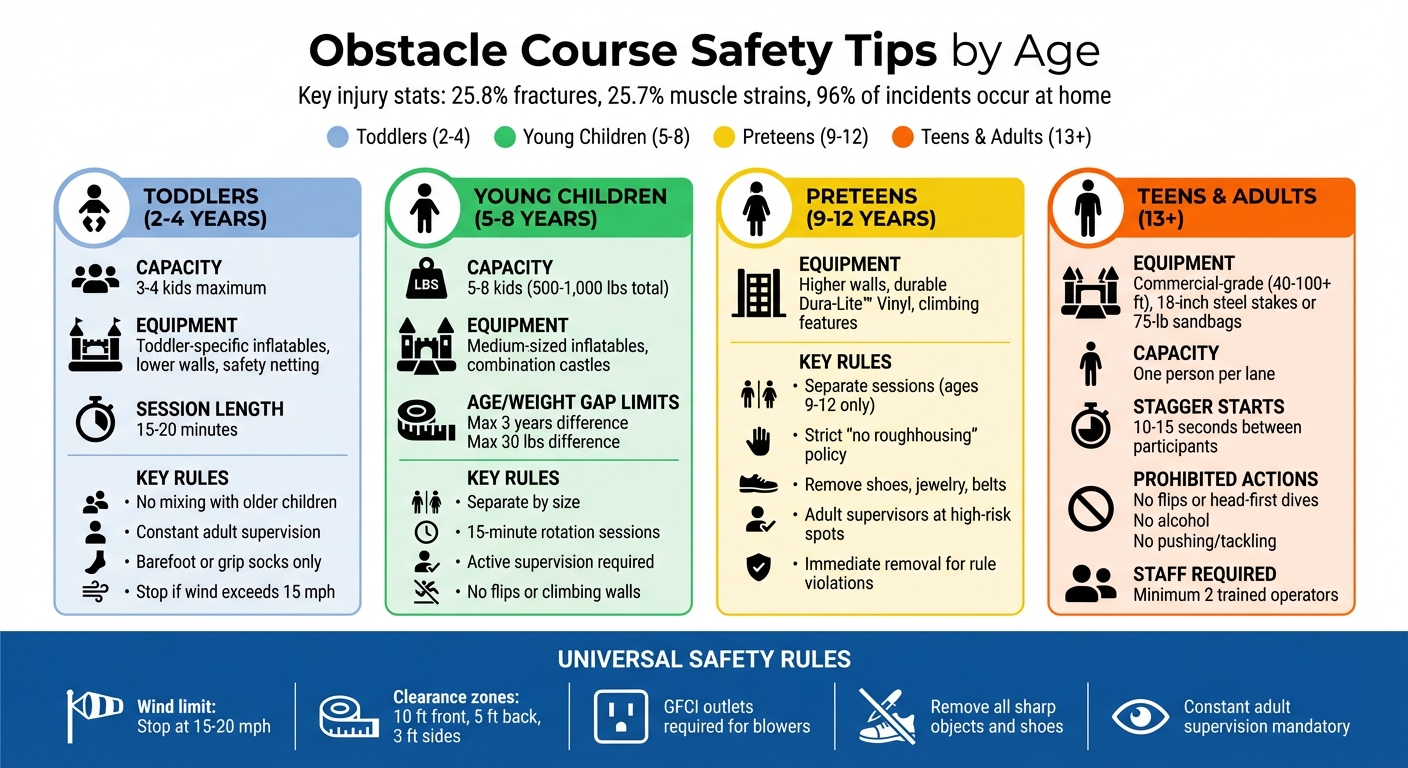
Inflatable Obstacle Course Safety Guidelines by Age Group
Safety Tips for Toddlers (Ages 2-4)
Main Risks for Toddlers
Toddlers face unique challenges on inflatable obstacle courses because their motor skills are still developing. Their limited balance and coordination make them more prone to falls on bouncy, unstable surfaces. On top of that, their smaller size makes collisions with older, larger children a real concern, often leading to injuries.
"Mixing toddlers with older kids greatly increases risk." – Hero Kiddo Inflatables
Environmental risks add to the danger. Inflatable surfaces can heat up significantly in extreme weather, potentially causing burns to sensitive skin. Wind is another factor – gusts over 15 mph can shift or destabilize the structure, even if it’s anchored properly. Most manufacturers also recommend inflatables only for children aged 3 and older, as younger kids may not yet have the physical readiness required.
These risks highlight the importance of safety measures tailored specifically to toddlers.
How to Keep Toddlers Safe
To reduce these risks, it’s essential to follow specific safety practices. Start by selecting inflatables designed for younger children, ideally those made for ages 2–5. These models often include features like lower walls for easier access, softer surfaces, and safety netting around openings. They’re also designed to handle fewer children at a time – typically no more than 3–4 – to avoid overcrowding.
Supervision is non-negotiable. Assign a responsible adult to keep a close eye on the inflatable at all times, watching for falls or rough play. To avoid accidents, keep toddlers and older kids separated – use different time slots or designated zones for play.
Keep play sessions short, around 15–20 minutes, to prevent exhaustion. Ensure toddlers are barefoot or wearing grip socks, and remove any shoes, jewelry, or clothing with hard elements before they enter. Place the inflatable on flat, soft ground, such as grass, and confirm it’s securely staked and anchored. Stay alert to weather conditions – stop play immediately if winds exceed 15 mph, surfaces become too hot, or rain begins, as wet surfaces are extremely slippery.
Safety Tips for Young Children (Ages 5-8)
Common Risks for Young Children
Kids aged 5 to 8 bring boundless energy to inflatable obstacle courses, but their developing coordination can make them more prone to accidents. Collisions often happen when children bounce at different speeds or directions, and falls are common as they navigate obstacles that may challenge their current abilities. In fact, inflatable-related injuries have seen a sharp increase, with fractures accounting for 25.8% and muscle strains at 25.7% of cases.
Another major factor is exceeding the inflatable’s recommended age, height, or weight limits, which greatly raises the risk of injuries. For example, a weight difference of more than 30 pounds among participants significantly increases collision risks.
Recognizing these challenges is key to tailoring safety measures for this age group.
Safety Practices for Young Children
To reduce risks for kids aged 5 to 8, it’s important to adopt specific safety practices. While toddlers benefit from simple, low-capacity inflatables, children in this age group need equipment that offers just the right level of challenge for their developing skills.
Choose medium-sized or combination castles with slides designed specifically for 5–8-year-olds. These structures strike a balance by being engaging without overwhelming children. Avoid mini-inflatables meant for toddlers or oversized ones designed for teens and adults.
Capacity matters. For kids aged 5 to 7, limit the group to 5–6 children at a time, with a total weight cap of 500–800 pounds. For 8-year-olds, allow 6–8 children, with a weight limit of 800–1,000 pounds.
To prevent injuries, separate children by age and size. Avoid mixing participants with an age gap of more than three years or a weight difference over 30 pounds. Use time-blocked rotation schedules, such as 15-minute sessions dedicated to specific age groups, with 5-minute breaks in between. Color-coded wristbands can make it easier for staff to identify which children belong in each session.
Active supervision is non-negotiable. Supervisors should do more than just watch – they need to enforce rules like no flips, tackling, or climbing on walls. Any violations should result in immediate removal from play. Before kids enter, check that the inflatable complies with BS EN 14960 safety standards, is securely anchored, and has a clean surface.
Safety Tips for Preteens (Ages 9-12)
Safety Challenges for Preteens
Preteens are full of energy and often push their physical limits, especially on obstacle courses. While they may have the strength and stamina to tackle challenging activities, they sometimes overestimate their abilities, leading to unique safety concerns.
One major issue is roughhousing. Unlike younger kids who might accidentally bump into each other, preteens often engage in more competitive and aggressive play. This can quickly escalate into wrestling or tackling, increasing the chance of injuries for everyone involved.
Another challenge is overcrowding. When too many energetic preteens are packed into the same area, the risk of collisions skyrockets. This becomes even more dangerous when preteens share the space with much smaller children. A fast-moving 12-year-old, for example, could easily knock over a younger, smaller child without meaning to.
Additionally, preteens’ greater weight and force can strain standard inflatables. If capacity limits are exceeded, the structural integrity of the equipment may be compromised, creating a potential hazard.
To keep preteens safe, it’s crucial to address these challenges with specific precautions.
How to Protect Preteens
The right equipment makes all the difference. Look for obstacle courses designed with higher walls to contain more vigorous movements and constructed with durable materials like Dura-Lite™ Vinyl, which can handle the increased weight and force preteens bring. Features such as climbing walls or basketball hoops can keep them engaged, but these should always include proper safety netting to prevent falls.
To minimize risks, schedule separate play sessions exclusively for ages 9–12. This prevents size and age mismatches, reducing the likelihood of injuries caused by larger preteens colliding with smaller children.
Establish and enforce a strict "no roughhousing" rule before play begins. Make it clear that breaking this rule will result in immediate removal from the activity. Place adult supervisors in key areas, especially near high-risk spots like climbing walls or slides, to step in quickly if play gets too intense.
Stick to capacity limits to avoid overloading the equipment. Ensure all participants remove shoes, jewelry, belts, and any sharp objects before entering the obstacle course. Finally, keep an eye on the weather – if high winds or storms are approaching, deflate the equipment immediately to prevent accidents.
Safety Tips for Teens and Adults (Ages 13+)
Main Hazards for Teens and Adults
Teens and adults face unique risks when using inflatables due to their greater weight, speed, and tendency for competitive behavior. These factors can lead to high-impact collisions, structural instability, and bottoming out, especially during races where lane boundaries are often ignored.
- Structural instability: The momentum and lateral forces generated by heavier participants can cause inflatables to shift or tip over if they’re not properly secured. This risk increases with sudden changes in direction.
- Bottoming out: When heavier users compress the inflatable surface too much, they may hit the hard ground underneath. This can result in bruises or sprains, especially with residential-grade inflatables that often have weight limits of just 100–150 lbs – making them unsuitable for most adults.
- Unsafe competitive behavior: Racing often leads to risky actions like flips, head-first dives, and roughhousing. These behaviors can cause severe injuries, such as neck or spinal damage. The drive to win can cloud judgment, making supervision critical.
Safety Guidelines for Teens and Adults
To reduce these risks, follow these essential safety practices:
- Choose the right equipment: Ensure the inflatable course is commercial-grade and designed for adult use. These courses are typically 40–100+ feet long and require stronger anchoring systems, such as 18-inch steel stakes or 75-lb sandbags at each anchor point, to handle the increased force.
- Control participant flow: Allow one person per lane at a time. The next person should only begin once the previous participant has cleared the first major obstacle or reached the slide. For races, stagger starts by 10–15 seconds to avoid collisions at bottlenecks or slide landings.
- Enforce proper attire: All sharp or potentially damaging items must be removed before entry. Shoes should come off to protect the inflatable material, but socks are recommended to prevent friction burns on slides.
- Ban dangerous behaviors: Prohibit flips, head-first dives, and rough play. Activities like pushing, tackling, or climbing on exterior walls should result in immediate removal. Adult courses should have at least two trained operators – one managing the entrance and another monitoring the slide landing area.
- Monitor weather and conditions: Stop use if winds reach 15–20 mph, as larger inflatables are more prone to lifting. Additionally, ban anyone under the influence of alcohol from participating, as impaired judgment significantly increases the risk of injury.
Safety Rules That Apply to All Ages
Basic Safety Rules for Everyone
Certain safety precautions apply universally, no matter the age group. First and foremost, secure each inflatable unit properly using stakes or heavy sandbags to prevent it from shifting or tipping during use. It’s also crucial to maintain a clearance zone: at least 10 feet in front, 5 feet behind, and 3 feet on each side of the unit.
Before entering, remove personal items like shoes, eyeglasses, jewelry, or anything sharp to avoid injuries or damage to the equipment. Additionally, clear the surrounding area of debris, such as sticks or rocks, to create a safe play environment.
Adult supervision is non-negotiable. A responsible adult must constantly monitor activity to enforce capacity limits and prevent risky behavior. Activities like flips, somersaults, wrestling, or climbing on outer walls and safety mesh are strictly prohibited, as they can result in serious injuries, particularly to the neck or back. Keep entry and exit points unobstructed for safe movement in and out of the inflatable.
Weather conditions also play a significant role in safety. If winds exceed 15–20 mph or severe weather is imminent, stop all activity immediately and deflate the unit. Blowers should always be plugged into dedicated Ground Fault Circuit Interrupter (GFCI) outlets, with cords secured to prevent tripping hazards. Inspect the inflatable before use to ensure there are no visible tears, loose anchors, or signs of low air pressure.
These safety measures align with the high standards set by Bouncy Rentals USA.
How Bouncy Rentals USA Ensures Safety
Bouncy Rentals USA takes safety seriously by providing equipment that is sanitized, insured, and inspected regularly to ensure structural soundness. All inflatables meet current safety standards and undergo professional maintenance to guarantee they’re event-ready.
The company’s trained staff handles every installation with precision, following manufacturer guidelines to ensure proper anchoring and positioning, reducing the risk of accidents. During setup, the team ensures that blowers are securely connected, safety zones are established, and all equipment is thoroughly tested before guests use it.
This meticulous approach allows parents and event organizers to relax, knowing that every detail has been addressed to create a safe and enjoyable experience for everyone. From start to finish, Bouncy Rentals USA prioritizes safety at every step.
Conclusion
Keeping inflatable obstacle courses safe requires tailoring activities to the participants’ ages. For toddlers, this means low obstacles and constant supervision. Young children and preteens benefit from structured sessions and clear turn-taking rules to avoid unnecessary collisions. Teens and adults, on the other hand, should follow equipment guidelines carefully, including respecting weight limits, to ensure safe use. Adjusting the challenge to match developmental levels – like offering 10–20 minute sessions for younger kids or timed rotations for older participants – helps maintain a fun and injury-free environment.
Most accidents on inflatables occur when kids of very different sizes and abilities share the same space. To minimize falls and collisions, short, age-specific sessions paired with strict access rules are key.
These strategies not only enhance safety but also make event management smoother. Companies like Bouncy Rentals USA simplify this process by providing durable, commercial-grade equipment, ensuring proper setup and anchoring, and supplying safety documentation for your peace of mind. Their trained staff inspects each inflatable to meet current safety standards before your event begins.
"Technique first, speed second, especially above the ground." – Heloa
FAQs
How do I pick the right obstacle course for my child’s age?
When picking an obstacle course for your child, think about their current developmental stage. Pay attention to their motor skills, level of confidence, and overall safety. Choose activities that align with their age and abilities, striking a balance between fun challenges and a sense of security. Adjust the difficulty as needed to keep them engaged without overwhelming them.
How can I safely rotate different age groups on one inflatable?
To ensure safe rotation among age groups, set up separate zones for each group and schedule rotations every 10–15 minutes. Incorporate games that suit each age group and assign supervisors to oversee each zone, helping to avoid overcrowding. Additionally, enforce weight and height limits and cap the number of participants per group to minimize the risk of injuries.
What should I do if wind picks up during the party?
If the wind starts to pick up during your party, it’s crucial to act quickly. Deflate the inflatable right away and move it to a secure spot. Winds exceeding 20-25 mph can pose serious safety hazards. Packing up the inflatable in such conditions is the safest choice to avoid accidents and keep everyone protected.