When setting up a bounce house, the surface you choose directly impacts safety, stability, and durability. Establishing a proper safety perimeter is also essential for a secure setup. Here’s a quick breakdown of the five most common surfaces and their pros and cons:
- Grass: Safest option with excellent cushioning and easy anchoring using steel stakes. Requires minimal prep but needs a tarp to protect the inflatable and grass.
- Concrete: Hard surface with no shock absorption. Needs heavy ballast (360–500 lbs per anchor) and safety mats to reduce injury risks.
- Asphalt: Similar to concrete but heats up faster, which can damage the inflatable. Requires the same ballast and protective measures.
- Artificial Turf: Provides consistent cushioning but doesn’t allow stakes. Ballast-only anchoring is required, and care must be taken to avoid damaging the turf.
- Sand: Offers natural cushioning but demands specialized screw-in anchors and additional sandbags for stability. Setup can be challenging.
Key Tips:
- Always use a heavy-duty tarp (10–12 mil thick) under the bounce house.
- Avoid slopes steeper than 5% (3 degrees).
- Stop operation if wind speeds exceed 20–25 mph.
Choosing the right surface ensures safety for participants and protects your equipment from damage.
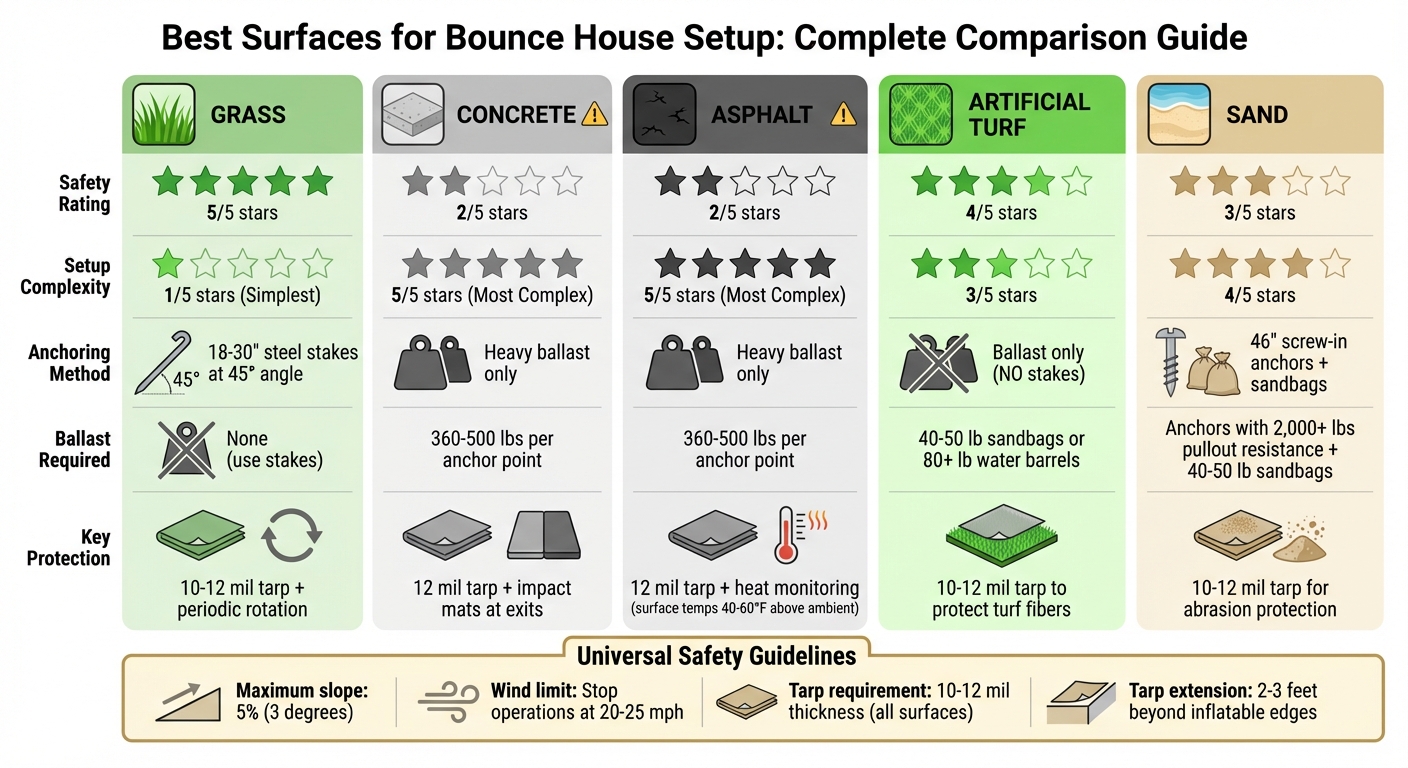
Bounce House Surface Comparison: Safety Ratings and Setup Requirements
1. Grass
Cushioning and Safety
When it comes to bounce house setups, natural grass is a top choice for safety. Its natural ability to absorb impact significantly reduces the risk of injuries from falls, earning it a 5-star safety rating for commercial inflatable installations. This is a stark contrast to harder surfaces like concrete or asphalt, which only achieve a 2-star safety rating due to their lack of cushioning.
"Grass represents the gold standard for inflatable installations across all metrics except availability." – Hero Kiddo Inflatables
This soft, forgiving surface not only enhances safety but also provides peace of mind for parents and event organizers during active play sessions.
Ease of Anchoring
Grass also makes anchoring inflatables easier and more secure. Heavy-duty steel stakes – at least 1 inch in diameter and 18 inches in length – can be driven directly into the soil to create a stable foundation. Compared to setups on concrete or asphalt, which require 360 to 500 pounds of ballast per anchor point, grass provides a much more reliable anchoring method, reflected in its 5-star rating for stability. However, it’s important to check the ground conditions; wet or muddy grass can weaken the stakes’ hold. Ensuring firm soil before installation is key to keeping the inflatable securely in place.
Surface Maintenance
To keep grass in good shape during and after an event, a little care goes a long way. For multi-day setups, rotating the bounce house every 24 to 48 hours helps the grass recover and prevents long-term damage. Once the inflatable is removed, raking the flattened areas and giving them a thorough watering can speed up regrowth. In one instance from March 2026, a lawn flattened during a 3-day event fully recovered within a week using this simple maintenance routine.
Protective Measures
To ensure both the grass and the inflatable remain in excellent condition, protective measures are essential. A heavy-duty tarp, 10–12 mil thick, should be placed under the bounce house. This not only shields the vinyl from moisture and wear but also extends the inflatable’s lifespan. The tarp should extend 2 to 3 feet beyond the edges of the bounce house for added protection. Before setting up, clear the area of sharp objects, rocks, or debris to prevent punctures or damage to the inflatable.
2. Concrete
Cushioning and Safety
Concrete is a tough, unforgiving surface that offers no shock absorption. This lack of cushioning increases the risk of injuries during falls or missteps. Unlike grass, which naturally absorbs impact, concrete provides no such benefit, making safety precautions a must. For this reason, concrete earns a 2-star safety rating, while grass scores a full 5 stars.
"Concrete is a stable surface… but it is a hard, unforgiving surface, so without proper measures, it can increase the risk of injury." – Hero Kiddo
To minimize the risk, consider adding safety mats or foam padding at key areas like entry and exit points. These measures can help soften the impact when kids jump in or out of the bounce house.
Ease of Anchoring
Anchoring a bounce house on concrete is much more challenging than on grass, earning a 5-star setup complexity rating. Since stakes can’t be used, heavy ballast systems are required for securing the inflatable. Each anchor point demands 360 to 500 pounds of weight.
Common options for ballast include heavy-duty sandbags (at least 40 pounds each), 55-gallon water barrels, or concrete blocks. To secure these weights, use ratchet straps instead of ropes or bungee cords, which are less reliable. Be prepared for a longer setup time – over 2 hours on concrete compared to about 30 minutes on grass.
Surface Maintenance
Before setting up on concrete, sweep the area thoroughly to remove sharp debris that could puncture the inflatable’s vinyl surface. Check for cracks, potholes, or uneven slopes, ensuring the incline doesn’t exceed 5% (approximately 3°). Additionally, on hot days, monitor the surface temperature closely. Dark concrete can heat up to 40 to 60°F above the surrounding air temperature, which can increase internal air pressure and strain the bounce house seams.
Protective Measures Needed
To protect the bounce house from damage, use a 10–12 mil heavy-duty tarp as a barrier between the inflatable and the concrete. The tarp should extend 2 to 3 feet beyond the edges of the bounce house to ensure full protection. This extra layer prevents the hard surface from wearing down the vinyl bottom. Next, we’ll explore how asphalt presents a similar but slightly different set of challenges for bounce house setups.
3. Asphalt
Cushioning and Safety
Asphalt, much like concrete, provides no shock absorption, which increases the risk of injuries from falls. Because of this, asphalt installations are considered high-risk and have been given a 2-star safety rating. To mitigate these risks, impact-attenuating mats that comply with ASTM F355 standards are required at all entrances and exits. These mats should extend 4 to 6 feet from access points and must be rated for a critical fall height of at least 30 inches.
"The industry classifies concrete [and hard surface] installations as high-risk activities requiring strict adherence to safety protocols." – Hero Kiddo Inflatables
Ease of Anchoring
Anchoring on asphalt is a demanding process that requires the use of heavy ballast at every anchor point. This surface is rated with a 5-star complexity for setup. Common ballast options include 40-pound sandbags, 55-gallon water barrels, or rubber-coated concrete blocks. To ensure reliable tension during dynamic loads, use ratchet straps instead of ropes or bungee cords.
Surface Maintenance
Before setting up on asphalt, carefully inspect the surface for any cracks, potholes, or slopes exceeding 5% (roughly 3°). On particularly hot days, black asphalt can reach temperatures 40–60°F higher than the surrounding air. This heat places stress on the vinyl material and can increase internal air pressure, which may lead to over-inflation. Regularly monitor the internal air pressure and adjust the blower output as needed to avoid damage.
Protective Measures
Asphalt’s abrasive nature gives it a 1-star durability rating. To protect the inflatable from friction damage, use a 10- to 12-mil heavy-duty tarp that extends 2–3 feet beyond the inflatable’s footprint. Additionally, wind conditions must be closely monitored. If wind speeds exceed 15 to 20 mph, deflate the unit immediately, as asphalt does not allow for the added stability provided by ground stakes.
Next, we’ll explore how artificial turf can provide a better alternative for bounce house setups.
4. Artificial Turf
Artificial turf strikes a balance between the natural cushioning of grass and the straightforward setup of harder surfaces. It provides consistent impact absorption and predictable friction, earning a 4-star safety rating. While this is better than concrete and asphalt (both rated 2 stars), it falls slightly short of natural grass, which scores 5 stars. The turf is constructed with synthetic fibers laid over a compacted aggregate base, ensuring dependable performance throughout the year.
Ease of Anchoring
When anchoring on artificial turf, avoid using stakes, as they can damage both the synthetic fibers and the base layer. Instead, rely on ballast options like commercial-grade sandbags (40–50 lbs) or water barrels (80+ lbs) to secure anchor points. This method gives artificial turf a setup complexity rating of 3 stars – more involved than natural grass (1 star) but less complicated than concrete (5 stars). For larger inflatables, such as obstacle courses, make sure to secure ballast at every anchor point for stability. After anchoring, inspect the turf to confirm it meets safety and stability standards.
Surface Maintenance
Before setting up, check the turf for slopes greater than 5% (around 3 degrees) to ensure the compacted base is stable and free of any dips or uneven areas. Clear the surface of sharp objects, rocks, or debris to protect both the turf and any protective tarp you might use. One advantage of artificial turf is its consistent year-round condition, which eliminates the moisture-related issues often encountered with natural grass.
Protective Measures
To extend the life of artificial turf during events, follow these precautions. Always place a heavy-duty tarp (10- to 12-mil thickness) under the inflatable to protect the turf from friction and heavy equipment. The tarp should extend 2–3 feet beyond the inflatable’s perimeter on all sides, creating a buffer zone that prevents wear caused by contact between the vinyl and the synthetic fibers. By taking these steps, artificial turf earns a 4-star durability rating, making it a dependable option for high-traffic events and prolonged use.
5. Sand
Sand provides natural cushioning, which helps absorb the impact from jumps and falls, making it a suitable choice for beach venues or sand courts. However, setting up on sand comes with its own challenges, often requiring specialized equipment. This surface earns a 3-star rating for both safety and durability.
Ease of Anchoring
Anchoring on sand can be tricky, earning it a 4-star rating for setup difficulty. Specialized screw-in anchors, such as penetrator or arrowhead models, are essential. These anchors need to penetrate about 46 inches deep and can deliver over 2,000 lbs of pullout resistance – arrowhead models can even reach up to 2,400 lbs. To enhance stability, supplement the anchors with 40–50 lb sandbags. Always test the anchor’s stability on-site and keep an eye on weather risks like high wind speeds. If gusts exceed 20–25 mph, deflate the inflatable immediately for safety. Once the anchors are secured, smooth and prepare the sand surface for a proper setup.
Surface Maintenance
Preparing the sand site is just as important as with other surfaces. Make sure the sand slope is no more than 5% (about 3°) and clear away any sharp objects, rocks, or debris. Additionally, ensure the sand is compact enough to support the anchoring system properly.
Protective Measures
To protect the inflatable from sand abrasion and moisture, lay a 10–12 mil commercial-grade tarp underneath it. Extend the tarp 2–3 feet beyond the edges of the inflatable for added protection.
Surface Comparison Table
The table below provides a clear overview of how different surfaces perform in terms of safety, anchoring, setup complexity, and protective measures.
| Surface Type | Safety Rating | Anchoring | Setup Complexity | Key Protective Measure |
|---|---|---|---|---|
| Grass | 5/5 Stars | 18–30" steel stakes at a 45° angle | 1/5 Stars (Simplest) | 10–12 mil tarp; periodic turf rotation |
| Concrete | 2/5 Stars | 360–500 lbs ballast per anchor point | 5/5 Stars (Most Complex) | 12 mil tarp; impact mats at exits; non-slip mats |
| Asphalt | 2/5 Stars | 360–500 lbs ballast per anchor point | 5/5 Stars (Most Complex) | 12 mil tarp; monitor surface heat (40–60°F above ambient) |
| Artificial Turf | 4/5 Stars | Ballast only (no stakes permitted) | 3/5 Stars | 10–12 mil tarp to protect turf fibers |
| Sand | 3/5 Stars | 46" screw-in anchors + 40–50 lb sandbags | 4/5 Stars | Deep penetration anchors exceed 2,000 lbs pullout resistance |
Grass stands out for its unmatched safety and straightforward setup, making it an ideal choice for most inflatable setups. Artificial turf also scores high on safety but requires careful handling to avoid damage to its synthetic fibers, as stakes are not allowed. Sand offers moderate cushioning but demands more advanced anchoring techniques to ensure stability.
Key Considerations:
- Avoid setting up on slopes steeper than 5% (around 3°).
- Watch wind speeds closely; operations should stop if gusts surpass 20–25 mph.
- Use a commercial-grade tarp (10–12 mil thickness) on all surfaces to protect your inflatable from wear and moisture.
This table serves as a practical guide to help you choose the best surface for safety and ease of setup. Use this information to refine your approach before proceeding to the final recommendations.
Conclusion
Selecting the right surface for your bounce house is all about ensuring safety, stability, and protecting your investment. Grass stands out as the top choice, offering natural cushioning, a 5-star safety rating, and easy anchoring with steel stakes. Hard surfaces like concrete and asphalt can work but require extra preparation – think 360–500 lbs of ballast per anchor point, heavy-duty 10–12 mil tarps, and close monitoring of heat and wind conditions. Artificial turf calls for a ballast-only anchoring system to avoid damage, while sand necessitates specialized 46-inch screw-in anchors for proper stability.
Each venue comes with its own set of challenges. For example, a backyard birthday party on level grass might involve minimal effort, but setting up on asphalt demands careful coordination, including managing ballast and watching for surface temperatures that can rise 40–60°F above the air temperature. Keep in mind that your setup should be on a slope of less than 5%, and always pause operations if wind gusts exceed 25 mph.
By understanding the unique characteristics of each surface, you can choose the best option for your event. When planning, Bouncy Rentals USA can help you navigate these specific requirements. Our team provides fully insured, sanitized equipment along with the right anchoring systems and protective materials to suit any surface – whether it’s grass, asphalt, or even sand.
For expert advice on surface preparation and equipment tailored to your event, visit Bouncy Rentals USA. Let us help you create a safe and unforgettable experience.
FAQs
Can I set up a bounce house on a driveway?
Yes, you can set up a bounce house on a driveway, provided the surface is concrete or asphalt. To keep it safe, make sure to use proper anchoring methods and place protective padding underneath to prevent slipping or damage. That said, grass is usually the better option since it provides more cushioning and stability for both the bounce house and those using it.
How do I anchor a bounce house without stakes?
To secure a bounce house without using stakes, you can rely on alternative methods such as ballast systems, weighted anchors, or equipment specifically designed for hard surfaces. For concrete, ensure that each anchor point is weighted adequately – typically between 360 and 500 pounds – to hold the bounce house firmly in place. Proper anchoring is crucial for safety, especially on surfaces like concrete or artificial turf where stakes aren’t an option.
What should I do if the wind picks up?
If the wind starts to pick up while the bounce house is in use, act quickly to ensure everyone’s safety. Begin by deflating it and securing it to prevent any accidents or injuries. Always make sure the bounce house is properly anchored, and keep a close eye on it during windy weather to keep everyone safe.