
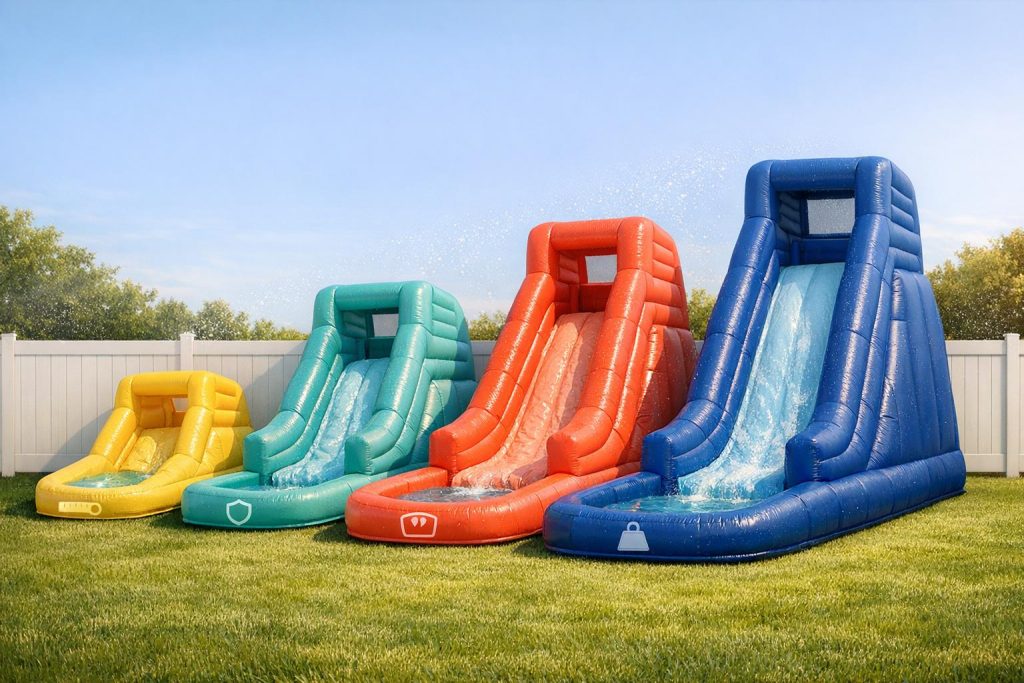
Inflatable water slides are not one-size-fits-all. Choosing the right slide depends on the age and abilities of your guests, ensuring safety and fun for everyone. Here’s a quick breakdown:
- Toddlers (Ages 2-4): Opt for slides under 10 feet tall with gentle slopes and shallow splash zones. Features like enclosed climbing areas and soft landings are ideal.
- Young Children (Ages 5-8): Mid-sized slides (13-18 feet) with moderate slopes are perfect. Look for dual lanes and combo units with added activities like water cannons or bounce areas.
- School-Aged Kids (Ages 9-12): Bigger slides (13-16 feet or taller) with steeper drops and racing lanes offer excitement. Ensure splash zones are shallow (4 inches max) and weight limits are adhered to.
- Teenagers (Ages 13-17): Thrill-seekers need slides 16-27 feet tall with steep drops and durable materials. Dual or triple lanes work well for group events.
- Adults (18+): Commercial-grade slides (22-30 feet tall) with high weight capacities are essential. Features like long slip-and-slide sections and deep splash pools enhance the experience.
Safety Tips for All Ages:
- Always supervise closely.
- Separate age groups to avoid collisions.
- Use slides on flat, debris-free surfaces with proper anchoring.
- Follow manufacturer weight limits and usage guidelines.
Pro Tip: For mixed-age events, consider separate slides or designated time slots to ensure everyone enjoys safely.
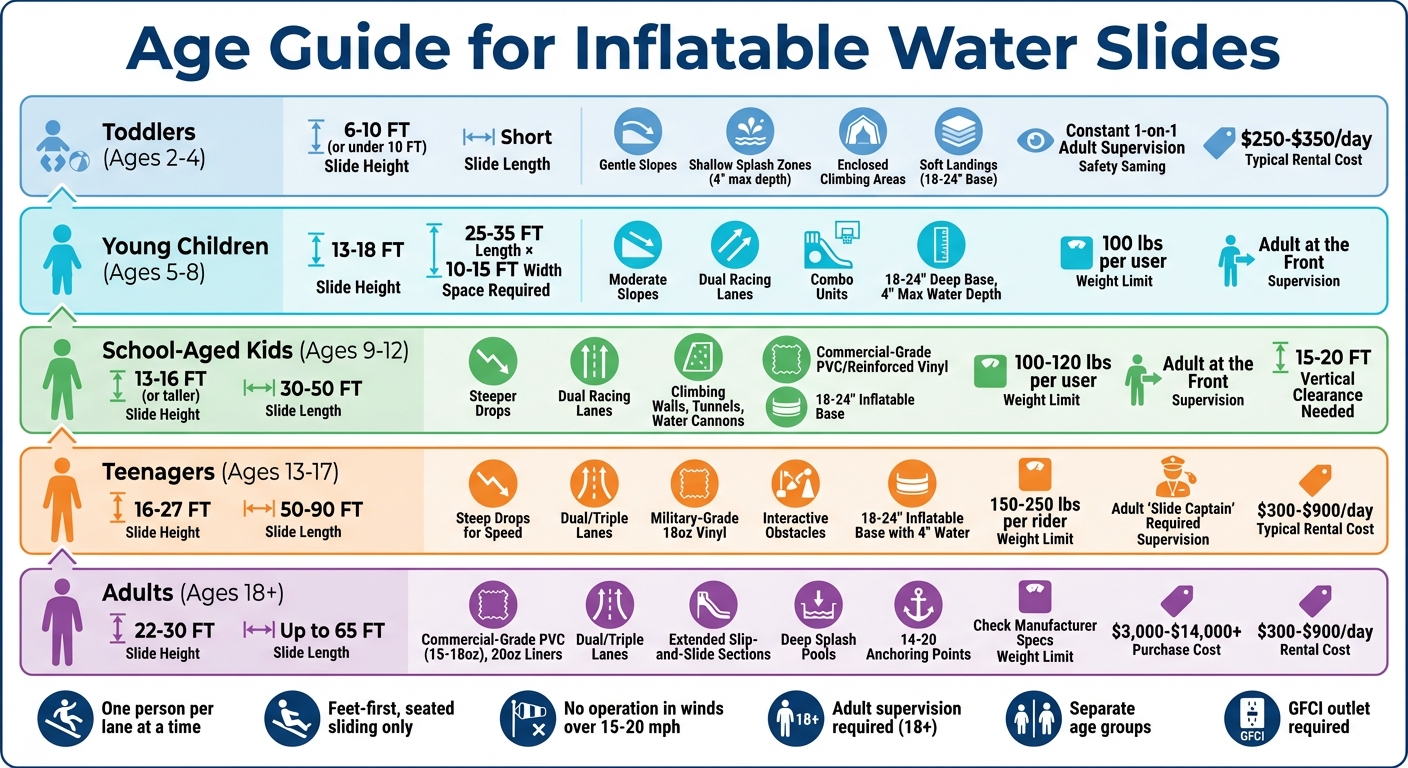
Age-Appropriate Inflatable Water Slide Selection Guide by Height and Features
Ages 2-4: Toddlers and Young Children
Best Slide Sizes and Features
For toddlers, slides should be between 6 and 8 feet in size, with a maximum height of 10–13 feet. The key is to have gentle slopes and gradual descents to keep their speed manageable.
"Toddlers don’t need height – they need confidence. Shorter slides with gentle slopes and shallow splash areas are perfect for this age group." – Five Little Monkeys
When selecting a slide, prioritize features like enclosed climbing areas and easy-to-climb steps. These help reduce the risk of falls and ensure toddlers feel secure. Splash zones should be shallow, with water no deeper than 4 inches, and an inflatable base offers a soft cushion instead of a deep pool. For added safety, look for finger-safe mesh windows that allow for supervision while keeping little fingers safe.
The landing area should include an inflatable base that’s 18 to 24 inches deep, surrounded by containment walls. Place 2-inch thick non-slip mats extending 4 feet around entry and exit points. Starter slides are also quite water-efficient, using just 2–3 gallons of water per minute, which makes them perfect for small backyard gatherings.
These features create a safe and fun environment, laying the groundwork for key safety practices.
Safety Tips for Toddlers
Always keep toddlers under close adult supervision. Stay within arm’s reach and avoid distractions to prevent accidents. Additionally, keep toddlers and older children separated on the slide to avoid rough play or collisions.
Teach toddlers to slide while seated and feet-first, avoiding head-first or standing positions. Before they start playing, check that they’ve removed shoes, jewelry, and glasses. Set up the slide on flat, grassy ground, ensuring it’s at least 10 feet away from houses, fences, trees, or utility lines. Clear the area of rocks, sticks, or debris to prevent injuries or damage to the inflatable.
On hot days, position the climbing side of the slide to face north or east to keep surfaces cooler for bare hands and feet. If the wind speed exceeds 15 mph, take the slide down immediately to avoid tipping. Lastly, secure the slide with 18-inch steel stakes at all anchor points.
Ages 5-8: Young Children
Best Slide Sizes and Features
Kids aged 5 to 8 are more confident and physically capable than toddlers, making them ready for top inflatable water slides ranging from 13 to 18 feet tall. These slides offer moderate slopes – enough to thrill but not overwhelm. They typically require a space of 25 to 35 feet in length and 10 to 15 feet in width, so double-check your available area before committing to a rental or purchase.
Dual-lane slides are a favorite for this age group. They let siblings or friends race side-by-side, cutting down on wait times and adding a fun competitive edge. For even more entertainment, consider combo units that go beyond just sliding. Features like bounce areas, small climbing walls, water cannons, and basketball hoops can keep kids entertained longer and turn a simple slide into an all-around adventure.
Safety in the landing zone is key. Look for an inflatable base that’s 18 to 24 inches deep, with containment walls to keep kids from sliding off. The splash area water should be no deeper than 4 inches to reduce drowning risks. Most residential slides for this age group are designed with a maximum individual weight capacity of around 100 pounds, so it’s important to check this limit before kids start playing.
Safety Tips for Young Children
In addition to slide features, strict safety rules are essential. Allow only one child on the slide at a time to prevent collisions, and make sure they slide seated and feet-first to avoid injuries. Always have an adult supervising to ensure kids don’t climb dangerously, jump from the top, or pile on each other.
It’s also important to separate age groups. Mixing young children with toddlers or teenagers can lead to accidental injuries due to size and strength differences. Place the slide on level grass with at least a 5-foot clearance from fences, trees, or other obstacles to allow for safe, active play. Before inflating, clear the area of any sharp objects, rocks, or sticks.
Keep an eye on the weather. If winds exceed 15 to 20 mph or lightning is spotted, deflate the slide immediately. Secure all anchor points according to the manufacturer’s guidelines to prevent tipping or shifting during use. And when water is involved, always connect the blower to a Ground Fault Circuit Interrupter (GFCI) outlet for electrical safety. You should also ensure you know how to connect a water hose properly to maintain a steady flow for the sprayers.
Ages 9-12: School-Aged Children
Best Slide Sizes and Features
For kids aged 9 to 12, bigger thrills are the name of the game. Inflatable water slides for this age group typically stand between 13 and 16 feet tall, with some models even taller. These slides often measure 30–50 feet in length and require a setup area of about 25–35 feet by 10–15 feet. Don’t forget to check for 15–20 feet of vertical clearance above the slide to ensure safe operation.
Dual-lane racing slides are a favorite for this age group, offering side-by-side lanes where kids can race each other at faster speeds thanks to steeper drop angles. To keep things exciting, consider combo units that include features like climbing walls with grips, crawl-through tunnels, water spray cannons, and even basketball hoops for an all-in-one adventure. Slides with larger splash zones or padded runout areas allow kids to build momentum for a thrilling finish.
Pay attention to weight limits – slides for this age range typically support 100–120 pounds per user. For durability, choose slides made from commercial-grade PVC or reinforced vinyl, which can handle rougher play and are up to five times stronger than standard materials. Many modern designs prioritize safety by limiting splash pool depths to 4 inches, while using inflated bases 18–24 inches deep to cushion landings instead of relying on deep water.
These features create an exciting yet safe environment for school-aged children, provided the proper precautions are taken.
Safety Tips for School-Aged Children
To match the energy levels of this age group, safety must go hand in hand with fun. Start by anchoring the slide securely with steel stakes at least 18 inches long to prevent movement during play. Always place the slide on flat, grassy surfaces, keeping it at least 10 feet away from buildings, trees, fences, or other obstacles. If setting up on a hard surface is unavoidable, use professional-grade non-slip safety mats that extend 4 feet from all exits.
"ASTM (American Society of Testing & Materials) requires [blower sirens] for any inflatable with a slide platform over 8′ tall, given the tip-over risk associated with the unexpected deflation of an inflatable slide unit." – Five Little Monkeys
Enforce clear usage rules: allow only one person per lane at a time, and make sure the next child waits until the previous user has exited the splash zone before starting their turn. Avoid mixing younger children with 9- to 12-year-olds, as differences in size and energy levels can lead to accidents. Before play begins, double-check both the maximum total weight capacity and the individual user limits to ensure everyone stays safe.
These guidelines help ensure that school-aged kids can enjoy their water slide adventures without unnecessary risks.
Ages 13-17: Teenagers
Best Slide Sizes and Features
Teenagers are all about high-energy fun, so water slides for this age group need to bring the thrill factor. These slides generally start at 16 feet tall and can go as high as 22 to 27 feet, offering the steep drops and speed older kids love. Most models range from 50 to 90 feet in length, especially for inflatable obstacle course rentals, and dual-lane racing setups are a big hit. To handle the extra wear and tear, these slides are typically made from military-grade 18oz vinyl with reinforced double-stitching for durability.
Safety is key, especially with the speed these slides generate. Landing zones should have an inflatable base that’s 18–24 inches deep, with water kept to a maximum depth of 4 inches to reduce risks. Many slides also feature interactive add-ons like climbing walls, tunnels, pop-up obstacles, water cannons, and even basketball hoops to keep the excitement going.
"Older kids and mixed-age events call for serious splash factor. These slides are typically 16 feet or taller, often with dual lanes, steep drop angles, and larger splash zones." – Five Little Monkeys
For pricing, a commercial-grade 22-foot single-lane slide costs around $4,295, while dual-lane options are priced closer to $4,795. Rental rates typically fall between $300 and $900 per day. If you’re hosting a teen-focused event, companies like Bouncy Rentals USA offer slides designed with these exact features to combine high-energy fun with top-notch safety.
These detailed designs ensure the slides can handle the speed and energy of teenage riders while maintaining strict safety standards.
Safety Tips for Teenagers
Teenagers bring more weight, speed, and energy to water slides, which means safety rules need to be strictly enforced. Always check the slide’s weight limits – usually between 150 and 250 pounds per rider – and the total capacity for multiple users. Overloading the slide can weaken the seams or create unstable conditions, putting everyone at risk.
Assign an adult "slide captain" to monitor the activity and enforce rules throughout the event. Roughhousing, flipping, wrestling, or chasing inside the slide should be strictly prohibited. Riders must always slide in a seated position with their feet forward – head-first sliding is a no-go. To avoid collisions, stick to a one-at-a-time rule per lane, ensuring the previous rider has fully cleared the splash zone before the next person starts.
"A potential crash is just waiting at the bottom of the slide, so no, you should not have adult [or teen] slide down an inflatable slide at the same time as children." – Gary Simon, Author
Mixing teenagers with younger kids on the same slide is also a bad idea. The size and energy differences can lead to dangerous collisions. To keep the unit stable, secure it at every anchor point using 18-inch steel stakes for grass setups or 50-pound sandbags on hard surfaces. Additionally, place non-slip safety mats extending 4 feet around all entrances and exits to prevent slipping on wet areas.
Ages 18+: Adults
Best Slide Sizes and Features
When it comes to water slides for adults, thrill and durability are key. These slides are built to handle heavier loads and provide an exhilarating experience, typically standing between 22 and 30 feet tall. They’re constructed with commercial-grade PVC (15oz to 18oz) and include 20oz heat-welded liners, ensuring they can endure frequent use while delivering longer, faster rides for adult users.
"Commercial inflatable water slides for adults are engineered to withstand heavy use while providing an exhilarating experience. Unlike their smaller counterparts designed for children, these slides feature robust construction, higher weight capacities, and more thrilling designs." – Blaine Ladd, BounceWave
Dual- and triple-lane slides are especially popular for adult events, as they allow for side-by-side racing and help manage crowd flow at larger gatherings. Some models even stretch up to 65 feet long, featuring extended slip-and-slide sections and deep splash pools for a refreshing finish. To ensure stability, these slides often include stabilizer pads and 14 to 20 anchoring points secured with stainless steel D-rings.
The cost of adult-sized slides depends on their size and features. Smaller commercial slides start around $3,000, while medium options range from $5,000 to $7,000. Larger models with dual or triple lanes can exceed $14,000. For event planners, rental rates typically range from $300 to $900 per day. Companies like Bouncy Rentals USA specialize in slides designed for backyard parties and corporate events, combining high-capacity builds with essential safety features.
With these heavy-duty designs offering an exciting ride, it’s equally important to follow proper safety practices to keep adult riders secure.
Safety Tips for Adults
Safety is crucial, especially with the higher speeds and weight capacities of adult slides. Always check the manufacturer’s weight limits before use to prevent overloading the slide. Adults and children should never use the same slide simultaneously.
"You will find that an inflatable slide manufacturer will likely tell you that it is not a good idea to have both adults and children sliding down inflatable slide at the same time." – Gary Simon, Jungle Jumps
To ensure safety, enforce a one-person-per-lane rule, allowing the previous rider to clear the splash zone before the next person starts sliding. Adults should always slide in a seated, feet-first position – head-first sliding is extremely dangerous. Remove any loose items like jewelry or glasses, and wear long sleeves and pants to reduce friction burns.
Alcohol and water slides don’t mix. Drinking impairs coordination and reaction time, so it’s strictly prohibited while using the slide. Assign a dedicated attendant to monitor usage and enforce capacity limits. For stability, secure the slide with 18-inch steel stakes at each anchoring point (14 to 20 points in total). Ensure the surrounding area is clear, with at least 10 feet in front and behind the slide and 5 feet on each side. Place non-slip mats extending 4 feet from all entry and exit points to reduce the risk of slipping on wet grass. Lastly, never operate the slide in winds exceeding 24 mph, and deflate the unit immediately if there’s thunder or lightning.
Safety Guidelines for All Ages
No matter who’s enjoying the water slide, some safety rules apply to everyone. First and foremost, a responsible adult (18 years or older) needs to be present at all times to supervise and enforce the rules. This "slide captain" should stay at the front of the slide, keeping an eye out for unsafe behavior and ensuring riders follow proper procedures.
"Adults who are in charge of watching children should keep an eye on children at all times and not be involved in any distracting activity, such as using their smartphone." – CDC
Only one person per lane should slide at a time, and the next rider must wait until the previous person has completely exited the splash pool. Riders must slide feet-first in a seated position – head-first sliding, flipping, or jumping from the top is not allowed. Before sliding, remove shoes, glasses, jewelry, or any items that could damage the slide.
Certain individuals should avoid using the slide altogether. This includes those with back or neck issues, pregnant women, or anyone feeling unwell. To help prevent the spread of illness, children experiencing diarrhea or vomiting should stay out of the water. For smaller slides, empty the water daily, rinse them thoroughly, and allow them to air-dry. If contamination occurs, disinfect using a bleach solution made with ½ cup of household bleach (5.25%–8.25%) per 1 gallon of room-temperature water, as recommended by the CDC.
Supervision and Rules by Age Group
While the general rules apply to everyone, supervision and specific guidelines should be adjusted depending on the rider’s age:
- Toddlers (2–4): Stick to small slides under 10 feet tall with soft, low-height features. These little ones need constant, one-on-one adult supervision.
- School-Aged Children (5–12): They can enjoy slides between 10 and 18 feet tall but still need an adult supervisor at the front to prevent younger kids from mixing with older, larger children.
- Teenagers (13–17): Teens can handle slides 17 feet or taller but must strictly adhere to the manufacturer’s weight limits.
- Adults (18+): Adults using commercial-grade slides (17 feet or higher) should be monitored by a peer or attendant. Alcohol consumption before sliding is strictly prohibited, and adults should never slide with children to avoid collisions.
| Age Group | Slide Height | Supervision Level | Key Safety Rule |
|---|---|---|---|
| Toddlers (2–4) | Under 10 ft | Constant 1-on-1 supervision | Use only soft, low-height features |
| School-Aged (5–12) | 10–18 ft | Adult at the front | No mixing small kids with larger children |
| Teens (13–17) | 17+ ft | Adult at the front | Follow manufacturer weight limits |
| Adults (18+) | 17+ ft | Peer or attendant monitoring | No sliding after consuming alcohol |
These age-specific recommendations, combined with the general safety rules, create a safer experience for everyone.
Weather and Setup Requirements
The environment where the slide is set up is just as important as the rules for using it. Choose a flat, debris-free surface with at least 10 feet of clearance from buildings or other structures, following standard space requirements for bounce houses. For stability, use heavy-duty stakes driven at a 45-degree angle for grass or secure the slide with 50-pound sandbags on concrete. Before inflating, check for overhead hazards like power lines or low-hanging branches.
"Never operate a bounce house in winds exceeding 15–20 mph. Deflate and store the inflatable during storms to maintain bounce house safety." – Too The Moon Bounce Co
Stop using the slide immediately if wind speeds exceed 15 mph. At the first sign of lightning or thunder, deflate the slide right away. Keep the blower running continuously while the slide is in use, as sudden deflation could create a risk of entrapment. Place the blower on a stable, dry surface, and use heavy-duty, outdoor-rated extension cords plugged into grounded outlets.
Choosing the Right Water Slide for Your Event
Picking the perfect water slide goes beyond just matching its features to the age of your guests. You also need to think about your event space. Before you book, measure your yard to confirm there’s a flat, grassy area with 5 to 10 feet of clearance on all sides for safe setup. Don’t forget to check for overhead hazards like power lines or tree branches. Plus, make sure there’s a dedicated electrical outlet with GFCI protection within 50 to 100 feet of the blower. These steps are just as important as age-specific safety considerations.
Height makes a difference. For toddlers (ages 2–5), look for smaller slides around 10 to 13 feet tall with gentle slopes and shallow splash zones. Kids aged 6–12 will enjoy slides in the 13 to 18-foot range, often featuring dual racing lanes or fun themes. For teens and adults, slides 18 feet or taller are ideal – but always check the manufacturer’s weight limits, which typically range from 150 to 250 pounds per rider.
Prioritize safety. If your event includes guests of varying ages, consider renting separate slides or organizing different time slots for each age group. This ensures everyone has a safe and enjoyable experience. Dual-lane slides can also help keep lines moving and reduce wait times.
"The lowest price doesn’t always represent the best value. Companies with meticulously maintained equipment, proper insurance coverage, and thorough safety protocols might charge more – but the peace of mind and quality experience justify the difference." – TJ’s House of Bounce
Plan your budget. Water slide rentals vary in cost depending on size and features. Toddler slides typically rent for $250–$350 per day, while 18-foot slides start at $425. Dual-lane models (19–20 feet) cost between $450 and $650, and mega slides (27–40 feet) range from $799 to over $850. Don’t forget to factor in extras like park delivery fees ($75), generator rentals ($85), or dirt setup charges ($65).
When you book with Bouncy Rentals, you can expect sanitized, fully insured equipment delivered on time by trained professionals. They take care of setup, safety checks, and takedown, leaving you free to enjoy your event stress-free.
FAQs
How do I pick the right slide if kids are different ages?
When picking a water slide for kids of different ages, focus on safety, size, and features that match their age. For younger kids (around 2–5 years old), look for shorter slides with gentle slopes and shallow splash zones. Older kids (6–12 years old) tend to prefer taller slides with faster speeds and fun additions like dual lanes. To keep everyone happy and safe, you might want to go for versatile slides with multiple features or even separate slides designed specifically for each age group.
How much yard space and clearance do I need?
To set up a water slide safely, you’ll need a space that’s approximately 25–30 feet long, 12–15 feet wide, and has at least 5 feet of clearance around it. Ensure the area is free from obstacles like trees, fences, or overhead wires to avoid any safety hazards and allow for proper anchoring.
What setup mistakes cause the most accidents?
One of the biggest mistakes people make when setting up a slide is not anchoring it securely. Without proper stakes or sandbags, the slide can shift or tip over, creating a safety hazard. Another common error is placing the slide on hard surfaces like concrete. This increases the risk of injuries if someone falls or slips. Always make sure the slide is firmly anchored and positioned on a soft, grassy area to keep everyone safe.
