
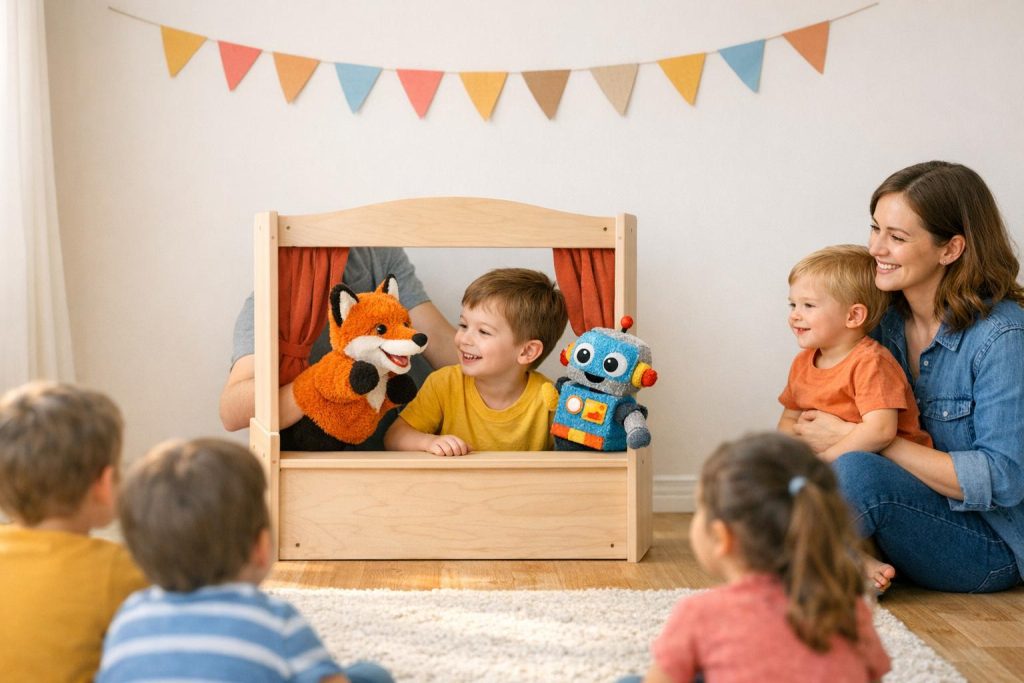
Puppet shows are an engaging way to make kids’ events more fun and meaningful. They encourage imagination, teach social skills, boost language development, improve motor skills, and create lasting family memories. Here’s a quick summary of the benefits:
- Imagination and Creativity: Kids actively shape stories, enhancing their creative thinking.
- Social and Emotional Skills: Puppets help kids explore emotions and practice empathy.
- Language Development: Puppets encourage kids to experiment with words and communication.
- Motor Skills and Confidence: Manipulating puppets builds coordination and self-assurance.
- Family Bonding: Interactive shows bring families closer through shared experiences.
Puppet shows combine fun and learning, making them a great choice for any kids’ event.
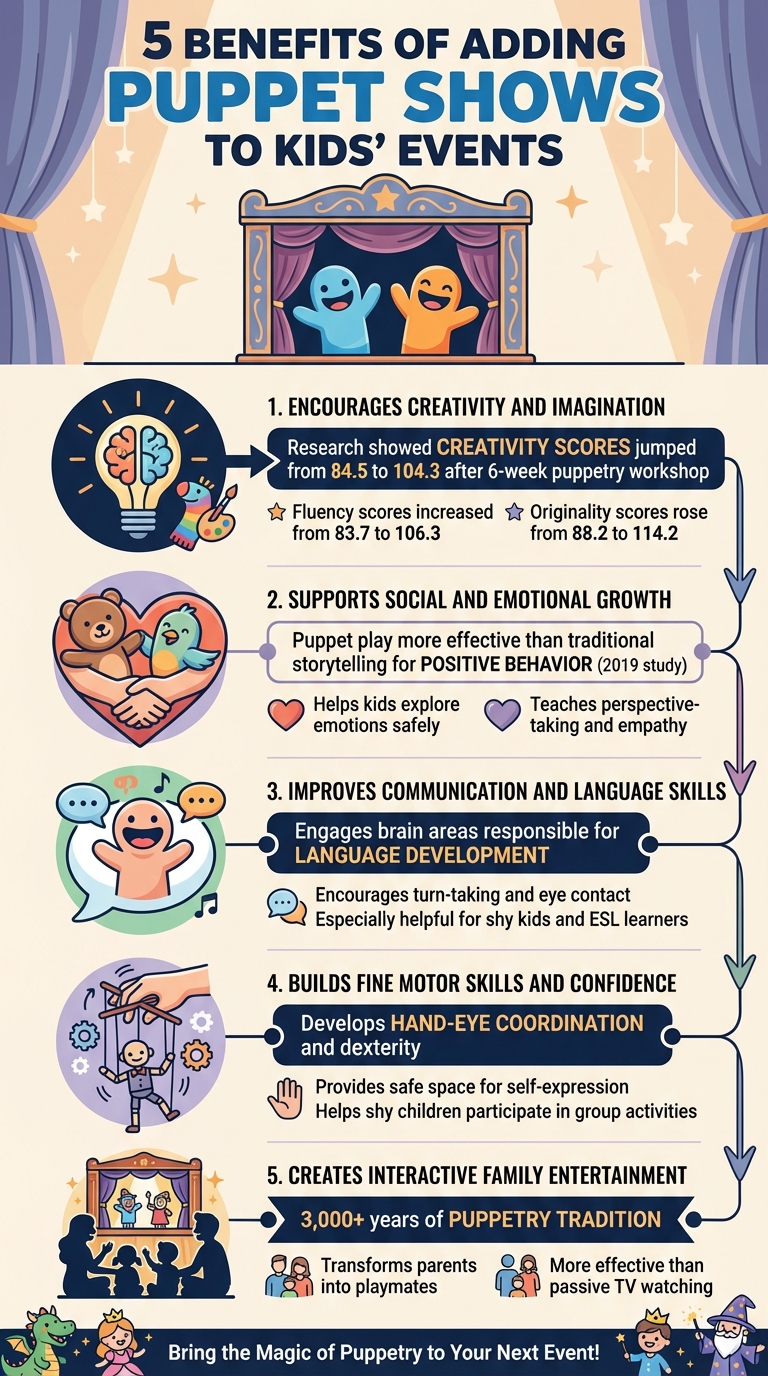
5 Key Benefits of Puppet Shows for Kids’ Events
1. Encourages Creativity and Imagination
Puppet shows have a unique way of turning passive watching into active, imaginative participation. When kids watch colorful characters spring to life, their minds don’t just follow the story – they actively shape it, imagining twists, turns, and what might happen next. This isn’t just a fun observation; it’s backed by research.
In June 2025, Antonis Lenakakis and Vasiliki Partsakoulaki conducted a six-week puppetry workshop in Athens, Greece, with 24 preschoolers. During this workshop, the children made their own puppets and participated in daily improvisation sessions. Results from the Thinking Creatively in Action and Movement (TCAM) test were striking: fluency scores jumped from 83.7 to 106.3, originality scores rose from 88.2 to 114.2, and overall creativity scores climbed from 84.5 to 104.3.
"While a puppet may be just a toy, it also catalyses a child’s imagination, which, in turn, fuels their creativity." – Tselfes & Parousi
Puppetry also nurtures what experts refer to as "Dramatic Thinking" – a blend of imagination, emotion, and physical expression within a fictional setting. Through puppets, children explore roles, experiment with voices, and try out different perspectives, all in a judgment-free zone. This freedom gives creativity the space it needs to thrive.
Interestingly, longitudinal studies suggest that preschoolers exposed to puppet theater demonstrate higher levels of creative thinking as they grow into adolescence. Whether it’s through professional puppet performances or crafting their own characters, these experiences build creative skills that last well beyond childhood.
2. Supports Social and Emotional Growth
Puppet shows create a comfortable space for kids to explore tough emotions. When a puppet acts out a scenario – like not wanting to share – it gives children the chance to observe and discuss solutions without feeling singled out. This approach makes social lessons feel more like fun and less like criticism. There’s evidence to back this up too.
A 2019 study revealed that puppet play is more effective at encouraging positive behavior than traditional storytelling. Why? Puppets spark a child’s imagination, helping them absorb social lessons almost effortlessly.
"Puppets keep social and emotional lessons from being too personal or shaming any one particular child. They’re an incredible tool for compassionate teaching." – Taunya Banta, Individualized Education Services Manager, KinderCare
Puppets also give a voice to kids who find it hard to express their feelings. As Claire Kessler from KinderCare explains:
"Puppet play helps kids talk about something when they’re in a tight spot"
For quieter or more reserved children, puppets often become an outlet for expressing emotions indirectly. This can be especially helpful when dealing with overwhelming feelings like sadness, frustration, or grief.
Another benefit of puppet role-playing is perspective-taking, a key part of developing empathy. By acting out different roles, children learn to see situations from someone else’s point of view, which helps them build stronger, more understanding friendships. Author Carolyn Sweeney Hauck highlights this:
"As children role play with puppets, they’re also learning to see something from another person’s point of view, which teaches them how to be empathetic friends"
This skill naturally leads to better interactions, whether in the classroom, at home, or in social settings.
3. Improves Communication and Language Skills
Puppet shows are a fantastic tool for helping kids develop their language skills. When interacting with puppets, children feel encouraged to try out new words, experiment with sounds, and build sentences in different ways. The puppet acts as a comforting middle ground, helping to ease the anxiety that can come with speaking.
Professor Jill Stamm has highlighted how puppets engage the areas of the brain responsible for language development, making them a powerful educational tool.
This kind of support is especially helpful for kids who are shy or hesitant to speak. One parent from MVP Kids shared a touching experience:
"Something magical happened when I put a puppet on the hand of my quiet, withdrawn preschooler… he suddenly had a voice. His puppet could speak for him the things he didn’t want to say for himself."
Research from the University of Sydney‘s School of Education and Social Work also shows that puppets encourage children to practice essential communication skills like turn-taking, maintaining eye contact, and expressing themselves creatively. For kids with disabilities or for those learning English as a second language, puppets can act as a universal language. The combination of visual and sensory elements makes it easier for them to join in and share their thoughts.
4. Builds Fine Motor Skills and Confidence
Puppeteering does more than just improve language skills – it also hones physical coordination and boosts self-assurance.
Controlling a puppet requires careful hand and finger movements to manipulate its mouth, limbs, and gestures. This process helps develop fine motor skills and dexterity. For kids working with more intricate puppets like marionettes, the added challenge of synchronizing hand movements sharpens their hand-eye coordination.
Puppets also create a comfortable space for self-expression. Children who are naturally shy or hesitant to speak in front of others can use a puppet as their voice. The puppet acts as a stand-in, letting them share thoughts, crack jokes, or ask questions without the fear of being judged. As Jim Henson, the mastermind behind the Muppets, put it:
"One of the nicest things about puppets is that it’s your own hand in there. You can make it do anything you want to."
This confidence-building effect is well-documented in educational settings. For instance, a 2019 study by a University of Sydney researcher observed a remarkable moment in a preschool setting. A child named Ben, who often avoided group activities and stayed on the sidelines, had a transformative experience with a puppet named Mabel. During a story session featuring "Ben and the Beast", the puppet called out his name. Instantly, Ben joined the group, sat close to the researcher, and fully engaged in the reading and role-play activities. His teachers, Jola and Belinda, noted this as an extraordinary instance of his participation and focus.
To bring these benefits to life at your event, consider setting up a simple puppet theater using a cardboard box or a cloth curtain. This can give shy children a safe space to perform. Choose puppets based on age – soft hand or animal puppets for younger kids, and marionettes for older ones. You can also encourage kids to make their own puppets using items like socks, paper bags, or rubber gloves, which adds an extra layer of creativity and skill-building.
5. Creates Interactive Family Entertainment
Puppet shows offer a special way to bring families together, going beyond simple entertainment. Unlike passive activities like watching TV, puppet shows actively involve both kids and adults. Performers often invite parents to join the fun – whether it’s wearing silly props, helping with tricks, or singing along to lively tunes. These moments create laughter, joy, and shared memories that strengthen family bonds.
Puppets also reshape the typical parent-child dynamic. Instead of just being caregivers, parents become playmates, stepping into the world of imagination alongside their kids. A 2019 study even found that puppet interactions are more effective at encouraging positive behavior changes than traditional storytelling methods. MVP Kids highlights this beautifully:
"A puppet can help a caregiver become a playmate and engage in pretend play as an equal."
What makes puppetry so magical is its universal appeal. With a history spanning over 3,000 years, this visual art form connects people across generations and languages. Interactive elements like call-and-response – where kids shout out corrections during songs or families chant "magic pledges" together – create high-energy moments that everyone remembers.
Want to keep the fun going at home? After the show, let kids and parents take turns using the puppets for spontaneous storytelling. Puppets can also spark meaningful conversations; children often feel more comfortable sharing their thoughts with a puppet character than during a direct chat with an adult. It’s an easy way to turn family time into something truly special.
Conclusion
Puppet shows ignite imagination, support emotional development, improve language skills, boost confidence, and create cherished family memories. Together, these elements turn ordinary gatherings into memorable experiences that children and families will treasure.
To make the most of these benefits, thoughtful event planning is key. Puppet shows provide a calm, focused activity that nurtures listening and creativity, while high-energy options like bounce houses from Bouncy Rentals offer kids the physical outlet they crave. Scheduling the puppet show after active playtime – like a session in the bounce house – helps kids transition smoothly, allowing them to settle down and enjoy the performance. Adding a puppet character to announce activity changes can also make transitions fun and engaging.
This balanced approach ensures every child finds something to enjoy. Positioning the puppet theater in a quieter area away from the lively inflatables creates a sensory-friendly space, giving shy children a chance to shine through puppetry, while more active kids can enjoy the physical challenges of inflatables. When booking with Bouncy Rentals, ask about package options that combine inflatables with other party must-haves.
FAQs
What age group is best for a puppet show?
Puppet shows are a fantastic choice for early childhood because they offer more than just entertainment. They help young kids develop important skills like better language abilities, boosted creativity, improved social understanding, and growing self-confidence. Plus, they’re a fun and engaging way to encourage learning and growth at the same time.
How long should a puppet show be at a kids’ event?
A puppet show at a kids’ event works best when it runs for 15 to 30 minutes. This timeframe strikes the perfect balance – keeping kids entertained and engaged without overstretching their attention spans. It allows enough time for lively interaction and imaginative storytelling while ensuring the excitement stays fresh.
How do I pair a puppet show with a bounce house rental?
Pairing a puppet show with a bounce house rental is a great way to create an event that balances both storytelling and active play. Begin with the puppet show to capture kids’ attention through humor and interaction. Once they’ve enjoyed the show, they can head to the bounce house for some energetic fun. Puppet shows can also serve as a quieter intermission or a way to wrap up the day, keeping kids entertained while giving them a chance to recharge or wind down. This mix ensures a fun-filled event without overwhelming the little ones.
