
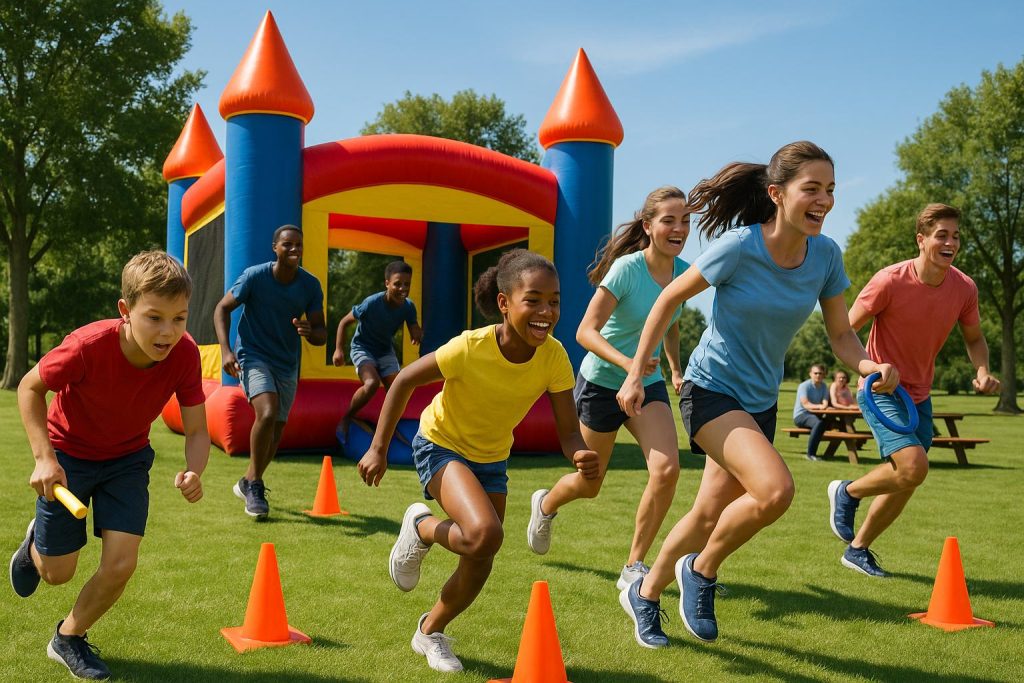
Bounce house games are a hit for parties, school events, and corporate gatherings, offering fun, structured activities for all ages. Popular games include obstacle courses, relay races, dodgeball, and Capture the Flag, each tailored to different age groups and skill levels. Safety is critical: group participants by size, enforce rules, and limit occupancy per manufacturer guidelines. Companies like Bouncy Rentals USA simplify planning by providing sanitized, insured inflatables with delivery and setup.
Key Takeaways:
- Top Games: Obstacle Course Dash, Last Jumper Standing, Relay Races, Capture the Flag, Simon Says, Dodgeball, Tug of War, and Teen/Adult Challenges.
- Age Groups: Games cater to kids (3-12), teens, and adults.
- Safety Tips: Limit players, supervise with referees, and avoid rough play.
- Setup: Use flat, dry surfaces; secure inflatables properly.
- Extras: Add themes, music, and prizes for more fun.
For a hassle-free experience, renting from a professional service ensures safe and memorable events.
Safety and Setup Guidelines for Competitive Bounce House Games
To keep competitive bounce house games safe, stick to the manufacturer’s occupancy limits, which are usually between 4 and 8 children. Overcrowding can lead to more accidents, especially during fast-paced games where the chances of sprains and falls increase significantly. To minimize risks, ban flips, somersaults, and roughhousing, as these can lead to serious neck or head injuries. Make sure all participants remove shoes and jewelry before entering, and group children by age and size to ensure the games are suitable for their abilities.
Proper setup is just as important for safety. Always place bounce houses on flat, dry grass or dirt, as these surfaces help absorb impacts better than hard or uneven ground. Secure the inflatable using stakes or weighted sandbags as recommended by the manufacturer, and ensure it can handle winds up to 20–25 mph. Periodically check the anchors during use to make sure everything stays in place.
Adjust game rules to match the age group of the participants. For younger kids aged 3–6, simple obstacles and shorter challenges work best. For older children and teens, consider adding timed relays or zone-based challenges, tweaking the difficulty to match their skills.
To maintain order and safety, have one adult referee for every 10–15 children. The referee’s job is to enforce the rules, watch for unsafe behavior, and rotate players every 5–10 minutes to keep everyone engaged and safe.
For hassle-free party planning, Bouncy Rentals USA offers professional delivery and setup. Their trained staff handles secure anchoring, ensures all equipment is thoroughly sanitized, and conducts safety inspections that meet ASTM standards – giving you peace of mind for a fun and safe event.
1. Obstacle Course Dash
The Obstacle Course Dash takes a classic bounce house and cranks up the fun by turning it into a high-energy race. Kids get to sprint, crawl, climb, and slide through a maze of barriers, tunnels, soft walls, and pop-ups, all while navigating the wobbly surface beneath them. You can run this as head-to-head races, individual time trials, or team relays where players tag their teammates after completing the course. It’s an action-packed challenge that tests both speed and skill.
This game is ideal for ages 5–12, though you can tweak it to suit different age groups. For younger kids (ages 4–6), simplify the obstacles, and for teens or adults, larger units with tougher challenges can make it even more exciting. Expect plenty of running, jumping, and quick turns, all made trickier by the bounce house floor, which requires extra balance and core strength compared to flat ground.
To keep things safe and fun, limit the number of participants to 4–8 per 13×13 ft unit. For bigger events, rotate players in groups or use multi-lane obstacle courses that let several racers compete at once. You’ll need an inflatable obstacle course (or a bounce house with added barriers), cones or flags to mark the start and finish lines, and a stopwatch for timing. Companies like Bouncy Rentals USA offer professional-grade obstacle courses with built-in challenges, plus delivery and setup by trained staff.
This game builds agility, speed, balance, and problem-solving skills, as players decide whether to leap over or duck under obstacles while keeping their balance. To mix things up, try themed rounds like "Ninja Warrior Challenge" or "Jungle Expedition." You can also add creative twists, like backward races or crawling-only heats (as long as they’re safe). To top it off, hand out prizes for the fastest times or the team with the best spirit – it’s a surefire way to keep everyone engaged and entertained.
2. Last Jumper Standing
Last Jumper Standing is a lively elimination game where players bounce in response to an adult leader’s commands. These commands can range from "jump on one foot" to "spin in a circle" or "tiny hops only." Players who fall, sit, or fail to follow the instructions are out and must leave the bounce area. The game continues until only one person is still upright and bouncing – that’s your winner for the round! The simple structure makes it easy to adjust for different ages and abilities.
To keep things fun and safe, adjust the game’s pace based on the age group. For kids ages 5–12, the standard format works well as a moderate activity. Younger kids (ages 3–4) might need simpler commands and a few "do-overs" to keep them engaged. For older kids and teens, you can ramp up the challenge with moves like side shuffles, 180° turns, or quicker command changes.
A group of 6–10 players is ideal for a typical backyard bounce house, though this depends on the unit’s size and capacity. If you’re hosting a larger gathering, consider splitting participants into heats, with winners advancing to a championship round. Alternatively, create separate brackets by age group to avoid mixing small children with older, larger participants, which helps minimize collision risks.
For safety, always use a professionally installed bounce house with a continuous-blower system. Assign one adult to lead the game and monitor play. You can even add music for a fun twist, like a "freeze bounce" round. Companies such as Bouncy Rentals USA take care of delivery, setup, and anchoring, so you can focus on the fun.
This game isn’t just entertaining – it’s great for improving balance, coordination, agility, and reaction time. To keep everyone safe, enforce rules like no flips, pushing, or rough play. And for an extra touch, tailor commands to fit your party theme – think "superhero jumps" or "robot steps."
3. Bounce House Relay Races
Bounce House Relay Races bring out the competitive spirit as teams race to complete fun tasks inside the bounce house. To set it up, divide your guests into 2–4 teams, mark a clear start and finish line, and assign a short task for each player. Tasks can include bouncing between walls, crawling under obstacles, or carrying a lightweight item. The first team to complete the relay wins, making it an exciting activity for everyone involved.
This game is ideal for kids aged 5–12, as their balance and coordination make them perfect for quick movements. For younger children (ages 3–4), simplify the tasks – like walking across the bounce house and back – with close adult supervision. Teens and adults can step up the challenge by using larger inflatables, such as obstacle-course units, and adding features like mini-climbs or tunnels. Because the game involves continuous running and jumping, keep each round short (30 to 90 seconds) and rotate teams to avoid overexertion, especially in hot weather.
To ensure safety and fun, stick to the manufacturer’s capacity guidelines and divide participants into smaller groups to prevent overcrowding. For larger gatherings, you can organize multiple heats, advance winners to a final round, or create separate brackets based on age groups.
You won’t need much equipment – just a bounce house and an adult to referee. For added excitement, you can include simple props like balloons, foam balls, beanbags, or even plastic cups filled with water for balance challenges. Here are a few fun relay variations:
- Balloon relay: Players must bounce while keeping a balloon in the air.
- Bounce pair relay: Two participants hold hands and race together. If they separate or drop their balloon, they must restart.
- Creative races: Try backward races, crab-walk races, or animal-themed races like frog hops or bunny hops.
These relay races aren’t just fun – they also help kids develop balance, coordination, speed, agility, teamwork, and communication. For races that involve handoffs or working in pairs, kids learn to time their actions and cooperate effectively. Always follow safety guidelines to ensure smooth play. You can even rely on companies like Bouncy Rentals USA to handle delivery, setup, and safety checks, so you can focus on hosting an action-packed day of relay fun!
4. Capture the Flag Bounce Edition
Capture the Flag Bounce Edition takes the classic game and gives it a fun, inflatable twist. Here’s how it works: split your group into two teams and assign each side of the bounce house as their territory. Place a soft flag – like a bandana, fabric square, or foam object – at the back of each team’s zone. The goal? Bounce, dodge, and weave your way to grab the opposing team’s flag and return it to your base without getting tagged. If a player is tagged, they either head to a designated "jail" or step out temporarily, depending on the rules you set. This version adds a fast-paced, team-focused layer to the traditional game.
Adjusting for Different Ages
This game is ideal for kids aged 7–12, as they typically have the coordination and ability to follow rules. For younger kids (ages 5–6), simplify the game by allowing walking or gentle bouncing, using soft tags, and keeping rounds short – just 2–3 minutes. For older kids and early teens (ages 11–15), try adding advanced twists, like requiring five controlled jumps before grabbing a flag or creating safe zones. Just remember: no pushing, tackling, or wrestling – safety first!
Game Setup and Safety Tips
Players are constantly bouncing and strategizing in a confined space, so it’s important to keep teams small enough to follow the bounce house’s capacity guidelines. If you have a lot of participants, consider running the game in heats or rotating substitutes to keep things safe and manageable. You’ll need a securely anchored bounce house, two soft flags, clear markers for team zones and jail areas, and an adult referee to oversee the action.
Skills and Fun Combined
This game isn’t just a blast – it also helps players develop agility, balance, endurance, spatial awareness, and teamwork. Kids will need to read their opponents’ moves, plan their routes, and work together to win. To ensure everyone stays safe, enforce light-touch tagging (using an arm, shoulder, or back), make sure shoes and sharp objects are removed before entering, and never exceed the bounce house’s capacity limits.
Whether it’s a birthday party, school carnival, or neighborhood event, Capture the Flag Bounce Edition is a high-energy activity that everyone will love. For hassle-free fun, check out Bouncy Rentals USA, where you can rent sanitized, professionally delivered inflatables to take your event to the next level.
5. Simon Says Bounce Challenge
The Simon Says Bounce Challenge puts a fun twist on the classic listening game, bringing it to life in a bounce house. In this version, one player becomes "Simon" and gives out bouncing-related commands like "Simon says jump on one foot", "Simon says spin around", or "Simon says sit down." The catch? Players should only follow instructions that begin with "Simon says." If someone acts on a command without the magic phrase (like "Stop bouncing!"), they’re out and move to the edge of the bounce house to cheer for the remaining players. The last person standing becomes the next Simon. It’s a slower-paced game compared to races but still challenges focus and quick thinking.
Age Range and Intensity
This game works well for kids aged 4 and up. For younger children (ages 4–7), keep commands simple – like "bounce three times" or "touch the wall" – and keep rounds short to hold their attention. Older kids (ages 8–12) can handle more complex instructions, such as "Simon says bounce to the back and touch the floor", and faster-paced commands. Teens and adults can also enjoy the game, especially with added complexity or team variations, as long as movements stay controlled. The intensity is generally low to moderate, focusing on safe bouncing and quick reactions rather than nonstop high-energy activity.
Group Size and Equipment
To ensure safety and fun, limit the game to 6–10 players at a time. For smaller groups of 3–5, each player can take multiple turns as Simon. Larger groups can rotate players in timed rounds (about 3–5 minutes) or split into smaller heats. If you want to add some flair, consider using a portable speaker for background music or colored wristbands to indicate who’s still in the game.
Skills and Safety
This challenge isn’t just about fun – it helps improve coordination, listening skills, impulse control, balance, and body awareness. It also promotes good sportsmanship as players cheer for others once they’re out. To keep things safe, group kids by similar size, ensure movements stay controlled, and have an adult oversee the game to enforce rules and monitor the bounce house’s capacity. Focus on controlled bounces, simple poses, and smooth directional changes to keep everyone safe while they play.
For an easy and stress-free setup, check out Bouncy Rentals USA. They provide sanitized, professionally delivered bounce houses that are perfect for Simon Says and other party games, whether you’re planning a birthday, school event, or neighborhood gathering.
6. Bounce House Dodgeball or Target Toss
Bounce House Dodgeball takes the classic playground favorite and ramps it up with an inflatable twist. Players bounce around while throwing soft foam or nerf balls at their opponents. Get hit, and you’re out – unless you manage to catch a ball mid-air, which puts you right back in the game. The bouncy surface adds a layer of unpredictability, making every dodge and throw more challenging. For a quieter option, Target Toss swaps out opponents for stationary goals like hoops, buckets, or marked zones inside the bounce house. Players aim for accuracy, racking up points with each successful toss. Both games bring plenty of fun, with Dodgeball focusing on quick eliminations and Target Toss rewarding precision.
Age Range and Intensity
Dodgeball is best for kids aged 6–12, as it requires a mix of throwing and dodging skills that younger children might find tricky. It’s a high-energy game that keeps players moving. Target Toss, on the other hand, is a great fit for ages 4 and up. Its focus on aiming rather than direct competition makes it less intense. Younger kids, especially those between 4 and 7, can enjoy building their hand-eye coordination without the pressure of elimination.
Group Size and Equipment
For Dodgeball, aim for 6–12 players (3–6 per team) and stock up on 10–20 lightweight foam balls or balloons. Target Toss works well with smaller groups of 4–8 players and needs stationary targets like hoops, buckets, or marked zones. To keep things organized, use streamers or cones to mark boundaries or divide the bounce house for team play. Short rounds of 1–2 minutes help maintain excitement while preventing exhaustion.
Skills and Safety
Dodgeball sharpens agility, coordination, and teamwork, while Target Toss hones accuracy, balance, and focus. Both games help kids improve their gross motor skills and spatial awareness in a fun, interactive way. Safety is a top priority: enforce a strict no-headshots rule, encourage aiming for arms and legs, and keep a close eye on the action. Only one game should run at a time to avoid chaos. The bounce house naturally keeps the activity contained, sparing your home from potential damage – no more worrying about broken windows or tipped-over furniture.
For an easy and stress-free setup, check out Bouncy Rentals USA. They offer sanitized, fully insured bounce houses and all the gear you need for Dodgeball or Target Toss, plus extras to keep the party going strong.
7. Tug of War and Team Strength Challenges
Tug of War adds a fun, competitive edge to your bounce house party – but with a twist. Two teams grab opposite ends of a rope and pull with all their might to drag the other side across a marked center line. Now, imagine playing this classic game near a bounce house or on inflatable balance lanes. The uneven footing turns the game into more than just a test of strength – it’s about coordination, timing, and teamwork. You can stick with the standard rules or tweak them to include resistance challenges, adjusting the game to suit the ages and abilities of your participants.
Age Range and Intensity
Like other bounce house activities, Tug of War combines strategy with physical effort. It works well for kids aged 5 and up, but the setup should match their age group:
- Ages 5–8: Use shorter ropes and smaller teams, with adults supervising to teach safe techniques and timing.
- Ages 8–12: Introduce standard kid-sized ropes and enforce simple rules like no wrapping ropes around hands. Keep rounds short and ensure proper spacing for safety.
- Ages 13 and up: Older kids and adults can take on full-strength games with heavier ropes. Add extra challenges like joust pedestals or bungee runs near the bounce house for a multi-event experience.
The intensity varies from moderate to high, as the game engages large muscle groups and quickly raises heart rates. Adjust team sizes, rope length, and round durations to match the participants’ energy and skill levels.
Group Size and Equipment
To keep things safe and organized, aim for teams of 4–8 players. For smaller groups, rotate players every round. At larger events, like school fairs or block parties, you can set up multiple teams and run short tournaments while others enjoy free play in the bounce house. Matches should last 30–60 seconds or end when one team moves the marker about 3 feet.
For equipment, use a 25–50 ft rope with a visible center marker. Set up on grass or rubber mats for added safety. If you’re looking to level up the experience, inflatable arenas designed for strength and balance games can add an extra layer of excitement.
Skills and Safety
Tug of War isn’t just about pulling – it builds core strength, grip, balance, teamwork, and communication skills. Kids learn to strategize, call commands like “pull on three,” and practice leadership while also handling wins and losses as a group.
Safety is key. Teach proper gripping techniques and ensure ropes aren’t wrapped around hands. Match teams by age and size for fairness, and only allow one game at a time. Keep a safe buffer zone around the play area, and have a referee to enforce rules. Stop the game immediately if someone falls or loses grip. Adult supervision is essential, especially for younger kids.
For a stress-free setup, check out Bouncy Rentals USA. They offer sanitized, insured inflatables and all the equipment you’ll need to keep everyone safe and entertained.
8. Teen and Adult Competitive Challenges
After exploring games for younger participants, let’s dive into challenges designed to push teens and adults to their limits. Activities like Gladiator Joust, Inflatable Wrecking Ball, and Bungee Runs bring out the competitive edge with tests of strength, balance, and agility. These inflatables can turn any setting – whether it’s a backyard party, a corporate team-building event, or a college gathering – into an arena of epic battles. Picture participants jousting on pedestals, dodging foam wrecking balls, or sprinting against bungee resistance, all while vying for victory. Of course, these high-energy games require careful attention to safety.
Age Range and Intensity
These challenges are tailored for participants aged 13 and older – those ready to handle the physical demands. For example, Gladiator Joust pits two players against each other as they balance on pedestals and try to knock their opponent off using foam jousting poles. This game emphasizes core strength and strategy. Meanwhile, the Inflatable Wrecking Ball raises the stakes: up to four players take turns swinging a foam wrecking ball at opponents standing on pedestals, leading to quick eliminations. Both games are designed for short bursts of high-intensity action, keeping participants on their toes.
Group Size and Equipment
For one-on-one challenges like Gladiator Joust or Bungee Runs, plan for 6–12 players rotating through rounds. Multi-player games like the Wrecking Ball can involve 8–20 participants, with quick tournament-style brackets to keep the excitement alive. You’ll need an inflatable play area (approximately 10×10 feet) equipped with pedestals, foam jousting poles, and bungee cords. For added fun, consider inflatables with built-in scoring systems to track progress easily.
Skills and Safety
These games aren’t just about fun – they also improve balance, coordination, strength, and strategic thinking. To ensure everyone’s safety, enforce strict rules: no flips, tackling, or wrapping hands around equipment. Keep rounds short, between 30–60 seconds, to prevent fatigue. Pair players by size and weight for fairness, and always have a referee on hand to oversee the action and maintain order.
For a stress-free experience, consider renting from Bouncy Rentals USA. They provide sanitized, insured equipment delivered right to your location, making it easy to focus on the fun while they handle the logistics. Whether it’s a backyard showdown or a corporate competition, these inflatables are sure to bring out the competitive spirit in everyone.
How to Make Competitive Bounce House Games More Fun
Once you’ve got the basics and safety measures in place, it’s time to take your bounce house competitions to the next level. Here are some creative ways to ramp up the excitement and keep everyone engaged.
Start by adding a visible scoreboard – a simple dry-erase board works great. Place it near the inflatable so you can easily track team names, points, and wins. Kids love seeing their progress, and it keeps the competitive spirit alive between rounds. To keep things fair and fun, set up age-based brackets (4–6, 7–9, 10–12, teens, and adults). This way, players face off against others of similar size and skill, minimizing frustration and ensuring safety.
Transform the vibe with themed decorations. Match the bounce house theme with coordinating balloons, banners, wristbands, and props. For example, a sports-themed event could feature mini foam footballs, team flags, and cone markers, while a carnival theme might include striped table covers and prize buckets labeled with fun challenges like "Obstacle Course Dash – Beat the Clock!"
Keep the energy high with music and announcements. Play upbeat, family-friendly tracks to set the tone, and use music cues to signal game rounds – music on means it’s bounce time, and music off signals a freeze or stop. An MC with a portable speaker can add even more excitement by announcing rounds, calling out winners, and cheering on participants. This not only keeps players motivated but also engages spectators.
Prizes and recognition are the perfect way to reward effort without making things overly competitive. Hand out small tokens or fun titles like "Best Team Spirit" to keep the atmosphere lighthearted. For younger kids, stickers, themed medals, ribbons, or small trinkets like bracelets or bouncy balls work wonders. Teens might appreciate printable "Champion" certificates, mini trophies, or a group photo with a cool backdrop. Adults, on the other hand, will enjoy quirky prizes like a "golden spatula" for backyard bragging rights or a simple gift card. Make sure to include awards for teamwork and sportsmanship, not just performance, to ensure everyone feels included.
If you want to make planning even easier, check out Bouncy Rentals USA. They offer a variety of themed bounce houses, inflatable obstacle courses, and interactive inflatables that are perfect for competitive games. Plus, they handle delivery, setup, and sanitizing, so you can focus on organizing scoreboards, brackets, and prizes instead of worrying about logistics.
Game Comparison Table
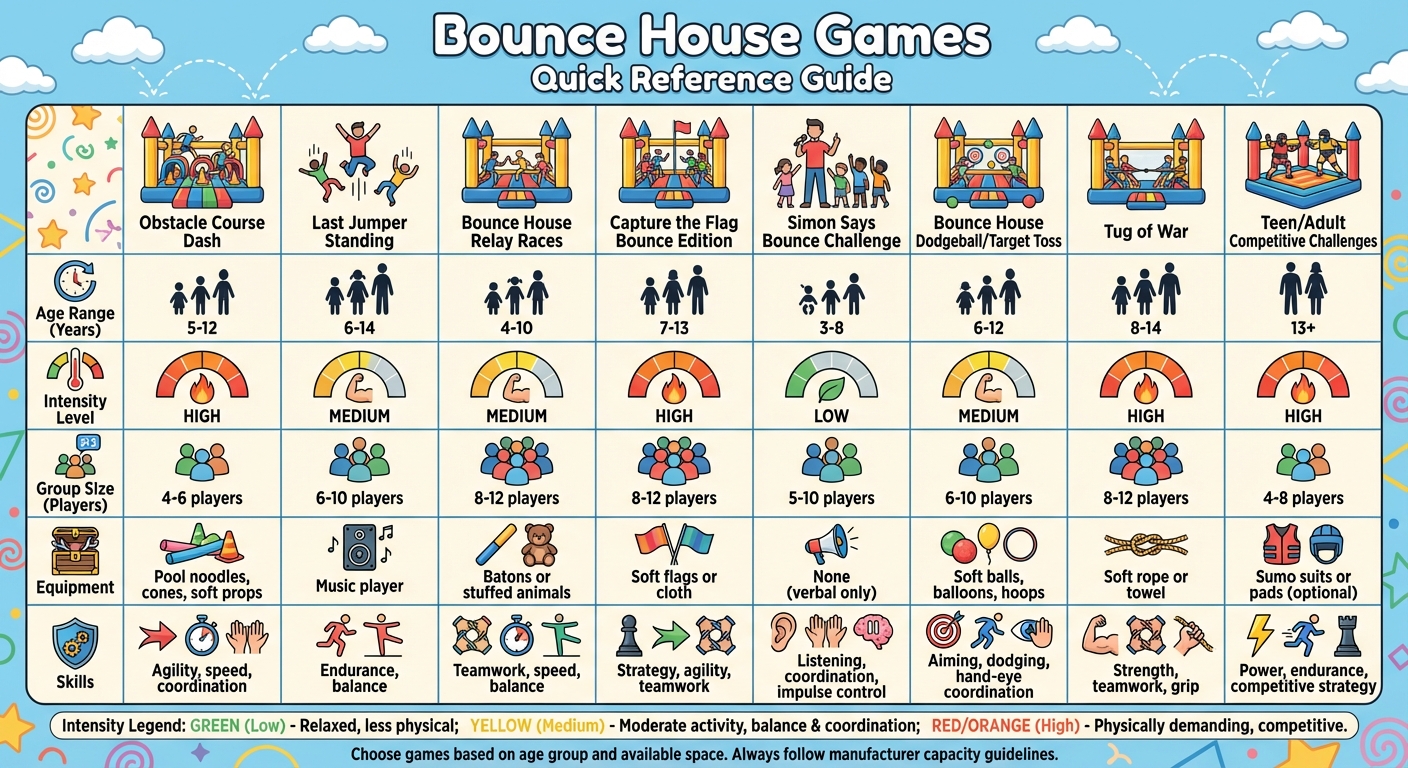
Bounce House Games Comparison Guide: Age, Intensity, and Skills
Here’s a handy table to help you compare games based on factors like age, intensity, group size, equipment, and the skills they involve. It’s a quick way to find the perfect activity for your event.
| Game | Age Range | Intensity Level | Group Size | Equipment Needed | Skills Involved |
|---|---|---|---|---|---|
| Obstacle Course Dash | 5–12 | High | 4–6 players | Pool noodles, cones, soft props | Agility, speed, coordination |
| Last Jumper Standing | 6–14 | Medium | 6–10 players | Music player (phone app works) | Endurance, balance |
| Bounce House Relay Races | 4–10 | Medium | 8–12 players | Batons or stuffed animals | Teamwork, speed, balance |
| Capture the Flag Bounce Edition | 7–13 | High | 8–12 players | Soft flags or cloth (t-shirts work) | Strategy, agility, teamwork |
| Simon Says Bounce Challenge | 3–8 | Low | 5–10 players | None (verbal only) | Listening, coordination, impulse control |
| Bounce House Dodgeball or Target Toss | 6–12 | Medium | 6–10 players | Soft balls, balloons, or hoop (beach balls) | Aiming, dodging, hand-eye coordination |
| Tug of War and Team Strength Challenges | 8–14 | High | 8–12 players | Soft rope or towel | Strength, teamwork, grip |
| Teen and Adult Competitive Challenges | 13+ | High | 4–8 players | Sumo suits or pads (optional, use pillows) | Power, endurance, competitive strategy |
For younger kids under 6, stick with low-intensity games like Simon Says Bounce Challenge to keep things safe and fun. Older kids and teens often enjoy high-energy options like Obstacle Course Dash or Tug of War, which let them burn off energy and show off their skills. Use this table to quickly match the right game to your group and keep the party flowing effortlessly!
Conclusion
Competitive bounce house games can turn any gathering – whether it’s a birthday party or a neighborhood block event – into an unforgettable, high-energy celebration. From fast-paced obstacle courses to team challenges like tug of war, there’s something for all ages and skill levels to enjoy.
The key to making the fun last? A mix of safety and structure. Choose games that suit the age group, enforce clear rules, and keep an eye on the action. Most activities require only simple supplies like cones, soft balls, plastic flags, or balloons – things you likely already have at home. When fun and safety come together, the result is a smooth, enjoyable event for everyone.
Bouncy Rentals USA takes the hassle out of planning by providing clean, insured bounce houses and inflatable obstacle courses. Their professional team handles delivery and setup, so you can focus on enjoying the festivities.
"The Bouncy Rentals USA bouncy castle delivered a lively, carefree experience. Our 7-year-olds spent hours jumping, sliding, and laughing – making our party truly memorable." – Jenna Cameron
Want to take your event to the next level? Pick your favorite games, choose a bounce house or obstacle course, and reach out to Bouncy Rentals USA. With the right setup and a well-thought-out plan, you’ll create a celebration packed with energy and memories that guests of all ages will treasure.
FAQs
What are the best ways to keep everyone safe during competitive games in a bounce house?
Before anyone jumps in, take a moment to check the bounce house for any signs of damage or wear. Supervision is key – keep an eye on participants and make sure the number of users stays within the recommended limits for their age and size. Ensure the bounce house is firmly secured on a flat, soft surface to prevent it from shifting or tipping over. Discourage roughhousing, flips, or any other risky moves that might result in injuries. And most importantly, stick to the manufacturer’s instructions to guarantee safe and proper use.
What are the best bounce house games for different age groups?
When it comes to bounce house games, kids aged 3-12 are usually the stars of the show. For the little ones (ages 3-5), simple activities like bounce tag or just carefree bouncing are a hit. Older kids (ages 6-12), on the other hand, often go for more energetic and competitive options like relay races or capture the flag.
But who says the fun stops there? Teens and adults can get in on the action too! Obstacle courses and interactive inflatables bring an extra layer of excitement and challenge to any gathering. Whatever the age, there’s a bounce house game that’s sure to keep everyone entertained.
What are some fun and competitive games to play in a bounce house at an event?
If you want to level up the fun with your bounce house games, mix in activities like relay races, obstacle courses, or tag challenges that make the most of the bouncy surface. Adding themed decorations, lively music, and small prizes can also set a festive tone and keep everyone involved. Want to take it even further? Combine the bounce house with other crowd-pleasers like a dunk tank or an inflatable slide to keep the energy up and your guests entertained for hours.
