
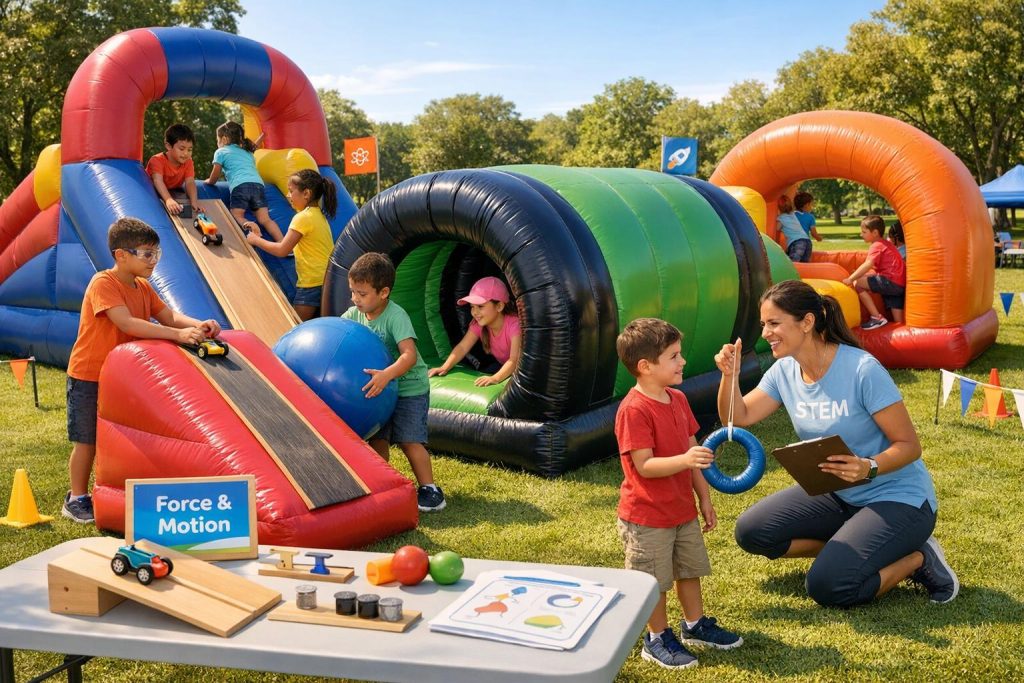
Inflatables can transform STEM education by turning abstract concepts into interactive, large-scale activities. They help students engage with physics, engineering, and spatial reasoning in ways that small-scale tools can’t match. For instance:
- Bounce houses (13×13–15×15 ft) demonstrate air pressure and aerodynamics.
- Obstacle courses (30×10–60×15 ft) teach velocity, friction, and momentum.
- Mazes (20×20 ft and up) sharpen spatial reasoning.
- Combo units combine climbing walls, slides, and platforms to explore stability and gravity.
Unlike smaller STEM tools like circuit kits or coding platforms, inflatables encourage physical activity and teamwork. While inflatables are great for events and require professional setup, smaller tools are better suited for everyday classroom use and individual learning.
Quick Comparison
| Feature | Inflatables (Bouncy Rentals) | Standard STEM Tools |
|---|---|---|
| Key Concepts | Physics, aerodynamics, engineering | Coding, chemistry, circuits |
| Engagement | High-energy, group activities | Focused, individual tasks |
| Setup | Professional delivery required | DIY, easy to manage |
| Space Needed | Large, open areas | Small workspaces |
| Cost | $150–$600/day + delivery fees | Budget-friendly materials |
| Weather Dependency | Requires good weather | Usable indoors year-round |
Inflatables are ideal for large events like STEM fairs, while traditional tools are better for regular lessons. Both have their place in creating hands-on, memorable STEM experiences.
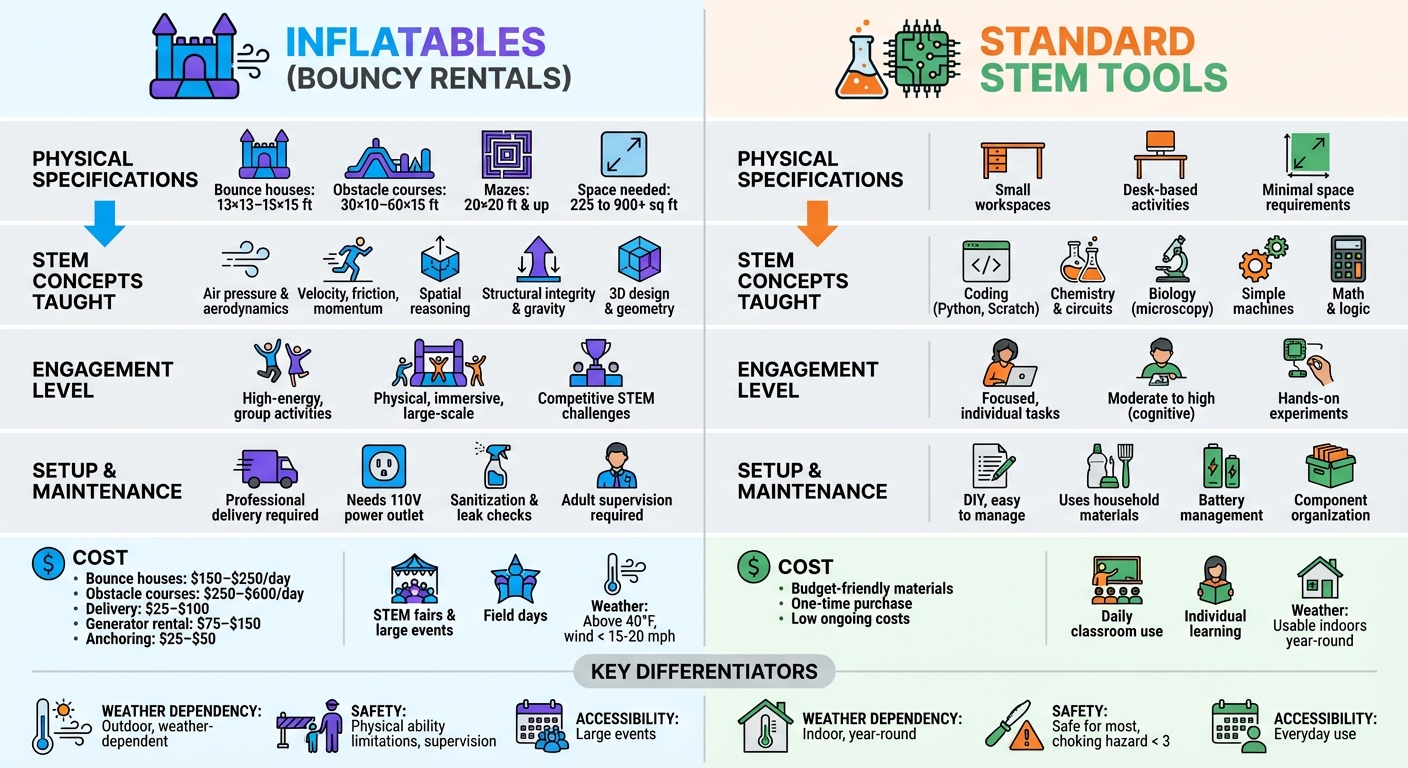
Inflatables vs Standard STEM Tools: Complete Comparison Guide
1. Bouncy Rentals Inflatables
STEM Concepts Taught
Bouncy Rentals inflatables turn physics and engineering into hands-on adventures. A standard bounce house (13×13–15×15 ft) demonstrates how air pressure works as a blower keeps the structure inflated. Obstacle courses, ranging from 30×10 to 60×15 ft, bring concepts like aerodynamics, friction, and speed into play as kids race through tunnels and climb over barriers. Inflatable mazes, starting at 20×20 ft, sharpen spatial reasoning as participants find their way through intricate pathways. Combo units, which combine slides, climbing walls, and multi-level platforms, highlight structural integrity and gravity in action.
These setups also connect directly to the 7-step engineering process – define, research, brainstorm, plan, prototype, test, and improve – by showcasing how structures maintain stability even with constant use. This hands-on approach makes classroom lessons feel more connected to real-world science. As David H. Cropley from the University of South Australia puts it:
"Creativity is the fundamental element of Engineering. Creativity is concerned with the generation of effective, novel solutions to problems".
With these inflatables, physical principles come to life through exciting, competitive STEM challenges.
Engagement Level
Physical activities like these make learning more immersive. Unlike small-scale models on a desk, inflatables encourage kids to use their whole bodies while exploring scientific ideas. Obstacle courses, in particular, create competitive STEM experiences for students as young as 5, making them a perfect fit for field days or STEM-themed events. The sheer size and vibrant design of these structures grab attention and keep students engaged from start to finish.
Setup and Maintenance
Bouncy Rentals takes care of everything – delivery, setup, safety checks, and takedown. Pricing varies: bounce houses rent for $150–$250 per day, obstacle courses for $250–$600 per day, with additional costs for delivery ($25–$100), generator rental ($75–$150), and specialized anchoring ($25–$50). By handling the logistics, Bouncy Rentals allows educators to focus on what matters most: creating an interactive and educational experience for students.
2. Standard STEM Tools
STEM Concepts Taught
Standard STEM tools are all about making science, technology, engineering, and math concepts approachable through smaller, hands-on experiments. Unlike large-scale inflatables, these tools focus on individual activities that teach core principles in a more accessible way. For instance, building with Legos or creating structures with marshmallows and toothpicks can illustrate engineering concepts like stability and weight distribution. In physics and chemistry, activities like "Cloud in a Jar" (showing the water cycle) or "Balloon Blow-up" (demonstrating chemical reactions) make abstract ideas tangible.
Math lessons often involve physical markers like sticky notes or bingo chips to help students connect numbers to real-world quantities. Games like "Math Bingo" add a fun, interactive layer to learning. Technology skills are introduced through coding platforms like Python or Scratch, and students can explore creativity through digital projects such as stop-motion animation. While these experiments might not have the same "wow" factor as inflatables, they are excellent for building foundational STEM knowledge.
Engagement Level
These tools are typically used in desk-based settings, focusing on activities like drawing star patterns or completing worksheets. While these methods are effective for teaching foundational concepts, they don’t offer the same level of physical engagement or excitement as larger, more dynamic setups. This can make it harder to capture the interest of older students and teens, who often respond better to more competitive or high-energy activities.
Setup and Maintenance
One of the biggest perks of standard STEM tools is how easy they are to set up and maintain. Unlike inflatables, which can be elaborate and time-consuming, these activities often use everyday household materials – think jars, ice, vinegar, paper, and markers. This makes them not only practical but also budget-friendly for both teachers and parents. Cleanup is straightforward, and the only ongoing task is restocking supplies, making these tools a convenient choice for regular use.
Pros and Cons
Let’s break down the key trade-offs between Bouncy Rentals inflatables and standard STEM tools, highlighting how each option shines and where they might fall short.
Inflatables provide a large-scale, hands-on experience that gets students actively engaged with concepts like physics, structural engineering, and spatial reasoning. They’re especially effective for teaching through movement and immersive challenges. On the other hand, standard STEM tools focus on smaller-scale, intricate concepts such as coding, circuitry, and chemistry. These tools are ideal for desk-based activities that can be used indoors all year round.
When it comes to engagement, inflatables stand out for their ability to turn abstract STEM ideas into high-energy, physical challenges – perfect for students who thrive on competition and activity. However, they require specific conditions: a large, open space (225 to 900+ square feet), access to a 110V outlet, and favorable weather (temperatures above 40°F and wind speeds below 15–20 mph). Standard STEM tools, by contrast, are far more flexible. They only need a small workspace and can be used daily without worrying about weather.
Safety and accessibility also vary. Standard STEM kits are generally safer in controlled, indoor environments, though small parts can pose choking hazards for children under 3. Inflatables, while fun, may not be suitable for every student due to physical ability limitations and require careful monitoring for safety. Setup is another factor: inflatables demand professional delivery, sanitization, and regular inspections, while standard STEM tools involve simpler DIY setups and basic maintenance like battery management and organizing components.
To make the decision easier, here’s a quick side-by-side comparison:
| Feature | Inflatables (Bouncy Rentals) | Standard STEM Tools |
|---|---|---|
| STEM Concepts Taught | Aerodynamics, structural integrity, 3D design, spatial reasoning, geometry | Circuitry, coding logic, biology (microscopy), simple machines, chemistry |
| Engagement Level | High (physical, immersive, large-scale) | Moderate to high (focused, hands-on, cognitive) |
| Safety & Accessibility | Requires adult supervision, anchoring, weather monitoring; limited by physical ability | Generally safe for indoor use; accessible to most students; small parts may be choking hazards |
| Setup & Maintenance | Professional setup; needs 110V power, large space, sanitization, and leak checks | DIY setup; small surface area; requires battery management and organization of parts |
While inflatables bring an exciting “wow” factor to events like STEM fairs or school carnivals, they come with logistical challenges. PVC, the material used in most inflatables, has a recycling category of 3, which means many curbside recycling programs don’t accept it. Meanwhile, standard STEM tools are easier to store and transport but may lack the same level of excitement for large-scale events. Both options have their place in an engaging STEM curriculum, depending on the setting and goals.
Conclusion
Inflatables add a whole new dimension to learning by combining physical activity with hands-on engagement – something traditional classroom tools can’t quite match. They take abstract STEM ideas, like aerodynamics, structural integrity, and spatial reasoning, and turn them into real-world, interactive experiences. By moving, exploring, and problem-solving, students can grasp complex concepts in a way that feels both natural and exciting.
That said, the key is knowing when and where to use them. For big events or lessons that require spatial visualization – like astronomy, geography, or engineering – these tools create a life-sized stage for learning that’s hard to replicate. Research even suggests that students in inquiry-driven, activity-rich science programs with writing components show notable improvement in writing proficiency exams.
For day-to-day classroom activities, though, traditional STEM tools are still the go-to. They’re perfect for focused topics like coding or circuitry, where precision matters more than scale. But when it’s time to shake things up or dive into concepts that thrive in larger-than-life settings, inflatables offer an unforgettable way to make lessons stick.
FAQs
How can inflatables make STEM learning more engaging and effective?
Inflatables take STEM learning to a whole new level by creating interactive, hands-on experiences that go beyond what worksheets or small models can offer. They allow students to dive into concepts like air pressure, structural integrity, and aerodynamics in a tangible way. For example, building inflatable structures or experimenting with airflow setups lets students see their ideas come to life. Watching a structure collapse or a ball zip through an airflow track provides instant feedback, sparking critical thinking and problem-solving.
What sets inflatables apart is their focus on active, kinesthetic learning. These activities get students moving, collaborating, and experimenting through trial and error. This makes STEM lessons not just easier to grasp but also far more engaging. Whether it’s for schools or community events, renting inflatables like bounce houses or obstacle courses is a simple way to introduce these lively, educational experiences without the hassle of extensive prep work.
What safety precautions should I follow when using inflatables for STEM activities?
When incorporating inflatables into STEM learning – whether you’re diving into physics topics like force and motion or tackling hands-on problem-solving – safety should always be the top priority. Begin by thoroughly inspecting the inflatable for any signs of wear or damage. Check that the blower is functioning properly and confirm the inflatable is securely anchored following the manufacturer’s guidelines. Avoid setting it up in windy conditions or on uneven ground, and ensure there’s plenty of space away from obstacles like rocks, trees, or low ceilings.
During activities, assign a trained adult to supervise at all times. Stick to the inflatable’s weight and capacity limits, and enforce clear rules for participants: no shoes, sharp objects, roughhousing, or flips inside the unit. Use clean, fully insured equipment from a reliable provider like Bouncy Rentals. To make safety part of the learning process, tie the rules to STEM concepts – for example, discussing how friction or gravity affects the inflatable’s performance. A quick safety briefing before starting can go a long way in keeping everyone safe while making the experience both fun and educational.
Can inflatables be used to teach STEM concepts to all age groups?
Inflatables offer a creative way to teach STEM concepts to learners of various ages, from young children to high schoolers. For younger kids, simple inflatable designs – like small bounce houses or air-filled tubes – can help introduce basic ideas such as shapes, balance, and spatial awareness in an interactive and safe environment.
As students get older, more advanced inflatables, such as obstacle courses or pressure-controlled chambers, can provide hands-on opportunities to explore topics like physics, engineering, and even data collection. These activities can be adjusted to fit the developmental stage of the participants, making inflatables a flexible and engaging tool for STEM education throughout K–12 classrooms.
