
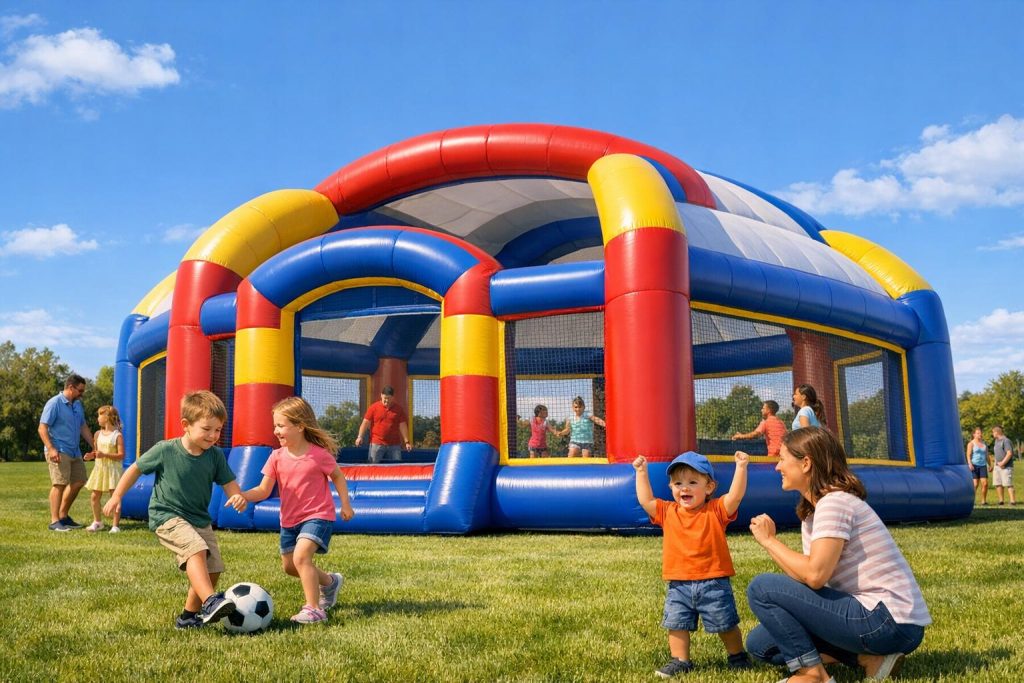
Inflatable sports arenas are large, air-filled structures designed for fun activities like bouncing, games, and sports. They are made from durable materials like PVC tarpaulin and require continuous airflow from a blower to stay inflated. These arenas are popular for events like birthdays, school functions, and corporate gatherings due to their ease of setup and versatility. Here’s what you need to know:
- Setup Time: Inflation takes 2–5 minutes, with full setup completed in 10–30 minutes.
- Materials: Commonly made from fire-retardant, mildew-resistant PVC tarpaulin.
- Safety: Includes features like finger-safe netting, emergency exits, and strict weight/capacity limits.
- Power Requirements: Operates on a standard 110-volt outlet; a generator may be needed for outdoor setups.
- Maintenance: Requires regular cleaning and inspection to ensure longevity and safety.
- Weather Considerations: Avoid use in winds above 20 mph, rain, or temperatures below 40°F.
Companies like Bouncy Rentals USA handle delivery, setup, and safety checks, offering a hassle-free experience. They also provide cleaning services and custom rental packages, making inflatable arenas a convenient option for any event.
Setting Up an Inflatable Sports Arena
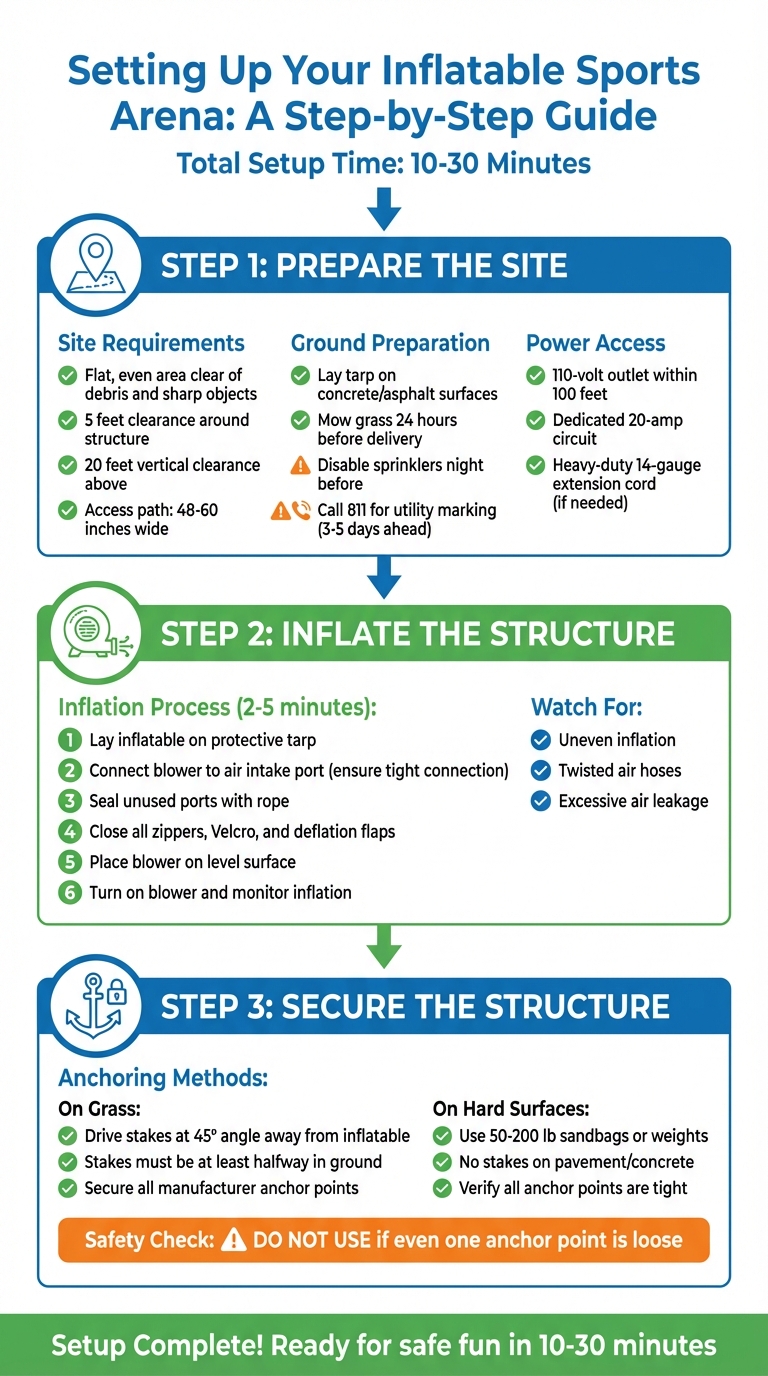
Complete Setup Guide for Inflatable Sports Arenas in 3 Steps
Preparing the Site
Start by choosing a flat, even area clear of debris, sharp objects, branches, or animal waste. If you’re setting up on concrete or asphalt, lay down a tarp to protect the inflatable from scuffs or punctures. Ensure there’s at least 5 feet of clearance around the structure and 20 feet of vertical space above it.
Make sure there’s an accessible path to the setup location. Most standard units require a path at least 48 inches wide, while larger arenas may need up to 60 inches.
If you’re using stakes to anchor the inflatable, call 811 (Call Before You Dig) at least 3–5 business days ahead of time to mark any underground utility lines. If the site has grass, mow it at least 24 hours before delivery to avoid wet clippings sticking to the inflatable, and disable any sprinklers the night before to keep the ground dry.
You’ll also need access to a standard 110-volt household outlet within 100 feet of the setup area. Ideally, use a dedicated 20-amp circuit for each blower. If an extension cord is necessary, opt for a heavy-duty 14-gauge cord that’s no longer than 100 feet to avoid damaging the motor.
Once the site is ready, you can move on to inflating and securing the inflatable.
Inflating and Securing the Structure
Lay the inflatable on the tarp to protect its underside, then connect the blower to the air intake port. Ensure the connection is tight to prevent air leaks. If there are multiple air intake ports, seal any unused ones securely with rope to maintain proper air pressure.
Before turning on the blower, close all zippers, Velcro openings, and deflation flaps. Place the blower on a level surface for safe operation. Most inflatables will fully inflate in about 2 to 5 minutes, but keep an eye out for any uneven inflation, twisted air hoses, or excessive air leakage during the process.
Once inflated, secure all anchor points provided by the manufacturer. If even one is loose, do not use the inflatable. For grass setups, drive stakes into the ground at a 45-degree angle away from the inflatable, ensuring they’re at least halfway in for stability. On hard surfaces like pavement, use sandbags or weights instead of stakes.
With these steps, setting up an inflatable sports arena typically takes between 10 and 30 minutes, making it a quick and efficient process.
Maintaining Your Inflatable Sports Arena
Regular Inspections
Before and after each use, take a few minutes to inspect your inflatable. Pay close attention to seams, stitching, anchor points, and straps, checking for any signs of punctures, tears, or looseness. It’s also important to test the blower’s performance and look for small holes in the fabric. A quick pre-use checklist can go a long way in preventing accidents. Once a month, schedule a more thorough cleaning and inspection to catch minor issues that might not be obvious during daily checks. Additionally, arrange for a professional inspection annually to ensure your inflatable aligns with safety standards. After inspections, give the arena a full cleaning to keep it in top condition.
"Regular maintenance isn’t just about keeping your bounce house clean – it’s about ensuring the safety of children and protecting your investment." – Henry, Safety in Inflatable Amusement Alliance
Cleaning and Sanitizing
Start by removing debris with a shop vacuum or a soft broom. For spot cleaning, mix a solution of 1 part vinegar to 3 parts water, avoiding bleach or harsh chemicals that could damage the material. Use warm, soapy water and a soft brush or cloth to scrub all surfaces, then finish with an EPA-approved, non-bleach disinfectant. Make sure the inflatable is completely dry before storing it to prevent mold and extend its lifespan. With proper care, commercial-grade inflatables can last 5–7 years, while high-quality PVC units can often last over a decade.
Safety Guidelines for Inflatable Sports Arenas
Participant Limits and Supervision
Before setting up an inflatable sports arena, check the manufacturer’s specifications for weight and capacity limits. For example, a standard 13′ x 13′ inflatable is typically designed to hold up to 800 pounds. To minimize the risk of injuries, group participants by age and size, keeping adults and children in separate sessions. Always have at least one responsible adult supervising the inflatable to ensure rules are followed and capacity limits are not exceeded. For larger setups like obstacle courses, consider assigning additional supervisors to monitor different sections effectively.
Participants should remove shoes, eyeglasses, jewelry, and any sharp objects before entering. Rough play, such as wrestling, flipping, or piling on others, should be strictly prohibited. Enforce a one-at-a-time rule for slides to avoid mid-air collisions. Additionally, keep participants clear of entrance and exit areas and restrict use for individuals who are pregnant or have back, neck, or joint issues. To further ensure safety, monitor weather conditions closely throughout the event.
Weather Precautions
Wind poses one of the greatest risks to inflatable safety. Most manufacturers recommend a maximum wind limit of 20 mph, while ASTM standards warn against use in winds exceeding 25 mph. To get accurate wind readings, use an anemometer at the event site instead of relying solely on general weather forecasts. Signs like swaying treetops or moving small branches can indicate unsafe conditions.
"If a bounce house is not properly secured to the ground, a gust of wind can send it airborne with children inside and the result can be tragic. If the tops of the trees are swaying, it may be too windy to let your child play inside of a bounce house."
– Ann Marie Buerkle, Acting Chairman, U.S. Consumer Product Safety Commission (CPSC)
If winds exceed safe limits or lightning is detected, evacuate all participants immediately and deflate the inflatable. Leave the anchors in place during deflation to prevent the structure from being carried off by the wind. Rain creates slip hazards and increases the risk of electrical issues, so pause use until the inflatable is completely dry. Additionally, avoid setting up the inflatable if temperatures drop below 40°F, as the material may lose its ability to maintain proper pressure.
Rental Policies at Bouncy Rentals USA
Delivery and Setup Services
At Bouncy Rentals USA, we take care of all the logistics so you can focus on enjoying your event. Our delivery team arrives between 30 minutes and 3 hours before your event starts to handle the setup, ensuring everything is ready to go on time. After your event wraps up, please allow up to 3 hours for our crew to return and pack everything up. Delivery is free within a 20-mile radius, but locations beyond that distance include a $25 fee. For outdoor venues without electricity, a generator is available for $75 per day. To secure your reservation, a $30 non-refundable deposit is required; however, this deposit will be refunded if you cancel due to weather conditions like rain or high winds. Our team follows strict manufacturer guidelines during setup, using 50–200 lb sandbags for stability on hard surfaces.
Cleaning and Safety Standards
Every inflatable sports arena undergoes a thorough cleaning, disinfection, and sanitization process between rentals. This ensures a fresh and safe experience for all users while minimizing health risks. Additionally, all rental units are crafted from 100% lead-free vinyl, so you don’t have to worry about harmful materials.
"Safety is not an option, it’s a REQUIREMENT, and the safety of your children is our #1 priority." – Bouncy Rentals USA
These high standards are just one part of what makes our rental services dependable and family-friendly.
Custom Rental Packages
We offer flexible packages to fit any occasion, whether it’s a school carnival, a corporate event, or a backyard party. You can mix and match inflatable sports arenas with other fun equipment like popcorn machines, cotton candy makers, snow cone machines, or even dunk tanks to create a complete entertainment setup. For reference, standard bounce houses need a level area of about 15′ x 20′, while combo units and slides require at least 20′ x 20′. Our team will work with you to select the right equipment to match your event’s space and energy.
Space and Equipment Requirements
Space Requirements
Inflatable sports arenas need more room than their actual size. You’ll need at least 5 feet of clearance on all sides, an extra 10 feet in front for safe entry and exit, and 15–20 feet of vertical space free from any obstructions. Make sure to measure the entire "cubed space" of your setup area, ensuring nothing hangs below the required height within that footprint.
Here’s a quick reference table showing typical footprints and the minimum setup areas required for various inflatables:
| Inflatable Type | Typical Footprint | Minimum Setup Area Needed |
|---|---|---|
| Standard Bounce House | 13′ x 13′ to 15′ x 15′ | 20′ x 20′ to 25′ x 25′ |
| Obstacle Course | 30′ x 10′ to 60′ x 15′ | 40′ x 20′ to 70′ x 25′ |
| Inflatable Maze | 20′ x 20’+ | 30′ x 30’+ |
| Combo Unit | 20′ x 15′ to 30′ x 20′ | 30′ x 25′ to 40′ x 30′ |
The ground must be flat and level. Grass works best since it allows for secure staking, but if you’re working with concrete or asphalt, sandbags will be necessary for proper anchoring. Avoid surfaces like gravel, mulch, sand, or steep slopes, as they can damage the inflatable or create unsafe conditions.
If you’re setting up on grass and plan to stake the inflatable, don’t forget to call 811 at least 3 to 5 business days before your event to have underground utilities marked. Also, ensure there’s a clear, flat path for the delivery crew – 48 inches wide for standard units and up to 60 inches wide for larger obstacle courses.
Once you’ve got the space sorted, it’s time to double-check the power setup to keep everything running smoothly.
Power Supply Needs
Inflatables run on a standard 110-volt outlet located within 50 to 100 feet of the setup area to avoid voltage drops. To ensure everything runs smoothly, connect the blower to a dedicated 20-amp circuit that isn’t shared with heavy-duty appliances like refrigerators or air conditioners. This reduces the risk of tripping breakers.
"The outlet must be dedicated to the inflatable without other devices on the same outlet due to possible breaker flips." – The Caswell Bounce House
Most rental companies provide their own GFCI (Ground Fault Circuit Interrupter) cords and discourage using personal extension cords, as they can lead to fire hazards or power failures. If your event is in a park or remote location without easy access to electricity, renting a portable generator is a great option. Companies like Bouncy Rentals USA offer generators for such outdoor venues.
Interestingly, inflatable blowers are pretty energy-efficient – they use less power than a standard handheld hair dryer, so you don’t have to worry about a big jump in your electric bill.
Conclusion
Inflatable sports arenas pack a punch when it comes to delivering endless fun while prioritizing safety and simplicity. By focusing on essentials like proper site preparation, reliable power sources, regular upkeep, and weather awareness, you can ensure that your rental experience goes off without a hitch. These steps underscore the importance of safety and convenience mentioned earlier.
At Bouncy Rentals USA, we take these principles to heart. Our team provides sanitized, insured equipment delivered right to your doorstep – perfect for backyard birthday parties, school carnivals, or neighborhood block parties. With custom rental packages designed to fit your needs, we handle the setup with care, so you can focus on enjoying the event. Features like finger-safe mesh windows and dedicated power circuits mean you can relax and let the fun take center stage.
FAQs
What safety measures are in place for inflatable sports arenas?
Safety should always come first when using inflatable sports arenas. To keep everyone protected, make sure a trained adult is always present to supervise the activity. Place the inflatable on a flat, clean surface, free of debris, and secure it properly with anchors. The blower must remain on at all times to maintain proper inflation. Before entering, participants should take off their shoes, jewelry, and any sharp items to avoid accidents. Activities like roughhousing, flips, or wrestling should be strictly off-limits. Keep an eye on the capacity limits, and if bad weather rolls in or the inflatable begins to lose air, stop use immediately. These steps help ensure a safe and enjoyable experience for everyone involved.
What kind of power source is needed for an inflatable sports arena?
To set up an inflatable sports arena, you’ll need a dedicated 20-amp circuit. For smaller setups using a 1-HP blower, a 15-amp circuit will work. The power source should be located within 50 feet of the arena. For optimal performance, use a 12- to 14-gauge extension cord that is no longer than 50 feet.
If there’s no outlet nearby, a 2 kW generator or larger can provide the required power. Just double-check that your equipment is compatible with the generator to ensure everything runs safely and smoothly.
What weather conditions make it unsafe to use inflatable sports arenas?
Inflatable sports arenas are not safe to use during high winds (over 20 mph), heavy rain, thunderstorms with lightning, or snowfall. Additionally, extreme temperatures – whether scorching hot or freezing cold – can compromise both the safety and the durability of the structure. Always put safety first and adhere to any weather-specific instructions from the rental company.
