

Modern inflatables are safer, sturdier, and easier to use than older models. With stronger materials, advanced safety features, and smart technology, they reduce injury risks by 80% and last up to 10+ years. Key improvements include:
- Durable Materials: 15–18 oz vinyl resists tears, UV damage, and extends lifespan.
- Enhanced Safety: Emergency deflation systems, reinforced seams, and impact-absorbing surfaces.
- User-Friendly Features: Automated pressure adjustments, quick setup, and designs for all age groups.
These upgrades make inflatables reliable for events, such as inflatable obstacle courses, whether for kids, adults, or mixed groups. Rental businesses benefit from lower maintenance and higher returns, while families enjoy safer fun.
| Feature | Older Models | Modern Models |
|---|---|---|
| Material Quality | 8–12 oz vinyl | 15–18 oz vinyl, UV-resistant |
| Safety Features | Basic netting | Advanced systems, fire-retardant materials |
| Lifespan | 1–2 years | 5–10+ years |
| Setup and Maintenance | Time-consuming | Quick-connect valves, mold-resistant |
These advancements ensure inflatables are durable, safer, and easier to manage, making them a better choice for families and event planners alike.
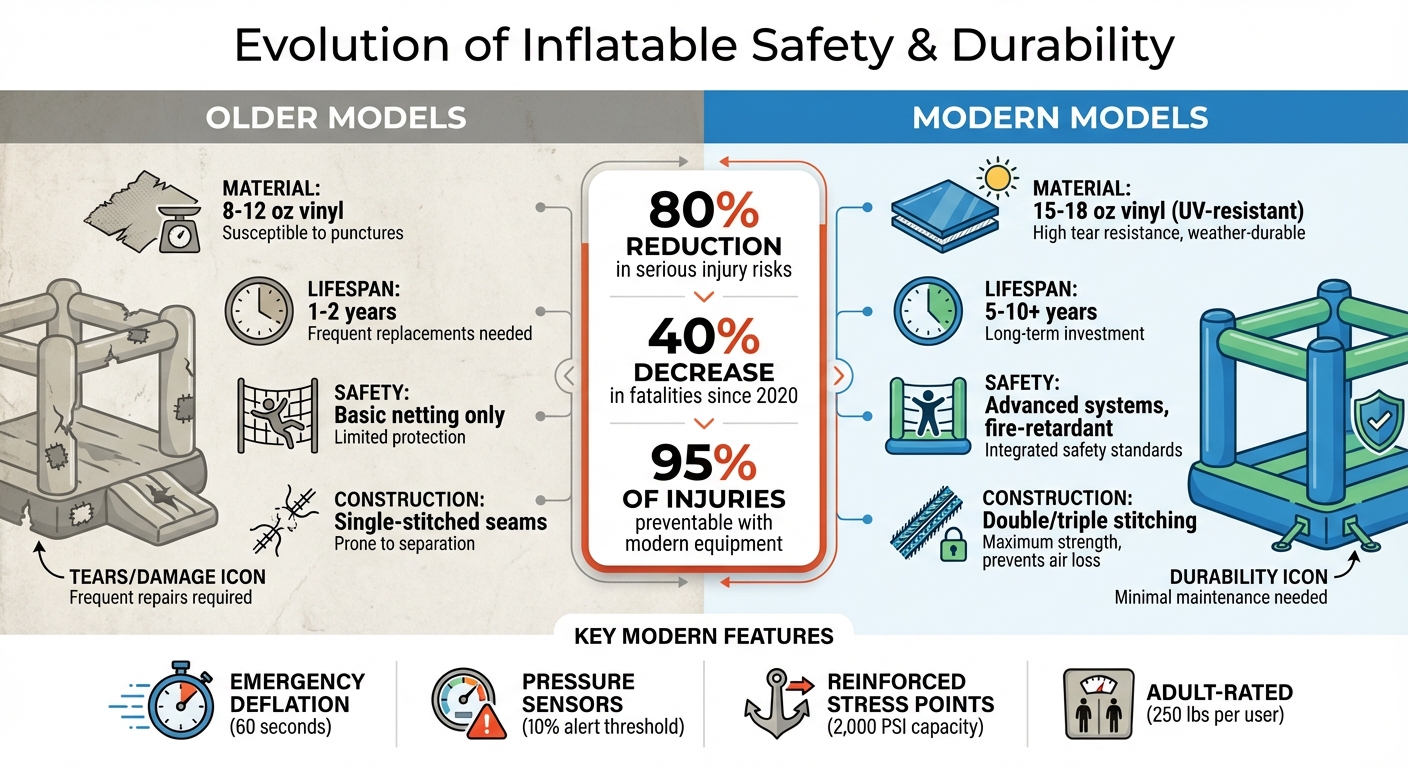
Modern vs Older Inflatable Designs: Safety and Durability Comparison
Problems with Older Inflatable Designs
Older inflatables came with a host of issues that raised concerns about safety, durability, and overall usability. Below, we break down the main challenges related to material quality, construction flaws, and limited user inclusivity.
Fragile Materials Prone to Damage
The fabrics and seams used in older inflatables were far from reliable. Thin materials combined with single-stitched seams made these units vulnerable to tears and punctures, often requiring constant repairs. To make matters worse, the manufacturing techniques of the time lacked precision. Without tools like computer-guided cutting, weak spots were inadvertently built into the designs, leading to frequent failures during use. Operators found themselves spending more time patching up damaged inflatables than actually running their businesses. In fact, the lifespan of these older units was significantly shorter than what we see today.
"Quality isn’t just about using the best materials – it’s about precision in every step of the manufacturing process." – Bounce Horizon Manufacturing Team
Safety Hazards from Poor Design
Beyond material issues, older inflatables posed serious safety risks due to flawed construction. One glaring problem was the lack of effective anchoring systems. This left inflatables vulnerable to wind gusts, which could overturn or even lift them off the ground – with children still inside. Between 2003 and 2013, the U.S. Consumer Product Safety Commission (CPSC) recorded 12 fatalities linked to inflatables, often due to improper anchoring. In 2018, hospital emergency departments treated over 18,000 injuries related to bounce houses, highlighting the ongoing dangers.
Another issue was the absence of proper impact-absorbing materials at entry and exit points, making falls more hazardous. Additionally, structural weaknesses meant that a single puncture or seam failure could lead to a sudden, catastrophic deflation.
"If a bounce house is not properly secured to the ground, a gust of wind can send it airborne with children inside and the result can be tragic." – Ann Marie Buerkle, Acting Chairman, CPSC
Limited Appeal for Mixed Age Groups
Older inflatables also fell short when it came to accommodating a variety of users. Early designs were simple bounce structures, offering little more than a jumping surface. They lacked the interactive features – like climbing walls, slides, or obstacle courses – that could engage older children or even adults. These limitations made them suitable only for small children, primarily at birthday parties, while excluding opportunities for broader use, such as corporate events or fitness activities.
Safety rules for these early models further restricted their appeal. Adults and children couldn’t use the equipment at the same time due to the risks posed by "unevenly matched users". Compounding the problem, the heavy materials used, like PVC and Hypalon, degraded quickly under UV exposure and couldn’t handle the weight of older or heavier participants. This lack of versatility limited their use to very specific scenarios, leaving little room for broader applications like festivals or team-building events.
These shortcomings underscore just how far inflatable designs have come, with modern advancements addressing many of these past issues.
How Updated Designs Fix These Problems
Modern inflatables have come a long way, addressing the flaws of older models through better engineering, advanced materials, and improved safety systems. These updates tackle past issues like weak materials, safety risks, and limited usability. As a result, today’s inflatables are more reliable for rental businesses and safer for guests, whether it’s a backyard birthday party or a large corporate event. Let’s dive into how these innovations improve durability, safety, versatility, and ease of use.
Stronger Materials That Last Longer
Today’s inflatables are built with durability in mind, using 15–18 oz vinyl per square yard – far sturdier than the 8–12 oz vinyl of older models. This heavier PVC resists tears and punctures, extending the lifespan of inflatables from just 1–2 seasons to 5–10+ years with proper care. UV-resistant coatings now protect against sun damage while keeping the material flexible, even after years of outdoor use. With the help of CAD software, manufacturers identify stress points, reinforcing them with double-stitched seams and patches in high-impact areas.
The difference is clear: a residential bounce house might cost $800 and last about two years, while a commercial-grade unit costs around $2,500 but can provide over eight years of service. For rental businesses, this means fewer repairs, less downtime, and a better return on investment.
Better Safety Features Built In
Stronger materials have paved the way for enhanced safety features. Modern inflatables now include quadruple-reinforced stress points that can handle up to 2,000 pounds per square inch. Integrated sensors monitor air pressure and alert operators to changes beyond 10%, while emergency deflation systems can collapse a unit within 60 seconds if needed. Quick-release anchor systems allow for rapid adjustments during sudden weather changes. Entry and exit areas now feature impact-absorbing materials and anti-slip surfaces, while "finger-safe" mesh netting prevents small-digit entrapment. Additionally, all materials meet CPAI-84 fire-retardant standards.
"Modern units incorporate reinforced construction, safety netting, and emergency systems that reduce serious injury risks by 80% compared to older equipment." – MagicJump Inc.
Since 2020, bounce house-related deaths have dropped by 40%, thanks to these advancements. Comprehensive safety protocols can further reduce incident rates by up to 80% – a significant improvement for both operators and users.
Features That Work for Different Age Groups
Unlike the simple bounce houses of the past, today’s inflatables cater to all ages. Modular obstacle courses, interactive floors, and climbing walls keep kids, teens, and adults engaged. Adult-rated units now support up to 250 pounds per user, making them ideal for team-building events and fitness activities. For toddlers, specialized units feature lower walls (under 4 feet), padded flooring, and parent viewing windows for safe supervision. Combo units use barriers and time-rotation systems to separate age groups, reducing collision risks – a factor behind 65% of injuries when mixed-age groups share equipment.
This adaptability makes inflatables suitable for a variety of events, from school carnivals and fundraisers to neighborhood parties and adult gatherings.
Easier Setup and Upkeep
Modern designs also make inflatables easier to set up and maintain. Quick-connect valves, modular components, and low-noise blowers (under 70 decibels) simplify setup, making them more suitable for indoor events. Solar-powered monitoring systems and automatic rain sensors reduce the need for constant supervision. Manufacturers now use lead-free, flame-retardant materials that meet ASTM F2374 standards, ensuring safer use and easier compliance with local regulations. Additionally, units are designed to dry completely before storage, preventing mold growth that plagued older models.
These updates save time and labor. Tasks that once required several workers can now be handled by smaller crews, reducing costs and allowing businesses to handle more events in a single day. At Bouncy Rentals USA, we’re proud to offer equipment with these modern features, ensuring every event is safe, fun, and memorable for all ages.
Old vs. New Inflatable Designs
When comparing older inflatables to modern ones, the differences are striking. Over the years, advancements in materials, construction, and safety have transformed these products into more reliable and longer-lasting options. For rental operators and event planners, understanding these changes sheds light on why modern inflatables are a smarter investment.
Comparison Table
The table below highlights the key distinctions between older residential inflatables and today’s commercial-grade designs:
| Feature | Older / Residential Designs | Modern / Commercial Designs |
|---|---|---|
| Primary Material | 8–12 oz material | 15–18 oz high-quality vinyl |
| Seam Construction | Single stitching | Double/triple stitching; heat-welded seams |
| Lifespan | 1–2 seasons | 5–10+ years |
| Safety Features | Minimal; basic netting | Lead-free, fire-retardant, finger-safe netting, non-slip surfaces |
| UV Resistance | Low; colors fade and material weakens | High; UV-proof colors and coatings |
| Anchoring | Basic stakes | Advanced anchoring systems meeting updated ASTM standards |
| Design Method | Manual patterns and hand-cutting | CAD digital modeling and automated CNC cutting |
| Exit Safety | Lacks exit padding | Impact attenuation materials at entrance/exit |
| Maintenance | Difficult to dry; prone to mold | Quick-drain systems and fade-resistant digital printing |
"The difference between a $800 backyard model and a $3,000 commercial inflatable isn’t just price – it’s how many kids can safely use it and how many seasons it will last." – JumpOrange Marketing Team
For example, a residential bounce house priced at around $800 might only last two seasons, while a commercial-grade inflatable, costing roughly $2,500, can provide dependable performance for more than eight years. This durability, combined with enhanced safety features like non-slip surfaces and advanced anchoring systems, makes modern inflatables a superior choice. In short, they offer better long-term value, greater reliability, and peace of mind for users.
Conclusion
Inflatable designs have come a long way, transforming party equipment into safer, more durable, and guest-friendly systems. The use of 18 oz commercial-grade vinyl, reinforced stitching, and advanced safety features has made these units more reliable while prioritizing participant safety. Emergency deflation systems, capable of collapsing a unit within 60 seconds, add another layer of protection.
These improvements have had a real impact. Statistics show that 95% of inflatable-related injuries can be avoided with proper safety measures and modern equipment standards. Since 2020, bounce house-related fatalities have declined by 40%.
"Professional installation isn’t just a recommendation – it’s a crucial safety requirement that can prevent 90% of bounce house accidents".
Designs tailored to different age groups also enhance safety. Toddler-friendly bounce houses feature padded floors and lower walls, while adult-rated units are built to support heavier participants securely.
If you’re looking to experience these advancements, Bouncy Rentals USA offers a wide selection of equipment that meets top safety standards. From bounce houses and obstacle courses to water slides and party extras like cotton candy machines and dunk tanks, their team takes care of delivery, setup, and takedown. This means you can relax and enjoy the event. Check out their offerings at Bouncy Rentals USA for your next birthday party, school event, or backyard celebration.
FAQs
What materials make modern inflatables more durable and safe?
Modern inflatables are made from commercial-grade vinyl, which usually weighs about 17 ounces. This material is tough, waterproof, and built to meet strict safety requirements. Its thickness helps reduce wear and tear, making it last longer even with regular use.
The vinyl also has a smooth, non-porous surface, making cleaning and sanitizing straightforward. This adds an extra layer of safety and hygiene for users. These features make inflatables more dependable and ideal for energetic events.
How do modern inflatable designs make them safer and more user-friendly?
Modern inflatables are built with advanced safety features and user-friendly designs to offer a fun and stress-free experience for everyone. For instance, reinforced anchor points help keep inflatables stable, even in windy conditions, while emergency deflation systems enable quick responses in unexpected situations. On top of that, impact-absorbing materials are used to lower the chances of injuries from falls, and many inflatables now include weather-resistant designs to perform better in changing conditions.
These upgrades not only reduce potential risks but also simplify setup and operation, making life easier for event planners and more enjoyable for guests. From bounce houses to water slides, these features enhance both safety and fun for people of all ages.
What makes modern inflatables safer and more enjoyable for everyone?
Modern inflatables come packed with improved safety and user-friendly features, making them suitable for people of all ages. They now include tougher materials, secure anchoring systems, and padded entry and exit points to help reduce the risk of injuries. Plus, many inflatables are designed for multiple activities – like bouncing, climbing, and sliding – so both kids and adults can join in the fun.
With updated safety standards and smarter designs, inflatables are built to handle large groups and high-energy events without compromising stability or durability. Whether it’s a kid’s birthday bash or a community get-together, these advancements make for a safer, more enjoyable experience for everyone involved.
