
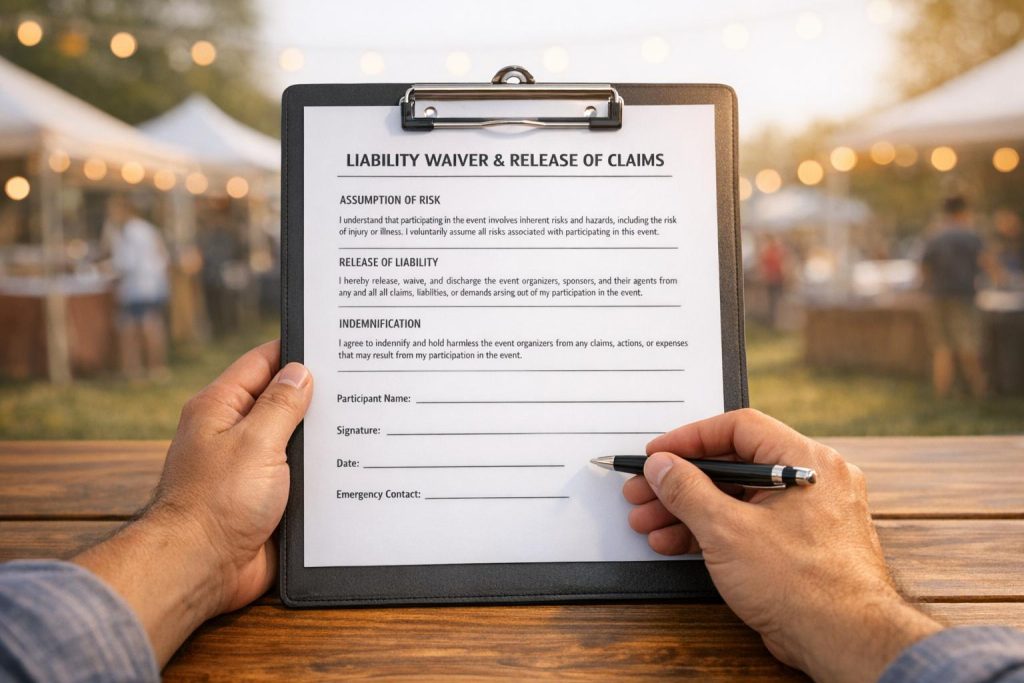
Liability waivers are legal documents that protect event organizers from certain injury or damage claims. In South Carolina, these waivers are essential for reducing financial risks and setting clear expectations for participants. However, they must meet specific legal standards to be enforceable. Key points include:
- Clear Language: Waivers must use simple, explicit terms, clearly stating that negligence is covered.
- Voluntary Agreement: Participants must sign willingly, without pressure or coercion.
- Assumption of Risk: Waivers should outline specific risks tied to the activity.
- Limitations: Waivers cannot excuse gross negligence, intentional misconduct, or violations of public policy.
South Carolina courts enforce waivers on a case-by-case basis, focusing on fairness and clarity. To strengthen legal protection, organizers should combine waivers with liability insurance and ensure compliance with state laws. For minors, parental consent is critical, though its enforceability in South Carolina remains debated. Properly crafted waivers, paired with insured vendors, reduce liability while ensuring safety for all parties involved.
What Makes a Liability Waiver Enforceable in South Carolina
In South Carolina, courts take a close look at liability waivers, interpreting them strictly against the party seeking protection. To ensure your waiver holds up in court, it must meet specific legal standards that demonstrate both parties fully understood and agreed to the terms. These standards are essential for creating a waiver that not only informs participants but also provides legal protection for your event.
Clear and Simple Language
A waiver should be written in straightforward, easy-to-understand language. Avoid using complicated legal terms that might confuse participants about the rights they’re giving up. South Carolina courts prioritize common sense and fairness when interpreting contracts, ensuring they don’t lead to unreasonable outcomes. The waiver must clearly state that participants are releasing you from liability, even for your own negligence. Generic templates won’t cut it – your waiver needs to be customized for your specific event. It should outline each party’s responsibilities, safety rules, and the risks involved.
Voluntary Agreement
The waiver must be signed willingly, a principle firmly supported by South Carolina law. Liability waivers, considered "exculpatory contracts", must be entered into fairly, with both parties having equal bargaining power. Participants should never feel rushed or pressured to sign. Attorney Chun T. Wright emphasizes the importance of avoiding claims of coercion:
What you’re trying to avoid is having a traveler tell a court that they signed the waiver ‘under duress.’ If you leave them no time to read it before the experience starts, and they have to sign it before they can participate, that leaves them some wiggle room (legally speaking) to make the ‘under duress’ claim.
To prevent such issues, give participants plenty of time to review the waiver – digital options can make this easier. Keep the waiver as a separate document rather than embedding it in general terms and conditions, as courts often disapprove of hidden clauses. Also, ensure that all signers are legally capable of entering into a contract. Note that South Carolina courts are divided on whether parental waivers for minors are enforceable.
Explicit Assumption of Risk
Your waiver should clearly outline the risks participants are accepting. Be specific about potential hazards. For example, skating waivers often list risks like falls or collisions. Apply the same level of detail to your event. For inflatable activities, mention risks such as falls, collisions, or improper use. Avoid overly broad language that courts might reject as being against public policy. Additionally, include the safety rules participants must follow, and make sure the waiver is signed, dated, and stored properly for each event.
When Liability Waivers Don’t Hold Up in South Carolina Courts
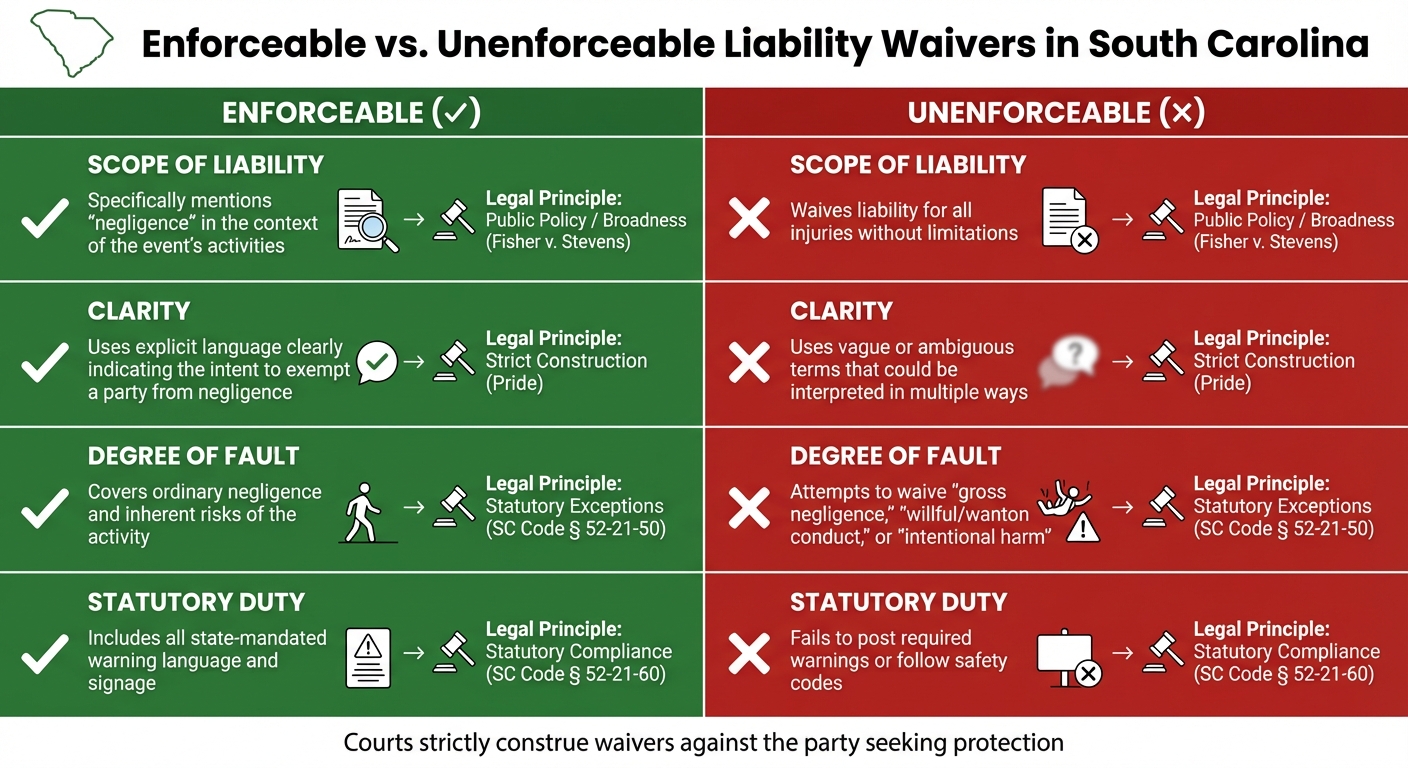
Enforceable vs Unenforceable Liability Waivers in South Carolina
In South Carolina, the law sets strict boundaries on liability waivers, particularly when they aim to excuse parties from fundamental safety responsibilities. Courts are generally skeptical of exculpatory contracts. As one pivotal case explained, "Since such provisions tend to induce a want of care, they are not favored by the law and will be strictly construed against the party relying thereon". Below, we break down key issues like overly broad terms and unclear language that can render waivers unenforceable.
Gross Negligence and Public Policy Exceptions
Even with clear wording and voluntary agreement, waivers cannot override core safety duties. For example, gross negligence – deliberate neglect of a critical safety measure – cannot be excused, as public safety takes precedence over contractual agreements. While waivers can cover ordinary negligence, gross negligence crosses a line that courts refuse to ignore. A notable case, McCune v. Myrtle Beach Indoor Shooting Range, Inc. (1998), illustrates this. In that case, Christine McCune lost sight in one eye during a paintball game when her mask, which didn’t fit properly, snagged on a tree branch. The court upheld the waiver she had signed because the incident involved only ordinary negligence.
Similarly, waivers cannot excuse willful misconduct or intentional harm, as these violate public policy and invalidate the agreement. Certain legal obligations also cannot be waived. For instance, under South Carolina Code § 52-21-60, if a skating rink operator neglects to post required warning signs, they cannot claim immunity, even if a waiver was signed.
Overly Broad or Vague Waivers
South Carolina courts also reject waivers that are overly broad. Language that seeks to release a party from "any injury for any reason" will be deemed void for violating public policy. This was evident in Fisher v. Stevens, where the court struck down a waiver with language covering "any person in any restricted area" as overly broad.
The ruling in Fisher v. Stevens emphasized:
An exculpatory agreement will be held to contravene public policy if it is so broad "that it would absolve [the defendant] from any injury to the [plaintiff] for any reason."
To be enforceable, waivers must use specific and explicit language that clearly demonstrates both parties’ intent to waive liability for negligence. Terms like "all risks" or "any and all claims" without explicitly mentioning negligence fail to meet this standard. Courts rely on common sense when interpreting such agreements – if the language leads to an unreasonable or extreme outcome, they will favor a more balanced and fair interpretation.
The table below highlights the differences between enforceable and unenforceable waiver provisions.
Table: Enforceable vs. Unenforceable Waivers
| Aspect | Enforceable Example | Unenforceable Example | Supporting SC Principle |
|---|---|---|---|
| Scope of Liability | Specifically mentions "negligence" in the context of the event’s activities. | Waives liability for all injuries without limitations. | Public Policy / Broadness (Fisher v. Stevens) |
| Clarity | Uses explicit language clearly indicating the intent to exempt a party from negligence. | Uses vague or ambiguous terms that could be interpreted in multiple ways. | Strict Construction (Pride) |
| Degree of Fault | Covers ordinary negligence and inherent risks of the activity. | Attempts to waive "gross negligence", "willful/wanton conduct", or "intentional harm." | Statutory Exceptions (SC Code § 52-21-50) |
| Statutory Duty | Includes all state-mandated warning language and signage. | Fails to post required warnings or follow safety codes. | Statutory Compliance (SC Code § 52-21-60) |
How to Create and Use Liability Waivers for Your Event
In South Carolina, a valid liability waiver must be tailored to the specific risks of your event. Gary Simon from Jungle Jumps highlights this:
It is recommended that you design a form that is specific to the inflatable industry.
A well-crafted waiver not only protects you but also ensures guests clearly understand their responsibilities.
Customizing Waivers for Your Event
Start by identifying all parties involved, using their full legal names and addresses. Then, describe the event in detail, outlining the risks associated with each activity – whether it’s inflatables, water slides, or obstacle courses. Include clear language about the assumption of risk, ensuring participants acknowledge responsibility for personal injuries or damage to rented equipment.
Your waiver should also list specific safety rules, such as age and weight restrictions, as well as supervision requirements. Don’t forget to address contingency plans for outdoor conditions. Every waiver must be signed and dated for each event, even if you’ve worked with the same customer before. As Simon points out:
A knowledgeable customer understanding what he can expect from your company and any resulting consequences in case the event falls through can only help, and protect, your business.
These details provide clarity for participants and establish a strong legal foundation for your event.
Making Sure Participants Understand the Waiver
A waiver is only effective if participants fully understand what they’re agreeing to. Present the waiver as a standalone document to ensure its terms are clear and easy to read. After signing, provide each participant with a copy of the waiver for their records – this transparency goes a long way.
Explain the benefit of signing the waiver, known as consideration, such as granting the participant the right to join the event. Legal Templates states:
For a release waiver to be valid, the releasor must receive something in return, known as consideration, for agreeing to the terms.
Additionally, specify which state’s laws govern the agreement (South Carolina, in this case) to avoid legal misunderstandings. These steps reinforce the waiver’s enforceability by emphasizing clear language and voluntary agreement.
Working with Insured Vendors
While waivers are essential, they don’t eliminate all risks. Pair them with comprehensive insurance coverage. When renting equipment for your South Carolina event, confirm that your vendor carries sufficient insurance to cover medical costs or legal fees that a waiver might not fully address. For instance, companies like Bouncy Rentals USA offer fully insured equipment and services, providing an extra layer of protection. Their documented inspection and sanitizing protocols further strengthen the enforceability of your waiver by demonstrating due diligence in maintaining safe equipment.
Although online templates are available, it’s smart to have a lawyer review your waiver to ensure it complies with South Carolina laws. The cost of legal advice is a worthwhile investment for added protection. Be sure to keep signed and dated copies of every waiver as your primary legal record.
How Bouncy Rentals USA Handles Safety and Liability
Fully Insured Equipment and Services
Bouncy Rentals USA prioritizes safety by maintaining full liability insurance that covers accidents and injuries at events in South Carolina, meeting the state’s safety requirements. Each piece of equipment is thoroughly inspected and sanitized through a detailed, multi-step cleaning process designed to minimize health risks. These procedures highlight the company’s dedication to providing a safe and reliable service.
Guidance on Event Liability and Planning
In addition to insurance and inspections, Bouncy Rentals USA offers event organizers valuable support in understanding and managing liability. Renting from them means more than just equipment – it includes expert advice on liability management. They provide clear, customized rental agreements that outline responsibilities for both parties, covering aspects like delivery, setup, takedown, safety rules, and even weather-related contingencies. This attention to detail helps organizers draft effective liability waivers that comply with South Carolina’s legal requirements, reducing potential risks. These measures ensure that rental options are not only safe but also ready for immediate use.
Safe Rental Options for South Carolina Events
The company offers a variety of well-maintained rental options for events, including bounce houses, water slides, inflatable obstacle courses, and extras like cotton candy machines and dunk tanks. Their trained staff handles every aspect of the setup, takedown, and safety checks, ensuring compliance with both local and national safety standards. This professional service helps event organizers address potential hazards, particularly those related to "artificial conditions." Under South Carolina Code Section 15-82-10, land possessors are responsible for mitigating risks that could harm children. With Bouncy Rentals USA, you can feel confident that every detail is managed with care and professionalism.
Final Thoughts
In South Carolina, liability waivers play a key role in protecting event organizers by limiting certain injury claims. When properly drafted and executed, these waivers provide an important layer of legal protection.
To ensure your waiver holds up, use clear, easy-to-understand language, secure voluntary signatures, and follow state laws like Title 15, Chapter 78, and Title 52, Chapter 21. However, waivers alone aren’t enough – pair them with robust liability insurance to strengthen your legal defense.
When minors are involved, extra precautions are essential. Obtain legally valid parental consent to mitigate risks, especially for events with equipment like bounce houses or water slides. Under the Trespasser Responsibility Act, landowners owe only limited obligations, but securing consent adds an extra layer of safety.
Working with fully insured vendors, such as Bouncy Rentals USA, can further reduce risks. Their rental agreements clearly outline responsibilities, covering everything from delivery to setup and safety measures. This not only helps you comply with South Carolina’s legal requirements but also minimizes potential liability exposure.
FAQs
What are the legal requirements for a liability waiver in South Carolina?
In South Carolina, liability waivers need to be written with clear and precise language that explicitly states a party is being released from liability, even for their own negligence. These waivers must also be carefully crafted to avoid violating public policy. South Carolina courts tend to interpret waivers strictly and often side with the person signing the document, which makes attention to detail essential.
If you’re organizing an event involving rentals like bounce houses or inflatable slides, it’s important to have a well-drafted liability waiver. This ensures your interests are protected while staying compliant with South Carolina’s legal requirements.
Are liability waivers signed by parents for minors legally valid in South Carolina?
In South Carolina, liability waivers signed by parents for their children are typically enforceable, but only if the waiver is clear, specific, and doesn’t conflict with public policy. Courts in the state take a very strict approach to these documents, meaning they won’t overlook negligence unless the waiver explicitly and unmistakably covers that risk.
If you’re organizing an event with activities like bounce houses or water slides, having carefully written waivers is essential. These documents not only help safeguard your interests but also contribute to creating a safe and enjoyable environment for everyone. To ensure your waiver aligns with South Carolina law, it’s always a good idea to consult a legal professional.
What makes a liability waiver valid or invalid in South Carolina?
In South Carolina, a valid liability waiver needs to use clear, precise language that explicitly identifies the risks being waived – this includes any risks tied to negligence. Additionally, the waiver must align with public policy and remain narrowly focused to avoid ambiguity or misinterpretation.
On the flip side, waivers can be deemed invalid if they are too vague, overly broad, fail to explicitly address negligence, or contradict public policy. South Carolina courts generally interpret waivers strictly, often favoring the party challenging the waiver if the wording is unclear or excessively broad.
