

Want to make your bounce house the star of your evening party? Adding LED lights is a simple way to create a glowing centerpiece that keeps the fun going after dark. LED lights are safe for kids, stay cool to the touch, and can even sync with music for a dynamic party vibe. Here’s what you need to know:
- Safety First: Use outdoor-rated, low-heat LED lights. Keep cords secured and away from high-traffic areas.
- Power Setup: Use a dedicated 20-amp circuit to avoid overloading. Heavy-duty extension cords are recommended.
- Best Lights to Choose: Opt for waterproof, RGBW color-changing lights for vibrant effects. Battery-powered lights are portable, while wired options provide consistent brightness.
- Installation Tips: Plan light placement for even coverage, use zip ties for secure mounting, and test everything before the event.
- Maintenance: Clean and store lights properly to extend their lifespan. Troubleshoot issues like flickering or dimming with simple fixes.
With these steps, you can safely transform your bounce house into a glowing attraction that guests of all ages will enjoy.
Safety Precautions Before Adding LED Lights
Before setting up LED lights for your bounce house, take a moment to prioritize safety. Combining electrical components with inflatables and energetic kids requires careful attention. In fact, the Consumer Product Safety Commission (CPSC) reported over 18,000 bounce house-related injuries treated in emergency rooms in 2018 alone.
Inspect the Bounce House and Electrical Components
Start by surveying the area around your bounce house. Check for any overhead obstacles like tree branches, power lines, or fences that could interfere with the setup. Ensure there’s enough clearance both above and around the inflatable to avoid potential hazards.
Next, evaluate your power source. A small blower typically uses about 7.0 running amps but can spike up to 17 amps during startup, consuming nearly 2,000 watts initially. Adding LED lights increases the load, so it’s best to use a dedicated 20-amp circuit to avoid overloading and tripping breakers. Lay a tarp underneath the inflatable to protect it from moisture and debris, and test the GFCI cord to ensure it will shut off safely in case of an issue.
Inspect all electrical components before installing the lights. Damaged wires, bulbs, or extension cords should be replaced immediately. Faulty equipment can lead to serious risks like electrocution, fire, or carbon monoxide poisoning, especially if exposed to water [7]. If extension cords are necessary, opt for heavy-duty ones to minimize fire hazards.
Finally, choose LED lights that prioritize safety by generating minimal heat.
Use Low-Heat, Outdoor-Rated LED Lights
Select UL-certified LED lights specifically designed for outdoor use [7]. Unlike traditional incandescent bulbs, LEDs produce far less heat, reducing the risk of burns or fire – especially important around children [7].
Keep cords out of high-traffic areas to prevent tripping accidents [7]. Use secure, non-damaging mounting methods, avoiding staples or nails, which can harm insulation and create electrical risks [7]. Instead, use plastic holders or gently wrap the lights around surfaces to prevent damage to wires or the inflatable material.
Make sure your installation method aligns with local and ASTM safety standards.
Follow Electrical and Safety Guidelines
Ensure your setup adheres to ASTM standards – ASTM F2374 for commercial bounce houses or ASTM F2729 for residential ones – to maintain safe operation. Keep the connection between the light cord and extension cord elevated and dry, avoiding contact with puddles or damp ground. Check the LED packaging for limits on how many strands can be safely connected, and avoid running the lights continuously to prevent overheating [7].
If the bounce house is for children 12 and under, confirm that all materials meet CPSC requirements for lead content and phthalates to protect kids from harmful chemicals. These precautions ensure your illuminated bounce house is both fun and safe.
| Electrical Component | Safety Requirement | Recommended Specification |
|---|---|---|
| LED Lights | Temperature & Rating | Low-heat, Outdoor-rated, UL-listed |
| Extension Cords | Gauge & Length | 12 or 14 gauge; Maximum 50-100 feet |
| Power Source | Circuit Type | Dedicated 20-amp circuit |
| Mounting | Attachment Method | Plastic holders or wrapping (no staples/nails) |
Selecting the Best LED Lights for Bounce Houses
After ensuring safety is addressed, the next step is choosing LED lights that match the event’s duration, outdoor conditions, and the desired atmosphere.
Waterproof and Weather-Resistant Lights
Outdoor events mean dealing with moisture, dew, or even surprise rain showers. To keep your setup safe, opt for LED lights specifically rated for outdoor use. Look for an IP67 rating or higher to ensure they can handle wet conditions effectively. This is especially important if your bounce house is near water slides or in areas with unpredictable weather. Outdoor-rated LED lights typically range in price, with aluminum models costing about $219 and brass versions starting at $289. If you’re renting, outdoor LED uplights are available for $34.00 to $50.00 per unit for a five-day rental period.
RGB and Color-Changing Lights
Adding color-changing lights can elevate the energy of evening parties. RGBW (Red, Green, Blue, White) lights are a better option than standard RGB models. According to VOLT Lighting, "RGBW LED lights can be used as a stand-alone crisp white light. RGB lights must run all three colors at once to produce something that resembles a blurry or foggy white. This uses a lot of energy and does not result in a true white tone". For even more flexibility, consider RGBCW lights, which offer Cool and Warm White options for fine-tuned color adjustments.
If you’re buying, individual RGBW LED Wall Wash Light Bars cost around $299.99, while complete color-changing outdoor lighting kits can range from $1,999 to over $5,000. Many modern systems also include smartphone app controls, making it easy to adjust colors or set schedules with just a few taps.
Battery-Powered vs. Wired Lights
Battery-powered LEDs are a great choice for portable accent lighting, especially in areas without nearby power outlets. These lights typically run for 3–12 hours per charge, depending on brightness settings, with dimmer settings extending the runtime. Renting wireless LED uplights costs approximately $26.00 per unit. Their portability also means fewer tripping hazards since there are no cords to manage.
Wired LEDs, on the other hand, provide steady, higher brightness levels, making them ideal for main illumination. They’re easy to use right out of the box, but managing extension cords safely is essential to prevent accidents. Wired lights are often the go-to choice for primary lighting in bounce house setups, while battery-powered options are perfect for decorative accents in spots that are hard to reach.
Here’s a quick comparison to help you decide:
| Feature | Battery-Powered LED | Wired (Plug-in) LED |
|---|---|---|
| Mobility | High; can be placed anywhere | Limited by cord length |
| Reliability | Depends on battery charge | Consistent brightness |
| Safety | No cords, fewer trip risks | Requires cord management |
| Brightness | Lower output | Higher light intensity |
Step-by-Step Guide to Installing LED Lights
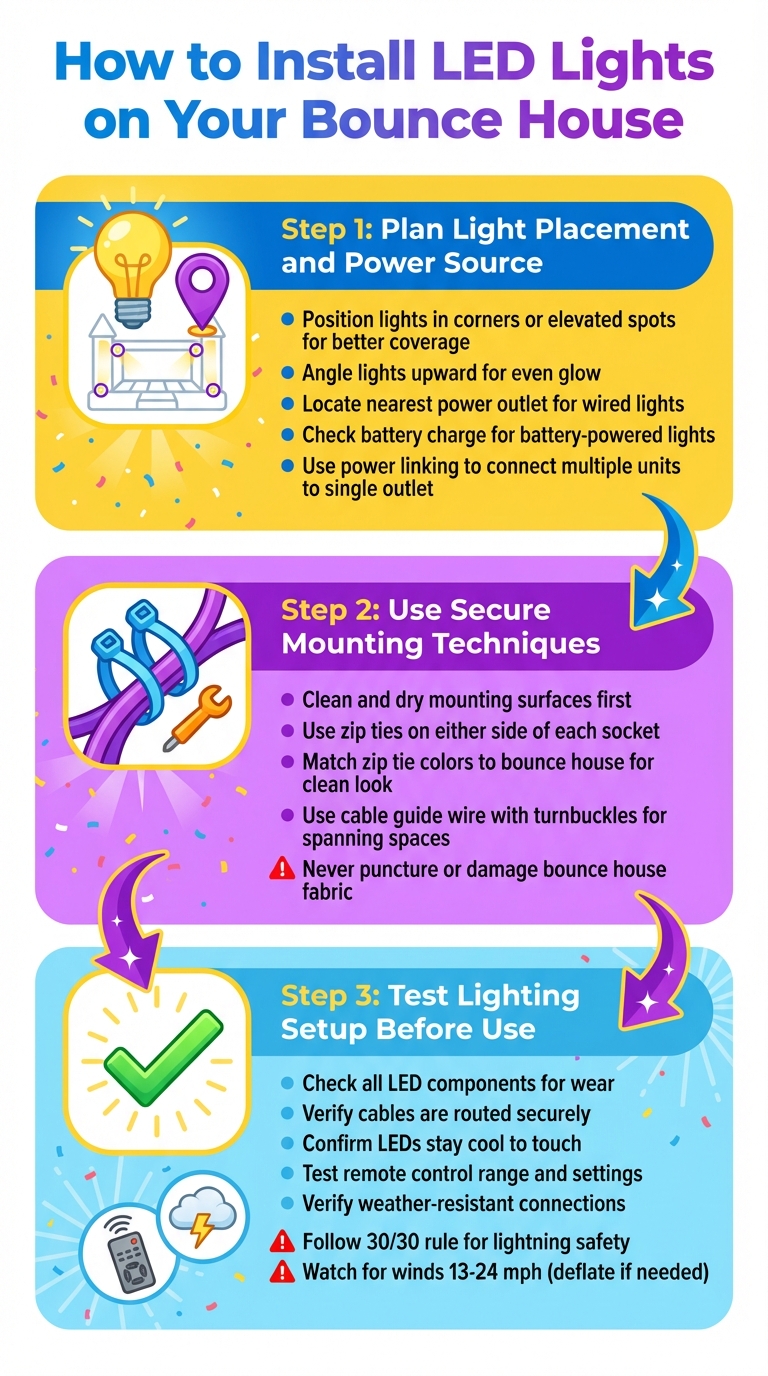
Step-by-Step Guide to Installing LED Lights on Bounce Houses
Once you’ve chosen the right LED lights for your bounce house, proper installation is key to ensuring safety and achieving the best visual effect. This process involves planning, securely attaching the lights, and thoroughly testing everything before use.
Step 1: Plan Light Placement and Power Source
Begin by deciding where the lights will have the greatest impact. Positioning LED lights in corners or elevated spots can provide better coverage for larger areas. Angling the lights upward can also help create a more even glow across the space. Taking the time to plan your layout ensures a smoother installation process and aligns with the safety principles mentioned earlier.
Identify a convenient power source early on. For wired LED lights, locate the nearest outlet and make sure cords don’t create tripping hazards. To keep things tidy, consider LED lights that support power linking, which allows multiple units to connect to a single outlet. If you’re using battery-powered lights, check that the batteries are fully charged before the event for uninterrupted operation.
Step 2: Use Secure Mounting Techniques
Once you’ve mapped out where the lights will go, focus on securely mounting them to maintain both safety and aesthetics. Start by cleaning and drying the mounting surfaces to ensure a solid grip. For string lights, zip ties are a great option, especially if you match the color of the ties to the bounce house for a clean, polished look.
"For maximum support, use a zip tie on either side of each socket (in lieu of using the loop on the socket)."
If lights need to span open spaces near the bounce house, use a cable guide wire with turnbuckles to keep the lights taut without putting stress on the inflatable material. Avoid any mounting methods that could puncture or damage the bounce house fabric.
Step 3: Test Lighting Setup Before Use
After installation, it’s crucial to test the entire setup to ensure everything works as intended. Check all LED components for signs of wear, confirm that cables are routed securely, and make sure the bounce house is stable using 18-inch stakes or sandbags.
Turn on the lights to verify they’re functioning correctly. LEDs should stay cool to the touch, which is an important safety feature. If your setup includes RGB or color-changing lights, test the remote control to ensure the range and settings meet your expectations. Finally, double-check that all electrical connections are weather-resistant and safe for outdoor use.
For safety during unpredictable weather, follow the 30/30 rule: if you see lightning or hear thunder, stop immediately and wait 30 minutes after the last occurrence before resuming. Keep an eye on wind conditions using the Beaufort Wind Scale. If you notice dust blowing or small trees swaying (indicating winds of 13–24 mph), deflate the bounce house and disconnect the LED lights.
Maintaining and Troubleshooting LED Lights
Taking care of your LED lights can go a long way in keeping them reliable and extending their lifespan. While LEDs don’t require much maintenance, a few easy steps can make a big difference. After each use, wipe the lights with a soft, dry microfiber cloth to remove dust and debris.
If you come across liquid spills or sticky residue, gently dab the area with a dry cloth or paper towel. Avoid scrubbing, as it can damage the internal components. For tougher spots, try blotting with a small amount of rubbing alcohol on a soft cloth. However, steer clear of harsh cleaners or corrosive chemicals – they can weaken adhesives and even cause corrosion.
Before storing your lights, make sure they’re completely dry. Even though many LEDs are weather-resistant, trapped moisture can lead to rust or electrical issues, especially around connection points. Check all connectors for tightness, as they can loosen over time with regular setup and takedown. Store your lights in a cool, dry, and covered space, away from extreme temperatures and humidity.
Consistent maintenance not only keeps your LEDs functioning well but also ensures your bounce house setup is both safe and visually appealing. Let’s dive into the best ways to clean and store these lights for long-term use.
Cleaning and Storing LED Lights
When removing and storing LED strips, handle them gently to avoid damaging the delicate internal components. After cleaning the lights and ensuring they’re completely dry, coil them loosely to prevent any stress on the wiring. Before putting them away, inspect power cords for signs of wear, like fraying or excessive bending.
If your lights were exposed to moisture – whether from dew or splashes during an outdoor event – dry them promptly with a soft cloth to prevent corrosion. Keep all accessories, such as remote controls, power supplies, and connectors, organized in a labeled container. This will make your next setup much easier and stress-free.
Once your lights are properly cleaned and stored, you’ll be ready to tackle any common issues that may arise.
Fixing Common Problems Like Flickering or Dead LEDs
If your lights flicker or don’t turn on, start by checking all connectors to ensure they’re securely fastened. Test the outlet by plugging in another device, and if needed, use a DC voltmeter to check the power supply.
Flickering often points to an overloaded or overheating power supply. If the power supply feels unusually hot or makes a buzzing or humming noise, unplug it immediately. Make sure you’re following the recommended 80/30 rule, which helps ensure your power supply has enough capacity. To troubleshoot further, remove any dimmers or splitters to isolate the issue.
For dark sections in the middle of a light strip, cut out the damaged segment at the designated cut lines and reconnect it using solderless connectors. If you’re experiencing dimming at the end of a long LED run, consider shortening the run, switching to a higher gauge wire, or upgrading to a 24V system. Always double-check that your power supply voltage matches the requirements printed on your LED strip.
| Issue | Likely Cause | Quick Fix |
|---|---|---|
| Lights won’t turn on | Power supply failure or loose connection | Check the outlet, secure connectors, and test the power supply with a voltmeter. |
| Flickering | Overloaded or overheating power supply | Improve ventilation and replace any power supplies that are hot or noisy. |
| Dimming at end of run | Voltage drop over distance | Shorten the run, use a higher gauge wire, or upgrade to a 24V system. |
| Dark section in middle | Damaged wiring or open circuit | Remove the faulty section and reconnect it with solderless connectors. |
With these tips, you can keep your LED lights running smoothly and looking great, ensuring your bounce house setups shine bright during evening events.
Enhancing Bounce House Rentals with LED Lights
Once you’ve ensured a safe and secure installation, adding LED lights to your bounce house setup can completely transform the look and feel of your event. These lights turn inflatables into show-stopping attractions, extending the fun well into the evening. Whether it’s a backyard birthday bash or a neighborhood block party, the right lighting can elevate the atmosphere and make the event feel extra special. With safety as your foundation, the next step is all about boosting the visual appeal and energy of your gathering.
Pair LED Lights with Bounce House Equipment
Bouncy Rentals USA offers a variety of inflatables, including bounce houses, water slides, and obstacle courses, all of which pair beautifully with LED lighting. By placing LED uplights around the perimeter of your inflatable, you can create a glowing accent effect that highlights its shape and vibrant colors.
"Uplights add great mood lighting and ambiance to any event… they work beautifully as an architectural wall wash or accent lighting." – American Party Lights
For optimal results, space the lights about six feet apart around the inflatable to ensure even coverage and eliminate dark spots. Match the LED colors to your event’s theme for a cohesive look. Plus, these lights are designed to use minimal power, so you can plug them into the same 110-volt outlet as your inflatable’s blower without worrying about overloading the circuit.
Create Memorable Evening Events
LED lights do more than just enhance the structure – they also set the mood for the entire event. Many LED lights come with sound-activated modes, which sync the lighting effects with your party music. Imagine lights that pulse, strobe, or shift colors to the beat – this creates an engaging, interactive experience for both kids and adults. The result? A glowing inflatable that doubles as a mini light show, adding an energetic, party-like vibe to your event.
If your setup is on a hard surface like a driveway, consider placing a tarp beneath the bounce house. Not only does this protect the inflatable, but it also helps reflect the LED light, amplifying the brightness and creating an even more striking visual effect. This simple addition ensures your event looks polished while keeping the rental equipment in top condition.
Conclusion
Adding LED lights to your bounce house setup does more than just brighten the scene – it creates an unforgettable party atmosphere. These lights can turn an ordinary evening gathering into a standout celebration. However, it’s essential to prioritize safety. Stick to cool-to-touch LED lights, secure all cords to avoid tripping hazards, and double-check that your power connections are safe. Always test the setup beforehand and ensure adult supervision to keep the fun worry-free for kids.
Keep an eye on the weather, too. If winds pick up beyond 15–20 mph, deflate the bounce house and secure the lighting immediately. The same applies to lightning – follow the 30/30 Rule: if thunder occurs within 30 seconds of a lightning flash, stop using the bounce house. These precautions ensure that safety remains at the heart of your event planning.
For a hassle-free experience, Bouncy Rentals USA provides sanitized, fully insured inflatables that pair seamlessly with LED lighting. Whether it’s a backyard birthday, a school event, or a neighborhood block party, combining high-quality rentals with thoughtful lighting can create a glowing centerpiece your guests won’t forget.
FAQs
How can I safely use LED lights with a bounce house for an evening party?
To set up LED lights with a bounce house safely for an evening event, keep these key tips in mind:
- Choose cool-touch, low-power LED lights. These lights stay cool while in use, making them safer for kids and reducing the risk of overheating.
- Avoid attaching lights directly to the bounce house. Instead, use stable stands or tripods positioned outside the inflatable to protect the fabric and maintain safety.
- Secure all cords and wires. Prevent tripping hazards by keeping cords away from the blower and busy areas. Use tape or cable clips to hold them firmly in place.
- Don’t overload electrical circuits. Double-check that the total power use of the lights and blower is well within the circuit’s capacity. Test the setup ahead of the event to ensure everything runs smoothly.
When set up properly, LED lights can bring a festive glow to your bounce house while keeping everyone safe!
What are the best LED lights to use for outdoor bounce house parties?
The best lighting options for outdoor bounce house events are cool-to-touch LED party lights and weather-resistant outdoor LED uplights. These choices not only keep things bright and lively but are also safe and energy-efficient.
Cool-to-touch LED party lights work perfectly for directly lighting up the bounce house. They consume very little power, remain cool even when running for hours, and can safely share an outlet with the blower without tripping the circuit. For a wider area, weather-resistant outdoor LED uplights are an excellent pick. They provide consistent lighting around the bounce house and nearby spaces while handling outdoor conditions with ease.
By combining these two types of lights, you’ll create a well-lit, safe, and exciting environment that everyone can enjoy!
What should I do if the LED lights on my bounce house are flickering or dimming?
If the LED lights on your bounce house are flickering or dimming, here’s how you can troubleshoot the problem and make sure everything’s ready for a safe and fun evening:
- Turn off the power: Before touching anything, unplug the setup or turn off the circuit breaker. Safety first – this prevents any risk of electric shock.
- Check voltage compatibility: Double-check that the LED lights match the voltage of your power supply, whether it’s 12V, 24V, or another specification. A mismatch can easily cause flickering.
- Inspect the connections: Look closely at the wiring. Are all connections secure and clean? Corrosion or loose wires can interrupt the power flow and cause issues.
- Verify the power supply capacity: Make sure your power supply can handle the total wattage of the LED lights. If it’s too small, you could see dimming or flickering.
- Avoid overloading circuits: Plug the bounce house and lights into a dedicated outlet. Sharing the circuit with other high-power devices could overload it and lead to performance problems.
If none of these steps solve the issue, it’s possible that the LED strip or power supply is faulty. In that case, replacing the defective part or consulting a licensed electrician is your best bet.
Pro Tip: Renting from Bouncy Rentals? Ask for a bounce house with LED lighting that comes with a properly rated power supply. Their team ensures everything is safe and ready to go, so you can focus on enjoying your evening party!
