If you’re planning to rent or operate inflatables like bounce houses or slides at public events in Illinois, here’s what you need to know:
- Liability Insurance is Mandatory: Operators must carry a minimum of $1,000,000 per occurrence and $2,000,000 aggregate in liability insurance.
- Permits are Required: Public events need an annual operating permit issued by the Illinois Department of Labor (IDOL).
- Inspections are Essential: All inflatables must pass annual inspections and follow an inflatable setup safety checklist to ensure safety compliance.
- Penalties for Non-Compliance: Operating without insurance or permits can lead to fines starting at $2,500/day and potential criminal charges as a Class A misdemeanor.
- Local Rules May Vary: Some cities, like Paxton, may have additional requirements, such as naming the city as an "additional insured."
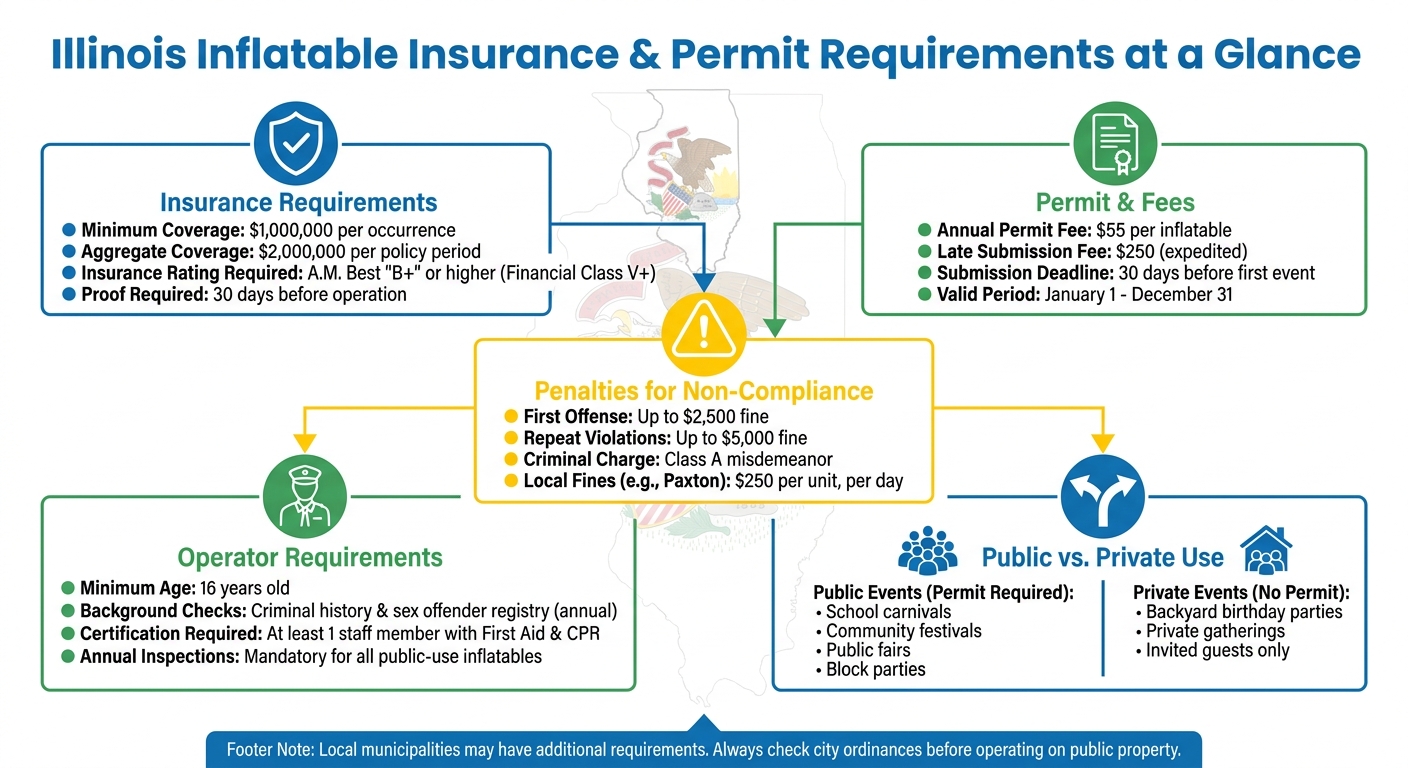
Illinois Inflatable Insurance Requirements Quick Reference Guide
The Illinois Amusement Ride and Attraction Safety Act
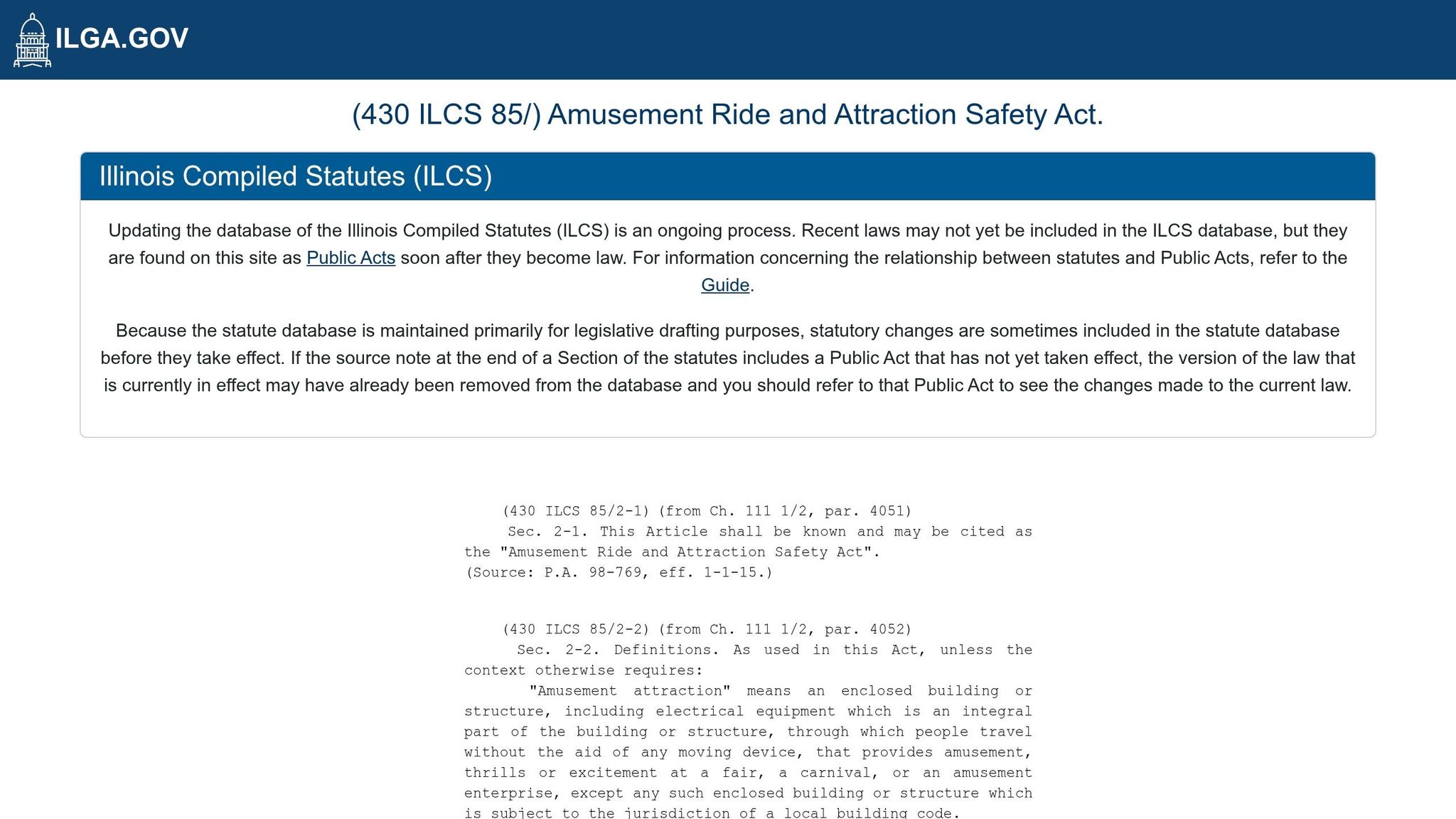
The Illinois Amusement Ride and Attraction Safety Act (430 ILCS 85/) sets the rules for inflatable attractions in Illinois. It requires all public rides – like those at carnivals, fairs, and festivals – to be inspected and approved by the Illinois Department of Labor.
How Illinois Defines Inflatable Attractions
Illinois law categorizes inflatable attractions as "amusement rides". These are defined as devices made for activities like bouncing, climbing, sliding, or interactive play. They’re typically constructed from flexible fabric and rely on continuous airflow from a blower to stay inflated. This classification includes bounce houses, inflatable obstacle courses, and water slides, putting them under the same regulations as other public amusement rides.
A key distinction in the law is between public and private use. The Act applies to events open to the general public, not private gatherings. For instance, a school carnival or a community block party would need a permit, but a backyard birthday party with invited guests usually wouldn’t. However, if the equipment is used at a public event, the owner must ensure proper permits are in place.
What the Act Is Designed to Do
The primary goal of the Act is to prioritize public safety by enforcing strict operational requirements. Inflatable attractions must pass an initial inspection and undergo annual reinspections. A state-issued permit decal confirms they are approved for public use.
The law also sets clear standards for operators. All attendants and assistants must be at least 16 years old. Additionally, owners are required to perform annual criminal history and sex offender registry checks on their employees. Recent updates under Public Act 103-177 mandate that at least one on-site employee be certified in First Aid and CPR during all operating hours. These measures aim to minimize risks and ensure that safety practices are consistently applied across Illinois. Next, we’ll explore the insurance and permit requirements that further protect these operations.
Required Liability Insurance for Inflatable Rentals
In Illinois, operating inflatables at public events without proper liability insurance is against the law. This rule ensures that operators are financially equipped to handle claims involving injuries, fatalities, or property damage.
Minimum Coverage Amounts
According to 430 ILCS 85/2-14, inflatable rental operators must carry liability insurance with minimum coverage limits of $1,000,000 per occurrence for bodily injury, death, or property damage, and a $2,000,000 aggregate per policy period.
The law explicitly states:
"No person shall operate an amusement ride or attraction unless there is in force a liability insurance policy or policies in an amount of not less than $1,000,000 for bodily injury to or death of one or more persons, damage to or destruction of property of others, or a combination thereof, and, subject to the per occurrence limit, in an aggregate amount of not less than $2,000,000…"
Additionally, operators must certify that their insurance provider holds an A.M. Best rating of at least "B+" (financial class V or higher). Non-compliance can result in severe penalties, including a Class A misdemeanor and fines of up to $2,500 for a first offense and up to $5,000 for repeat violations.
To meet these requirements, operators must also prove their compliance during inspections.
Showing Proof of Insurance During Inspections
Illinois takes insurance verification seriously to promote safety at public events. Operators must submit a certificate of insurance at least 30 days before their first day of operation or the expiration of their current permit. Failure to meet this deadline results in an expedited inspection fee of $250, in addition to the standard annual permit fee of $55.
During the required annual inspection, operators must present proof of insurance to the inspector. Only after verifying compliance does the Illinois Department of Labor issue a permit decal. This decal serves as proof at public events that the inflatable complies with all state regulations.
Permit and Inspection Requirements
In Illinois, inflatables intended for public use must have an annual permit and pass an inspection before they can be operated at public events. After verifying your insurance, you’ll need to secure a permit and complete the inspection process to stay compliant with state regulations.
Annual Permit Fees and Exemptions
The cost for an annual permit is $55 per inflatable, covering the calendar year from January 1 through December 31. This fee must be paid before your application is processed. Payments can be made via the State of Illinois EPAY service, check, or money order.
If you’re renting an inflatable for private use – like top inflatable water slides for backyard parties or a similar private event with restricted access – state permits are not required. However, the Illinois Department of Labor has issued a clear warning:
"If you rent an inflatable and it is operated at a public event without a permit, as the owner you are guilty of a Class A misdemeanor".
Non-profit organizations, such as religious, educational, or charitable groups, may also qualify for exemptions. These exemptions apply if the inflatables are located in buildings inspected by the State Fire Marshal or local authorities, provided the necessary exemption forms are submitted.
The next step in the process ensures that all safety and operational standards are met through inspections.
How Inspections Work
Before obtaining a permit, operators must create an account with the Illinois Public ID system to access the Amusement Rides and Attraction Safety (ARAS) Portal. Just like insurance documentation, permit applications must be submitted at least 30 days before your first event. Late submissions incur a $250 expedited fee in addition to the $55 permit fee. Once your application is approved, an inspector will contact you to schedule an on-site inspection.
During the inspection, officials evaluate the inflatable’s foundation, structural stability, and safety features. Operators are also required to provide several documents, including:
- Criminal history and sex offender registry checks for all employees (including volunteers)
- Training logs specific to each ride
- A written substance abuse policy
Once the inflatable meets all safety requirements, the inspector will attach a permit decal directly to the equipment. This decal serves as visible proof that the inflatable complies with state regulations.
Local Rules and Recent Legal Changes
Cities and villages across Illinois often add their own rules on top of state laws. These local ordinances typically come into play when setting up inflatables on public property, like city parks or municipal facilities, and they can be stricter than statewide regulations. Let’s take a closer look at how city-specific requirements and recent legislative updates shape these standards.
City-Level Insurance Requirements
The City of Paxton provides a good example of how local rules can add extra layers to state requirements. According to Chapter 121 of the Paxton municipal code (established by Ordinance 15-35 in December 2015), operators must carry $1,000,000 in liability insurance, as required by state law, but with an additional stipulation: the policy must name the City of Paxton as an "additional insured". This protects the city from any legal claims tied to the inflatable’s use on public property.
Paxton also has specific rules for event setups. Permit applications must be submitted seven calendar days in advance, and stakes are not allowed for securing inflatables in city parks. Instead, inflatables must be freestanding and weighted. While there’s no fee for the permit, failing to obtain one can lead to the immediate removal of the inflatable and a $250 fine per unit, per day.
Other municipalities often follow a similar pattern. Many require signed indemnification agreements and proof that the city is listed as an additional insured on the policy. Before setting up on public property, it’s a good idea to check with the local city clerk or parks department to confirm insurance requirements, permit deadlines, and any operational restrictions. These local rules make it clear that verifying municipal regulations is a critical step before any event.
2026 Updates to State Laws
While local rules evolve, Illinois’s state law on insurance requirements has remained steady. Under Public Act 103-177, effective January 1, 2024, the core state insurance standards were reaffirmed, and these minimums will still apply in 2026.
Municipalities are allowed to enforce their own safety and insurance standards, as long as they meet or exceed the state’s baseline requirements. This means operators need to stay informed about both state laws and local ordinance changes, as cities can adjust their rules independently. Keeping up with these updates ensures compliance and avoids potential complications during event setups.
Bouncy Rentals USA: Fully Insured Party Rentals
Bouncy Rentals USA stands out as a reliable example of meeting Illinois’ complex insurance and safety requirements with ease. Navigating the state’s intricate insurance laws can be challenging, but partnering with a provider like Bouncy Rentals USA ensures event organizers can focus on planning a memorable event without worrying about compliance issues.
Full Insurance Coverage
Every inflatable provided by Bouncy Rentals USA is fully insured, meeting Illinois’ minimum requirements of $1,000,000 per occurrence and $2,000,000 aggregate. Their insurance provider holds an A.M. Best rating of "B+" or higher and a financial class of "V" or above, aligning with the Illinois Department of Labor’s standards. This level of coverage makes it easy for venues like schools, parks, and municipalities to secure a Certificate of Insurance when needed.
Available Inflatable Options
Bouncy Rentals USA offers an extensive selection of inflatables, all compliant with legal standards. Whether you’re hosting a kids’ birthday party, a school carnival, or a neighborhood block party, they have something for every occasion:
- Bounce houses: A favorite for children’s parties.
- Inflatable obstacle courses: Perfect for school events and community gatherings.
- Water slides: A refreshing hit for summer celebrations.
- Combo units with slides: Versatile options that combine multiple play features.
To add even more fun, they also rent out party extras like cotton candy machines, popcorn makers, dunk tanks, and snow cone machines – everything you need to complete your event.
Safety Standards and Service
Safety is a top priority at Bouncy Rentals USA. All equipment is regularly sanitized and inspected to ensure it’s in top condition. The delivery team takes care of everything, from setup to takedown, while conducting on-site safety checks. Staff members, all of whom are at least 16 years old as required by Illinois law, provide clear guidance on safe use. For public events requiring state permits, the company manages the inspection process and ensures each unit has the required Illinois Department of Labor annual permit decal prominently displayed.
Summary
In Illinois, inflatables are classified as amusement rides, which means they must meet strict insurance and safety regulations. Anyone hosting an inflatable at a public event – like a carnival, school fair, or community gathering – must obtain a valid permit. Additionally, operators are required to carry liability insurance that meets or exceeds state-mandated minimums. The insurance provider must also hold an A.M. Best rating of at least "B+" and a financial class of "V" or higher.
Compliance isn’t optional. Operating without a permit is considered a Class A misdemeanor, carrying serious legal and financial consequences, including potential charges. Beyond the legal risks, proper insurance is crucial for protecting event organizers and businesses from liability claims. This is especially important given that over 2,500 people in the U.S. have been injured by inflatable attractions in the past decade.
Given these strict requirements, working with a fully compliant provider is essential. Bouncy Rentals USA stands out by meeting all state regulations. They carry the required insurance, ensure every inflatable displays the Illinois Department of Labor permit decal, and handle inspections, safety checks, and regulatory paperwork. Their thorough approach allows event organizers to focus on creating a fun and memorable experience without worrying about legal risks or last-minute permit complications. This attention to compliance not only shields organizers but also promotes public safety.
FAQs
Is my event considered “public” or “private” under Illinois law?
Under Illinois law, an event is considered “public” if it occurs in a public space or on private property that the public can access, such as a carnival or fair. This holds true regardless of whether an admission fee is required. On the other hand, events on private property with limited access are typically classified as “private.”
Who is responsible for the permit and insurance – the renter or the inflatable owner?
In Illinois, renters must obtain the necessary permit and liability insurance to operate an inflatable. The insurance must provide coverage of at least $1,000,000 per occurrence and $2,000,000 in aggregate. Proof of this insurance must be presented during the inspection process. Meeting these requirements is essential for the safe and lawful use of inflatable attractions in the state.
What do cities usually add beyond the state insurance and permit rules?
Cities tend to impose additional safety measures on top of state insurance and permit requirements. These can involve mandates like having a responsible adult present for supervision, setting strict capacity limits, and restricting usage to private property to prevent risks associated with public areas. Be sure to review local regulations carefully to stay compliant.