Losing items at events is common, but a well-organized lost and found system can make recovery easier while improving guest satisfaction and protecting your event’s reputation. Here’s how to set up and manage an effective system:
- Before the Event: Assign a dedicated coordinator, set up a secure and visible lost and found station, and prepare essential supplies like lockable storage, inventory logs, and digital tools for tracking items.
- During the Event: Log found items quickly, use digital tools like photo libraries for easy identification, and provide attendees with access to updates via event apps or QR codes.
- After the Event: Complete an inventory of unclaimed items within 24 hours, notify potential owners using attendee data, and responsibly dispose of unclaimed property according to local laws.
Using technology and clear processes ensures lost items are handled efficiently, reduces liability risks, and leaves attendees with a positive impression of your event. For events with complex setups, like those featuring inflatables or large rental equipment, coordination with staff during setup and teardown is key to minimizing losses. Every recovered item reinforces your commitment to excellent event management.
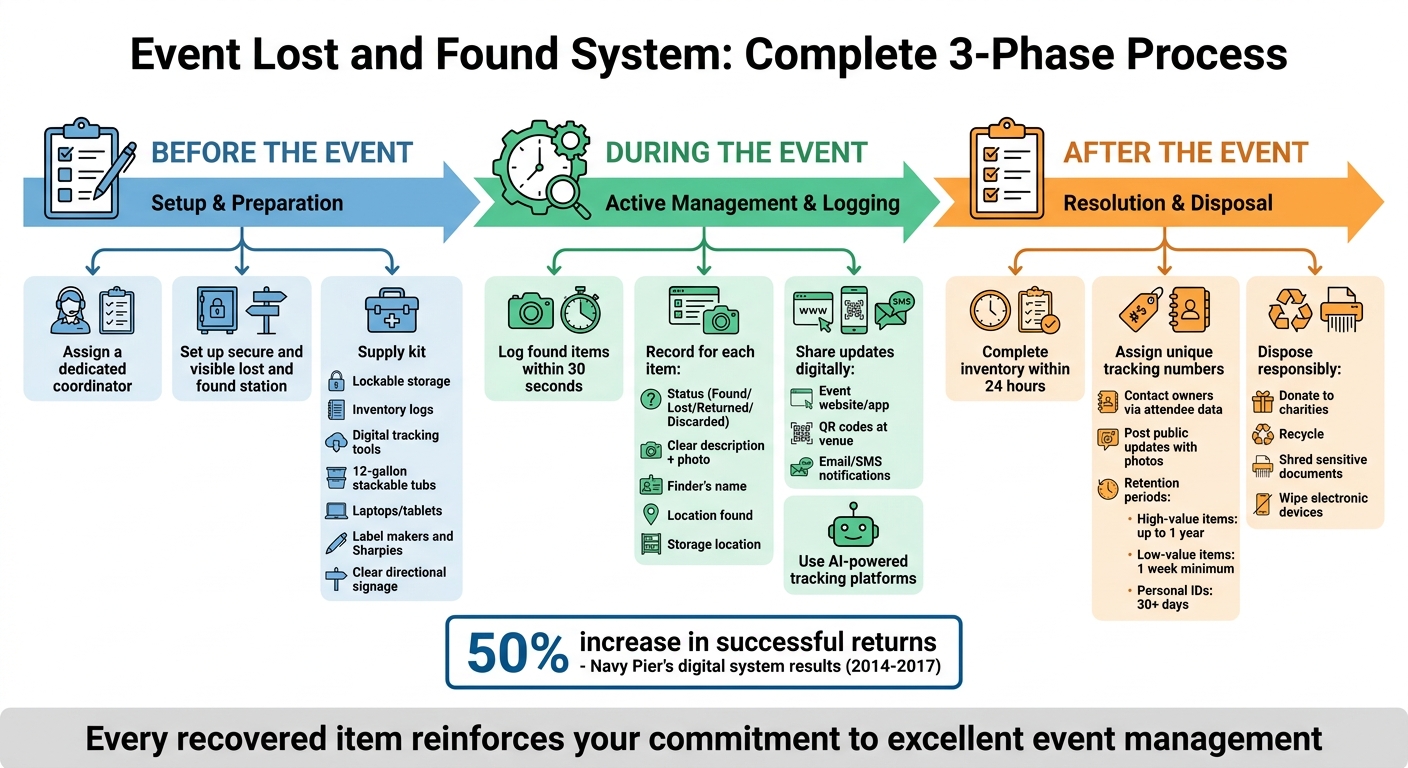
3-Phase Lost and Found System for Events: Before, During, and After
Setting Up Your Lost and Found System Before the Event
Getting your lost and found system in place before the event kicks off can save you from a lot of headaches later. With the right preparation, you can keep things running smoothly, even at large outdoor gatherings. Here’s how to get started.
Assign a Lost and Found Coordinator
The first step is to assign someone to take charge of the lost and found process. This person – or team – will be responsible for logging items with clear photos and descriptions, verifying claims to ensure items go back to their rightful owners, and keeping communication open with guests.
Pick someone who is reliable, tech-savvy, and familiar with basic security practices. For bigger events, the coordinator might need to manage a team of volunteers to help handle the workload. As Faundit points out, “A well-functioning Lost & Found system requires clear accountability. Designate specific staff members or departments… to manage lost items”.
Choose and Set Up a Central Location
Next, set up a secure, easy-to-find lost and found station. Pick a spot that’s visible but not in a high-traffic area to avoid bottlenecks. Make sure there’s plenty of room for organized storage, constant staffing, and clear signage so guests know where to go. Security is a must – use lockable cabinets or a secure room to store valuable items like electronics, wallets, and passports.
Reliable internet access is also important for using digital tracking tools. You’ll want enough space to sort items by category or date. Andy Robertson from Festival Pro advises, “The facility can usually be managed by festival volunteers who will log all items handed in as well as accepting applications for lost property and giving advice about remotely locking phones or cancelling bank cards”. Having tablets or laptops on hand for immediate logging ensures nothing gets missed.
Prepare Required Supplies and Equipment
Make sure your station is stocked with the right tools. Durable, stackable 12-gallon tubs are great for organizing items, and wheeled tubs can make setup and teardown much easier at outdoor events. For high-value items, secure storage like lockable cabinets is essential. You’ll also need inventory logs, clipboards, label makers, and Sharpies to keep everything in order.
Tech gear is just as important. Have a laptop or tablet for digital tracking, along with powerbanks and multi-head chargers to power on found phones and check for owner details. Walkie-talkies can help your team stay connected with staff working around the event. Lastly, clear directional signage is key – guests need to be able to find your station easily, especially at events with spread-out attractions like those hosted by Bouncy Rentals USA.
Handling Lost Items During the Event
Once the event is in full swing, a well-organized approach to managing lost items is essential. A smooth system ensures that lost belongings are quickly logged, tracked, and returned without disrupting the event’s flow. Staff should be prepared to handle found items efficiently, while attendees should have an easy way to check for their lost belongings. The key is to keep everything moving at the pace of the event.
Create a Process for Logging Found Items
Make it a priority to log each found item within 30 seconds. Equip staff with software that lets them snap a photo and enter key details directly from a mobile device. For every item, record its status (Found, Lost, Returned, or Discarded), a clear description, the finder’s name, the exact location where it was found, and where it’s being stored.
Photos are a game-changer, allowing owners to identify their belongings quickly without having to sift through piles of items. For example, Chicago’s Navy Pier adopted Crowdfind’s digital lost-and-found system in June 2014. The platform, which featured a photo library accessible via the venue’s website, led to a 50% increase in successful item returns by December 2017. Guests could browse time-stamped logs online instead of manually searching through collections.
Share Found Item Updates Without Interrupting the Event
Rather than making loudspeaker announcements, use a digital inventory that attendees can access on their phones. Create a dedicated search page on your event website or app where guests can view photos and descriptions of found items without disturbing the event. To make it even easier, place QR codes around the venue – especially near high-traffic spots like inflatable attractions at Bouncy Rentals USA events – that link directly to the portal.
Some platforms can automatically match lost item reports from attendees with staff logs. Owners are then notified via email or text, keeping communication discreet and efficient.
"This is a chance to address an easily forgotten part of customer service, and for planners to shine in an unexpected way".
Use Digital Tools to Track Items
Digital tools not only streamline updates but also simplify the retrieval process. Platforms like Pixit (formerly Crowdfind) and Faundit are specifically built for events and festivals. Pixit leverages artificial intelligence to create detailed item descriptions and estimate their value based on uploaded photos, reducing the need for manual entry. Faundit, on the other hand, automates the entire process, from logging found items to coordinating their return with attendees.
For added security, opt for tools with ISO 27001 certification to protect personal data. Linking found items to guest profiles or ticket IDs further enhances efficiency. For instance, if someone reports a lost phone, the system can instantly check if it’s already been logged and notify the owner.
"From backbones to dignity: people lose all kinds of things at Zwarte Cross. But never have things been found as quickly as with iLost!".
What to Do With Unclaimed Items After the Event
Even after your event wraps up, managing unclaimed items remains a crucial task. This involves documenting leftover belongings, reaching out to potential owners, and responsibly disposing of unclaimed property while adhering to local regulations. These steps ensure accountability and maintain the professionalism of your event management.
Complete an Inventory Within 24 Hours
Start by logging all unclaimed items within 24 hours of the event’s conclusion. Record essential details like the item’s type, brand, color, size, and the location where it was found. Assign each item a unique tracking number to simplify retrieval and match it with digital records.
Sort items based on their value and sensitivity, ensuring secure storage for high-risk belongings like electronics or personal IDs. For instance, the TSA reports that nearly 90,000 to 100,000 items are left behind at security checkpoints each month. Make a note of any unique identifiers on the items. When claims are made, ask for these details or request a valid photo ID to confirm ownership.
This meticulous documentation ensures that your post-event processes align with earlier lost and found measures, creating a seamless system.
Contact Owners and Post Public Updates
Once the inventory is complete, focus on notifying potential owners. Use attendee registration data to send emails or SMS alerts. If your lost and found system includes automated matching features, leverage it to notify individuals directly. Additionally, consider uploading time-stamped photos of unclaimed items to a public gallery on your event website, giving attendees a chance to identify their belongings.
Retain unclaimed items for 60 to 90 days, depending on local regulations. Items with higher monetary or sentimental value might be held for up to a year, while lower-value items could be retained for just a week. Personal identification documents should be stored for at least 30 days before disposal.
"If there are unclaimed phones, we wipe their data, and we make sure that any sensitive items [like unclaimed credit cards] are shredded."
- Dan Sullivan, General Manager, Crowdfind
Dispose of Unclaimed Items According to Local Laws
After the holding period ends, dispose of unclaimed items as per local laws. Common methods include donating to charities, recycling, destruction, or transferring items to state agencies for surplus sales.
Before disposal, ensure sensitive information is securely handled by wiping memory devices and shredding documents. Keep detailed disposal reports to track items that have exceeded their retention period. Including liability clauses in event contracts can further protect organizers and venues from legal issues related to unclaimed property.
Following these steps not only safeguards sensitive data but also reinforces the professionalism of your event management. By integrating these practices, you can handle lost property efficiently while maintaining the high standards expected by clients, like those served by Bouncy Rentals USA (https://bouncyrentalsusa.com/).
How to Coordinate Lost and Found With Event Operations
Integrating your lost and found system with event logistics is all about thoughtful planning. By placing stations strategically, working closely with your crew, and designing layouts to minimize losses, you can ensure a smoother experience for everyone involved. Let’s explore how to align lost and found efforts with your event operations.
Position Stations Near Main Attractions
Make it easy for attendees to report or retrieve lost items by placing stations near high-traffic attractions like bounce houses, water slides, and mechanical bulls. For example:
- Water slides: Set up a station in the dry zone near the splash area where guests often leave items like towels, goggles, or waterproof phone cases.
- Inflatables: If your event features Bouncy Rentals USA units, position the station so it’s visible from multiple angles. Use clear, high-contrast signage to guide attendees.
As Memberboat advises, a well-designed event space should allow for “seamless navigation, easy networking, and smooth movement between key areas”. Keeping pathways clear between attractions like dunk tanks, mechanical bulls, and food service areas can reduce congestion and the risk of items being left behind.
When items are found, ensure staff log the exact location where they were discovered (e.g., "near the water slide area"). This detail helps owners retrace their steps and improves the chances of a successful reunion.
Work With Setup and Teardown Crews
Lost and found efforts should start even before the event begins. Coordinate with setup and teardown crews to ensure a systematic approach to item recovery. Here’s how:
- Setup inspections: Work with crews handling Bouncy Rentals USA inflatables to check hidden pockets in combo units and themed bounce houses where items like shoes, socks, or jewelry might get trapped.
- Teardown protocols: During breakdown, crews should count stakes, poles, and accessory bags while systematically walking the venue. Taking photos of the process provides visual documentation that can help verify inventory and locate misplaced items.
To stay organized, establish a 24-hour inventory rule: log all unclaimed items within one day of the event’s end. This aligns with the "Closeout" phase of event management, ensuring the venue is cleared and all items are accounted for. Without structured tracking, recovery rates for lost equipment can drop below 7%, so meticulous coordination is key.
Reduce Lost Items in Busy Areas
A well-thought-out event layout can help prevent items from being lost in the first place. For instance:
- Separate attractions from food areas: Keep inflatables and water slides away from food service zones to avoid mixing personal belongings with dining supplies.
- Create activity zones: For space-intensive attractions like dunk tanks, designate specific zones to keep pathways clear and allow guests to move freely.
- Provide proximity seating: Place tables near activity areas – one table for every eight guests is a good guideline – so attendees have a secure spot for their belongings.
Additionally, use signage and social media updates to remind guests to keep track of their items, especially in high-energy areas where excitement can lead to carelessness. For valuable equipment, consider GPS trackers or Bluetooth tags. With over $1 billion worth of equipment lost or stolen annually from rental companies, according to the American Rental Association, these measures can save both time and money.
Conclusion
An effective lost and found system does more than just reunite guests with their belongings – it strengthens trust and builds loyalty. As Faundit puts it:
"A smooth Lost & Found process can transform a potentially negative experience into a positive one."
When guests feel confident that their items are safe, they’re more likely to leave glowing reviews, recommend your event to others, and come back for future experiences.
The benefits extend beyond guest satisfaction. By implementing clear logging procedures, using digital tracking tools, and setting defined policies, you can reduce confusion and lighten the load on your staff. Additionally, professional systems ensure sensitive guest information – like addresses or payment details – is handled securely, avoiding potential risks tied to unprotected communication. For large-scale events, digital tracking and dedicated coordinators help keep errors to a minimum.
Every item you recover sends a message about your dedication to guest care. Whether it’s a child’s cherished toy left behind or a phone misplaced near a water slide, how you manage these situations directly impacts how attendees remember the event. Partnering with companies like Bouncy Rentals USA ensures that every aspect of your event logistics is handled with professionalism. Their commitment to sanitized equipment, on-time delivery, and seamless setup allows you to focus entirely on creating memorable experiences for your guests.
FAQs
What should I do if someone claims an item but can’t prove it’s theirs?
If someone claims an item but can’t prove it’s theirs, ask for specific details or evidence that could confirm ownership. This might include describing unique characteristics of the item or providing related documentation. If they can’t provide adequate proof, hold onto the item temporarily while conducting further verification. Alternatively, follow your organization’s lost and found policy, which may involve storing the item for a designated period or eventually disposing of it if ownership can’t be established. This approach helps ensure the process is handled fairly and minimizes potential mistakes.
How long should I keep unclaimed items after an event?
Unclaimed items are usually held for 30 to 90 days following an event. The exact duration depends on your organization’s policies and industry standards. Once this time has passed, you can determine the best course of action, like donating or disposing of the items. Make sure your policy complies with local regulations and is clearly communicated to attendees.
How can I safely handle lost IDs, credit cards, and phones?
To ensure lost IDs, credit cards, and phones are handled securely at events, here are some practical steps:
- Create a secure lost and found area where attendees can report or claim lost items.
- Maintain a detailed log of all found items, making it easier to match them with their rightful owners.
- Encourage attendees to immediately cancel or lock sensitive items, such as credit cards or phones, by contacting their bank or service provider.
- Implement digital tools or forms to simplify and organize lost property inquiries efficiently.