Generators are essential when hosting inflatable rental events, especially in areas without nearby power sources. They ensure safe, continuous airflow for bounce houses and other inflatables, which require constant power to stay inflated. Here’s what you need to know:
- Power Needs: Most commercial blowers use 9–14 amps. A 1 HP blower requires about 1,200 watts to start and 750 watts to run. Always account for startup surges (50–100% higher than running wattage).
- Choosing a Generator: Match the generator size to your total power needs, including a 20–25% buffer for safety. For example, a 1 HP blower typically needs a 2,000-watt generator.
- Multiple Devices: Calculate combined wattage for all equipment (e.g., bounce houses, cotton candy machines) and include the highest startup surge.
- Fuel Options: Gasoline generators are powerful but emit more pollutants. Propane burns cleaner and lasts longer but provides slightly less power. Dual-fuel generators offer flexibility.
- Safety Setup: Place generators at least 20 feet away from inflatables and guests. Use heavy-duty, outdoor-rated extension cords under 50 feet long.
- Maintenance: Inspect generators before use, check fuel and oil levels, and store them properly after events to ensure long-term reliability.
Proper planning and setup ensure safe, uninterrupted power for inflatable events. Follow these guidelines to keep your equipment running smoothly and your guests safe.
How to Choose the Right Generator
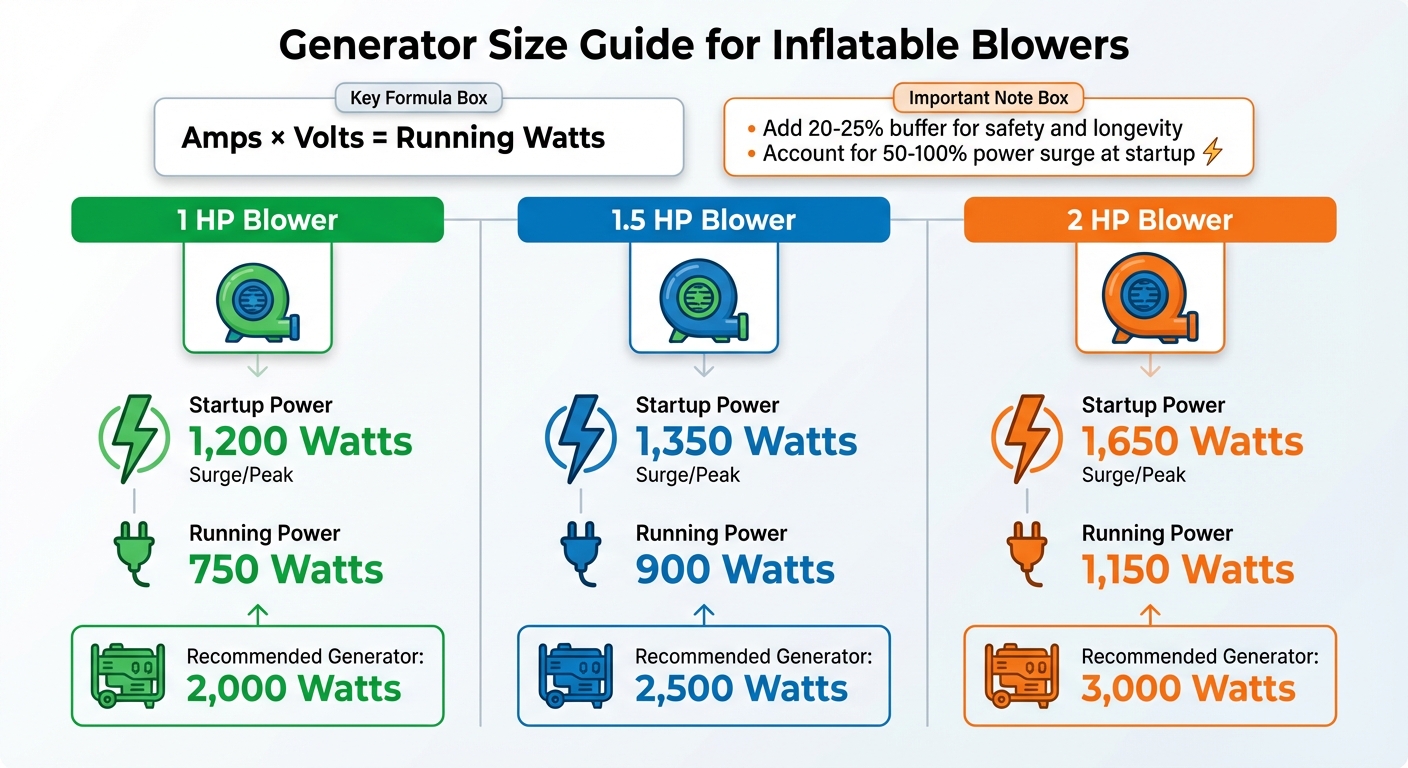
Generator Size Guide for Inflatable Rental Blowers
Calculating Power Needs
Start by checking your blower’s label for its amp and voltage ratings. Use the formula: Amps × Volts = Running Watts to determine the power needed. For instance, a blower rated at 10 amps on a 120-volt circuit would require 1,200 watts to run.
Keep in mind that blowers experience a power surge when starting up, which can be 50% to 100% higher than the running wattage. Your generator must be able to handle this surge without issue.
Here’s a quick reference table to help you match blower sizes with generator requirements:
| Blower Horsepower (HP) | Watts to Inflate | Watts to Maintain | Recommended Generator Size |
|---|---|---|---|
| 1 HP | 1,200 | 750 | 2,000 Watts |
| 1.5 HP | 1,350 | 900 | 2,500 Watts |
| 2 HP | 1,650 | 1,150 | 3,000 Watts |
Add a 20% to 25% buffer to your total wattage to prevent overheating and ensure smooth operation.
Once you’ve calculated the power needs for individual devices, consider how running multiple pieces of equipment will impact the total demand.
Running Multiple Inflatables and Party Equipment
If you’re operating several devices, calculate the total running wattage by adding up the requirements for each piece of equipment. Then, factor in the highest startup surge among them. For example, running two bounce houses (1,200 watts each) alongside a cotton candy machine (2,100 watts) results in a combined running wattage of 4,500 watts. Adding the highest startup surge (1,200 watts) and a 25% safety margin means you’ll need a generator rated for about 7,125 watts.
Combining water slides and party rentals can increase power demands significantly. For instance, popcorn and cotton candy machines often draw around 2,100 watts each. Sound systems typically use between 100 and 500 watts, while LED string lights require just 20 to 50 watts. As a general rule, events often need generators rated at 5,000 watts or more, depending on the size and complexity of the setup.
For safety and efficiency, always place your generator at least 20 feet away from guest areas. Use heavy-duty, outdoor-rated 10- or 12-gauge extension cords, and avoid lengths over 50 feet to prevent voltage drops that could damage your equipment.
Once you’ve sized your generator, it’s time to choose the right fuel type for your event.
Gasoline vs. Propane Generators
Gasoline generators are known for delivering high power and being easy to refuel. However, gasoline has a short shelf life and produces higher emissions. For example, a 2,000-watt generator with a 1-gallon fuel tank can power a medium-sized bounce house for about 80 minutes, with fuel costs averaging $4.70.
Propane generators, on the other hand, burn cleaner, emit fewer pollutants, and have an indefinite shelf life, making them a good choice for equipment that isn’t used frequently. However, propane generally provides about 10% less power than gasoline, which may be a concern if you’re running multiple blowers close to the generator’s maximum capacity.
Dual-fuel generators offer flexibility by allowing you to switch between gasoline and propane. This can be particularly useful for all-day events or remote locations where one fuel type may not be readily available. Regardless of the fuel type, always let the generator cool down before refueling to minimize the risk of fire or accidents. Following safety tips for water slides and other high-power equipment ensures a secure environment for all guests.
Safe Generator Setup and Operation
Once you’ve chosen the right generator, setting it up and operating it correctly is essential to ensure safe and uninterrupted power for your inflatables.
Where to Place Your Generator
Always position your generator at least 20 feet away from the bounce house, nearby structures, and guest areas. Place it on solid, level, and dry ground, making sure the exhaust points away from people. This distance helps harmful carbon monoxide disperse safely. Never operate a generator indoors or in partially enclosed spaces like garages, sheds, or tents – carbon monoxide can accumulate dangerously fast. If you’re dealing with rain, use a ventilated generator cover specifically designed for wet conditions. Avoid running the generator on wet grass without proper protection.
"The 20-Foot Rule: Always place the generator at least 20 feet away from the bounce house, any structures, and all guest areas." – Pogo Bounce House
Extension Cords and Grounding
Stick to heavy-duty, outdoor-rated extension cords – preferably 10- or 12-gauge – and keep them under 50 feet in length to prevent voltage drops that could damage blower motors. A 25-foot cord is often the ideal choice. Make sure the cord has a three-prong grounded plug and that the generator is grounded according to the manufacturer’s instructions. To avoid accidents, cover cords with a tarp in high-traffic areas to protect them from moisture and reduce tripping risks.
"It is unsafe to attach multiple extension cords together to reach further than fifty feet. It could start an electrical fire, ruin your blower and/or damage your outlet and cord." – Bounce Insider
Once your cords are securely set up and properly grounded, you’re ready to check the generator’s fuel and performance during the event.
Checking Fuel and Performance During Events
Before starting the generator, double-check fuel and oil levels. Running low on oil can trigger an automatic shutdown or even cause permanent engine damage. For small generators with 1-gallon tanks, you may need to refuel every 80 to 90 minutes when powering a medium-sized bounce house. Larger tanks, however, can last between 4 and 8 hours. Always turn off the generator and let it cool completely before refueling to avoid fire hazards. Pay attention to any rough sounds or signs of a tripped breaker, which could indicate an overload. If your generator has an "Economy Mode", use it to adjust engine speed based on power demand. This feature can extend runtime to as much as 17 hours on a single tank.
Generator Maintenance and Troubleshooting
Keeping up with routine maintenance is key to avoiding problems and getting the most out of your generator. After all, reliable power is essential for the safe and consistent operation of weather-resistant bounce houses or other equipment.
Pre-Event Inspection Checklist
Start by giving your generator a thorough visual check. Look for leaks, loose bolts, or signs of wear. Pay special attention to electrical connections, as rodent damage can cause serious issues. Use the dipstick to confirm the engine oil is at the proper level, and inspect coolant hoses for cracks while ensuring the coolant itself is topped off. Clean fuel is just as important – make sure it’s free of water or debris to prevent engine damage.
Next, check the battery. Terminals should be clean, tight, and corrosion-free. A fully charged 12V battery should read between 12.6V and 12.8V. If it dips below 12.4V, recharge it before your event. Remove dust and debris from air inlets, exhausts, and cooling vents to avoid overheating. Finally, run the generator for 15–30 minutes under a light load. Monitor the voltage, frequency, and oil pressure, and listen for any strange noises like knocking or grinding – they could indicate mechanical problems.
If something goes wrong during the event, use the troubleshooting steps below to address common issues.
Fixing Common Problems During Events
Startup problems are often caused by stale fuel (older than 30 days), low oil triggering an automatic shut-off, or a closed fuel valve. For cold engines, set the choke to "ON" to limit airflow, then switch it to "OFF" once the engine warms up to prevent stalling.
"The most common cause of startup issues with portable generators is old fuel left in the fuel system, clogging up the carburetor." – Generac Customer Service
If the engine runs but isn’t producing power, unplug all connected devices, reset any tripped breakers or GFCI buttons, and reconnect the blower. If the generator struggles under load, it could be overloaded or have a clogged spark arrestor. Try reducing the load or cleaning the exhaust screen. Rough running or surging is often due to a dirty air filter or stale fuel. In these cases, clean or replace the air filter and drain old gasoline.
Here’s a quick reference table to help you troubleshoot:
| Symptom | Likely Cause | Immediate Solution |
|---|---|---|
| Engine won’t crank | Dead battery or seized engine | Charge or replace the battery; check for blockages |
| Engine cranks but won’t start | Empty tank, closed fuel valve, or low oil | Refill fuel, open the valve, and top off oil |
| Starts then dies quickly | Clogged fuel cap vent or low oil | Loosen the fuel cap; check the oil level on level ground |
| Runs but no power output | Tripped breaker or GFCI | Reset circuit breakers and GFCI button |
| Bogs down under load | Overload or clogged spark arrestor | Reduce the load; clean the exhaust screen |
Storing and Caring for Your Generator After Use
Once the event is over, disconnect all equipment. While the generator is still warm, change the oil and replace the filter to remove contaminants effectively. Clean the area around the spark plug to prevent debris from entering the combustion chamber, and replace spark plugs every 100 hours of use or once a year.
If you’re storing the generator for more than 30 days, either drain the fuel system completely or add a fuel stabilizer to a full tank to keep the carburetor from gumming up. To prevent rust inside the cylinder, add a teaspoon of engine oil through the spark plug hole and pull the recoil a few times. Clean battery contacts with a baking soda solution, apply anti-corrosion spray, and store the generator in a dry, sheltered spot away from sparks or open flames. Running it monthly with a load will also help keep the fuel system in working order.
Meeting Safety Regulations and Standards
Safety Standards for Inflatable Rentals
Operating inflatable rentals comes with strict safety guidelines, including compliance with ASTM standards and state-specific codes. These rules address everything from the placement of generators to managing power cords, ensuring both the safety of guests and the smooth operation of the equipment.
One key rule is that generators must be placed at least 20 feet away from the inflatable, nearby structures, and guest areas. This distance is crucial for preventing carbon monoxide poisoning, minimizing noise exposure, and reducing the risk of burns or fire hazards.
"Always place the generator at least 20 feet away from the bounce house, any structures, and all guest areas. This is a non-negotiable safety rule." – Pogo Bounce House
Another important aspect is cord management. Regulations explicitly state that extension cords should never be connected together. Instead, only heavy-duty, outdoor-rated cords – 10- or 12-gauge – should be used, and their total length must not exceed 50 feet.
"Never use an extension cord to set up further than fifty feet from the power source. It is unsafe to attach multiple extension cords together… It could start an electrical fire." – Bounce Insider
When it comes to refueling, always turn off the generator and let it cool completely before adding fuel. Spilled gasoline on a hot engine can easily ignite.
By following these safety regulations, you can ensure a secure setup for your inflatable rental events.
Securing Generators at Events
Properly securing the generator at an event is just as important as its initial setup. Generators should be placed on a solid, level, and dry surface to avoid tipping or excessive vibration. Additionally, point the exhaust away from the inflatable and any nearby structures to prevent fumes or noise from affecting the party area.
To further reduce risks, generators should be kept in a restricted area, far from children. Hot engine parts can cause serious burns, and tampering with the equipment poses other safety risks. If rain is in the forecast, use a specially designed, ventilated generator tent or cover. Avoid running the generator on wet grass unless it has adequate protection.
Extension cords should also be routed safely – keep them out of foot traffic or cover them with a tarp to prevent tripping hazards. Each blower should be connected to its own circuit or breaker, typically rated for 15 to 20 amps, to avoid overloading the system and risking a sudden deflation during the event.
Conclusion
Hosting successful inflatable events hinges on careful power planning and strict safety measures. Start by calculating your total power requirements, then add a 20% to 25% buffer to prevent overheating and extend your generator’s lifespan. Conduct routine pre-event inspections and store equipment properly to maintain reliability over time.
Stick to the safety setup tips discussed earlier, such as placing generators in well-ventilated areas, using extension cords correctly, and timing refueling during natural event breaks. Since most generators run for 4 to 8 hours on a full tank, plan refueling schedules to avoid unexpected shutdowns.
A well-prepared generator setup ensures your event runs smoothly and safely. Whether you’re using a quieter inverter generator for residential gatherings or a conventional model for larger, high-power events, these practices keep inflatables running and guests secure. By following these steps, you can create a seamless and enjoyable experience for everyone involved.