Inflatable inspection forms are critical safety checklists designed to ensure inflatables like bounce houses and slides are safe for use. They help identify potential issues, meet legal and insurance requirements, and comply with safety standards like ASTM F2374. Here’s what every form should include:
- Equipment Details: Record the inflatable’s name, serial number, weight limits, and blower specs.
- Inspection Date/Time: Log when the inspection occurred for accountability.
- Inspector Info: Include names, certifications, and signatures of inspectors/operators.
- Safety Compliance: Verify adherence to regulations, check for defects, and confirm pass/fail status.
- Pre-Use Checklist: Inspect seams, anchor points, blowers, and safety features before every use.
Proper documentation protects your business, ensures compliance, and provides proof of safety practices in case of accidents.
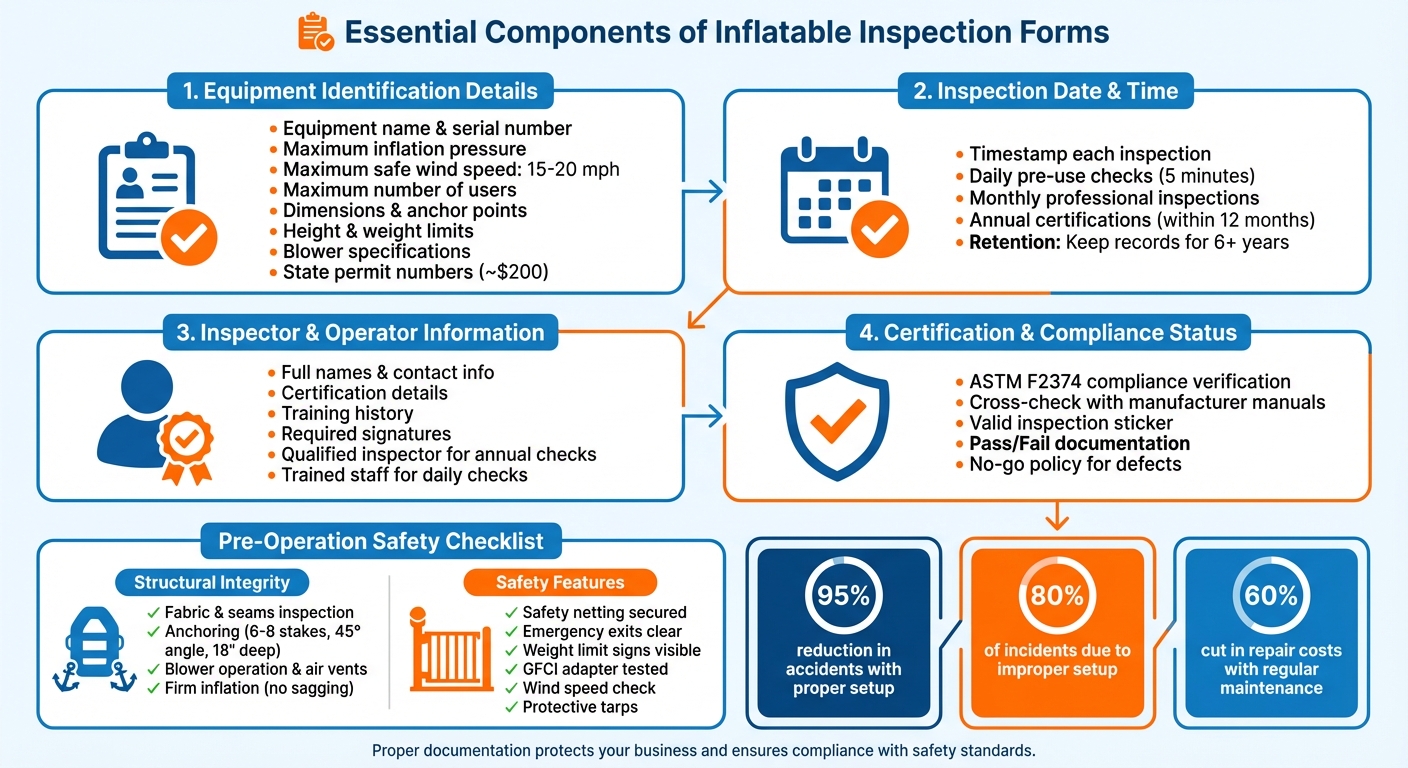
Essential Components of Inflatable Inspection Forms Checklist
Core Components of an Inflatable Inspection Form
To create a thorough and legally defensible record, every inflatable inspection form needs to cover four key areas. These categories ensure proper accountability, track inspection history, and confirm compliance with safety standards.
Equipment Identification Details
Start by documenting the inflatable’s name and serial number to maintain an accurate inspection history. Additionally, include the following:
- Maximum inflation pressure (as specified by the manufacturer)
- Maximum safe wind speed
- Maximum number of users at one time
- Dimensions and the total number of anchor points
These physical specifications are crucial for verifying that the setup meets the requirements outlined during the design review.
Pay close attention to user restrictions. Clearly record height and weight limits to prevent overloading, and confirm that safety labels and weight limit tags are visible and easy to read. Also, document the blower fan or compressor specifications to ensure they match the manufacturer’s original design. If you’ve replaced the blower with one that differs from the original specifications, this modification must be explicitly noted on the form.
Finally, include any regulatory markers, such as state-issued operating permit numbers. These permits, which typically cost around $200, are mandatory in most states.
Once all equipment details are recorded, the next step is to timestamp the inspection for accountability.
Inspection Date and Time
Recording the date and time of each inspection establishes a clear timeline of when the inflatable was deemed safe for use. This timestamp is critical, especially in the event of an incident, as it proves the inspection occurred before the equipment was used by the public.
Time-stamping also ensures compliance with required inspection intervals, such as daily pre-use checks, monthly professional inspections, and annual certifications, which must occur within 12 months of the previous inspection. Completed, time-stamped inspection forms should be filed alongside the specific hire agreement for the event and retained for at least six years to meet insurance and legal obligations.
With the timing documented, the next priority is identifying who conducted the inspection.
Inspector and Operator Information
The form should clearly differentiate between the roles of inspector and operator. For annual and initial inspections, list a "qualified inspector", which in many jurisdictions means a state-certified inspector. For daily or pre-hire checks, the responsible party is often the owner, an employee, or trained staff.
The Irish Inflatable Hirers Federation explains:
The first three inspections (Conformity to Design, Initial, and Annual) must be performed by a qualified inspector.
Make sure to record the full names and contact information for both the inspector and the operator to establish accountability. Include the inspector’s certification details and the operator’s training history to confirm their ability to identify potential defects. Signatures are essential to verify that the checklist was completed truthfully. Additionally, maintain a separate training documentation form to back up the qualifications listed on the inspection sheet.
Certification and Compliance Status
This section confirms whether the inflatable complies with current safety standards and is approved for use. The Health and Safety Executive emphasizes the importance of proper verification:
A report of a satisfactory initial test should not be issued unless the competent person has witnessed and verified that, at the time and place of test, the device performed safely.
Cross-check all recorded data with the manufacturer’s manuals to ensure the equipment meets the required specifications. In states like Oklahoma, verify that the inspection date matches a valid, visible inspection sticker issued by the Department of Labor. If a defect is found during the inspection, the inflatable must not be used until the issue is fully resolved. This includes following a sanitization checklist to ensure the unit is hygienic and safe for the next user. This pass/fail result should always be clearly documented on the form.
Pre-Operation Safety Checklist
Before every use, a physical inspection is essential to ensure the inflatable is safe for participants. This routine check helps catch minor issues before they turn into serious hazards and ensures compliance with state and national safety regulations. As the Irish Inflatable Hirers Federation states:
The inflatable must not be used by the public until all defects identified during the routine inspection are resolved.
The sections below outline the critical visual and functional checks that must be completed before each operation.
Structural Integrity Checks
Start by examining the fabric and seams for any signs of tears, holes, punctures, or wear. Pay extra attention to high-stress areas like corners and double-stitched seams, as these are more prone to damage. A quick visual inspection before each use can prevent many operational issues.
Next, check that the inflatable is securely anchored and positioned. Stakes should be driven at a 45-degree angle and placed at least 18 inches into the ground. Most commercial inflatables require six to eight stakes for proper securing. Ensure tethers and ropes are intact and that the unit remains stationary when pulled. As HeroKiddo explains:
A properly anchored bounce house won’t budge, even when kids are going wild inside.
Inspect the inflation system thoroughly. Confirm the blower is operating smoothly, that mesh guards are in place, and that air vents are unobstructed. Once inflated, the unit should feel firm with no sagging, wrinkling, or distortion. Monitor air pressure during the event, and if sagging occurs, remove participants immediately.
Safety Features Assessment
In addition to structural checks, verify that all safety features are functioning correctly. Inspect safety netting to ensure it is securely attached, free of tears, and not sagging. Emergency exits and barriers should be unobstructed and operational. Confirm that weight limit signs are clearly visible and easy to read for both staff and attendees.
Electrical components also require attention. Test the GFCI adapter before operation, and inspect the cord periodically during the event to ensure it remains safe.
Environmental conditions play a critical role in safety. Inflatables should not be used if wind speeds exceed 15–20 mph. Additionally, lay protective tarps under the inflatable during setup to shield the bottom fabric from damage and wear.
Pass/Fail Documentation
Document the inspection results clearly, noting any defects or issues that need repair before use. Mark each item to confirm it has been checked.
The Irish Inflatable Hirers Federation highlights the importance of maintaining these records:
Being able to present a completed routine inspection sheet from your records will serve as important proof for your insurance provider or legal parties involved.
Adopt a strict "no-go" policy: if any defects are found, the inflatable must not be used until all issues are resolved. Using digital checklists can simplify this process by enabling real-time data entry, photo documentation of defects, and automated maintenance reminders. These tools help ensure accurate records and support both compliance and liability protection.
Manufacturer Guidelines and ASTM Standards
This section shifts focus from basic inspection components to the importance of following manufacturer instructions and industry standards. Every inflatable comes with specific operating instructions that must be properly documented. These include critical details like the maximum inflation pressure, which should be clearly marked at the inflation point. Additionally, the exact number of anchor points required to withstand wind loads must be specified. Without this documentation, the risk of unsafe operation increases significantly.
The industry standard to follow is ASTM F2374-24, updated on June 25, 2024. This standard provides detailed guidance on the design, manufacture, operation, and maintenance of commercial inflatable amusement devices. These devices are commonly used by rental companies, amusement parks, and family entertainment centers. As ASTM International explains:
The purpose of this practice is to delineate information regarding the design, manufacture, installation, operation, and maintenance of inflatable amusement devices.
Manufacturer-Specific Requirements
Inspection forms should include fields for the manufacturer’s recommended maintenance schedule. Most commercial inflatables require a combination of daily pre-use checks (taking about 5 minutes), weekly deep cleanings, monthly professional assessments, and annual safety certifications. It’s also essential to document blower compatibility and confirm the presence of automatic cut-outs to prevent over-pressurization. The Health and Safety Executive highlights:
The maximum inflation pressure… must also be clearly and indelibly marked next to the inflation point.
Operational limits, such as weight capacity, maximum participant count, and age group separations, must be verified. Additionally, ensure safety labels and warning signs remain clearly visible. If an inflatable lacks its original manufacturer paperwork, a professional design review is required before it can be legally operated.
By incorporating these manufacturer guidelines, you can create an inspection form that aligns with ASTM F2374-24, minimizing potential risks.
ASTM F2374 Compliance
Conforming to ASTM F2374-24 ensures that your inspection process addresses key risk areas to prevent injuries. The standard mandates checks on anchoring systems, impact attenuation materials at entry and exit points, and the presence of trained operator supervision. Recent updates to the standard place a stronger emphasis on improved anchoring systems and reducing fall risks near entry areas.
Your inspection form should include fields to document the number of anchor points as specified in the manufacturer’s manual, assess the condition of padding at entry and exit points, and verify that blower fans are compatible with required safety features. Following these guidelines can reduce accidents by up to 95%, as improper setup is responsible for 80% of incidents. Additionally, sticking to regular maintenance and inspection schedules can cut repair costs by as much as 60%.
Integrating manufacturer instructions and ASTM standards into your inspection forms is a critical step toward ensuring regulatory compliance and operational safety. The next step involves examining state-specific regulations to ensure your inspection documentation meets all local requirements.
State-Specific Regulatory Requirements
While national standards like ASTM F‑24 provide a baseline, each state has its own additional rules and requirements that must be addressed. Oversight varies by state, with agencies such as the Maryland Department of Labor, the Louisiana State Fire Marshal, and the Texas Department of Insurance managing compliance in their respective regions. Your documentation must account for state-specific rules on registration, insurance, and inspections to ensure full compliance. These requirements build upon manufacturer guidelines and ASTM standards to enhance operational safety.
Insurance requirements differ widely between states. For instance, Maryland mandates a $200,000 minimum liability for non-mechanical inflatables, while Texas sets higher thresholds at $1,000,000 for bodily injury and $500,000 for property damage. New Mexico has even stricter requirements, demanding $3,000,000 in coverage per occurrence.
Advance notification is another area where states vary. For example, Alaska requires 10 days’ notice, Arkansas asks for 4 days, and Pennsylvania mandates inspections every 28 days or at each setup. States like Florida and Colorado leave these specifics to local regulations.
Annual Registration and Certifications
Most states require inflatables to display a current registration decal or compliance sticker issued by a state agency. Kay K. Morgan, Associate at Merlin Law Group, explains Texas’s requirements:
A reputable and a ‘legal’ vendor in Texas must: be fully insured and have a current Texas Amusement Ride Compliance Sticker… for each inflatable that is rented with that device’s vend/serial number on the sticker.
Your inspection forms should include fields for recording registration details such as registration numbers, decal IDs, and equipment serial numbers. Cross-referencing these details ensures that each unit is legally registered. Louisiana law explicitly states:
No inflatable amusement device… shall be operated in this state without a current certificate of registration, valid registration plate, and registration decal issued by the office of state fire marshal.
Registration fees also vary by state. Texas charges $40 per sticker, Oklahoma $1 per device, New York $100 per ride, and Louisiana $20. Maryland requires annual registration by April 1. Including a section on your forms to track renewal dates and fee payments can help avoid lapses in compliance.
Third-Party Inspection Requirements
In addition to registration, many states require annual third-party inspections to enforce safety standards. For example, Louisiana mandates that inspections follow ASTM F‑24 guidelines and be carried out by certified third-party inspectors. According to the Louisiana Revised Statutes:
Each inflatable amusement device… shall be inspected by a third-party inspector for safety and subjected to nondestructive testing… at least annually, in accordance with ASTM‑F‑24.
Inspector qualifications vary by state. New Mexico accepts NAARSO-certified inspectors, Rhode Island requires independent professional engineers, Texas allows insurance-authorized inspectors, and Washington permits state-certified third-party inspectors. Your forms should capture the inspector’s name, certification type and level, certification number, and expiration date.
States also have specific requirements for maintaining inspection records. For example, Arkansas requires that inspection certificates and proof of insurance be physically available at the inflatable’s location during operation. Some states, like Ohio and New Jersey, require operators to submit itineraries of planned locations for unannounced follow-up inspections. Louisiana takes a strict approach: if a third-party inspector identifies deficiencies, they must notify the state fire marshal within 10 days, potentially triggering a cease-and-desist order.
The Washington State Department of Labor & Industries emphasizes:
To ensure that amusement rides in Washington are safe, ride operators are required to have their rides inspected annually by third-party safety inspectors.
Timely scheduling is crucial. For example, in Oklahoma, inspections must be arranged at least 72 hours before operation. Once passed, a compliance sticker is issued. In Washington, this comes with a $10 fee per inflatable for the operating permit decal. Documenting all inspection details thoroughly ensures compliance with state laws and avoids operational disruptions. Tailoring your inspection forms to these specific requirements will help streamline the process and keep your operations legally sound.
Insurance and Liability Information
When it comes to inspection forms, having thorough insurance and legal documentation is just as important as conducting technical checks. These documents not only protect your business but also meet the requirements of venues like schools, parks, and municipalities. Many such venues won’t even allow setup without proof of coverage, often requiring liability limits between $1 million and $2 million. Skipping this step can lead to serious legal complications.
Proof of Insurance Coverage
A Certificate of Insurance (COI) is your go-to document for proving insurance coverage. This certificate provides key details like policy limits and expiration dates. It’s critical to ensure your COI is up-to-date for every event. Your inspection forms should include spaces for recording the policy number, coverage amounts, and expiration date to confirm your protection is valid during the event.
Insurance policies come in various forms, each serving a specific purpose:
- General liability insurance: Covers third-party injuries and property damage, often requiring $1,000,000 per occurrence and $2,000,000 in aggregate coverage.
- Property and equipment insurance: Protects your inflatables from risks like theft, fire, or damage.
- Commercial auto insurance: Provides coverage for transport-related incidents.
- Umbrella coverage: For larger events or premium venues, additional coverage from $3,000,000 to $10,000,000 may be necessary.
To avoid disruptions, set reminders 30 to 60 days before your policy expires so you can update your COI in time. Many venues also require being listed as an "Additional Insured" on your policy – a process that usually costs $25 to $50 per certificate and takes 7 to 14 days to process. Double-check that the business name, policy numbers, and expiration dates on your inspection form align with the current documentation.
Proper legal protection doesn’t stop at insurance. Liability waivers are another essential layer of security.
Liability Waivers and Agreements
Liability waivers and hold-harmless agreements help shield your business from claims by clearly outlining that the customer accepts responsibility for any injuries or equipment damage during the rental period. Your inspection forms should reference or include these waivers as part of the overall documentation package.
An effective waiver should include:
- The lessee’s name and the event’s physical address
- The renter’s license or ID number
- Detailed delivery and pickup times
- Explicit "assumption of risk" language, stating that liability remains even after the event ends
The renter must sign and date the waiver to confirm they understand the safety guidelines and accept the risks. Before installation, complete the inspection form with the renter present to confirm the equipment’s condition and safety. A walkthrough together after the inspection allows you to address any concerns, and the renter’s signature creates a clear record that both parties agreed on the equipment’s condition at delivery.
Digital tools make managing this documentation easier. Mobile devices allow for real-time data entry, automated reminders for inspections, and centralized storage for certifications and records. Using online PDF editors or rental software, you can capture e-signatures instantly, share them with stakeholders, and securely archive them. Always file the inspection checklist, signed waiver, and hire agreement together, and retain these records for at least six years to comply with legal and insurance requirements.
Record-Keeping and Retention Practices
Thorough inspection records are more than just paperwork – they’re your safeguard during insurance claims, legal disputes, or audits. These records can help you avoid hefty fines and liability issues.
Organizing Inspection Records
Ditch the handwritten logs and move to digital field reports. They eliminate re-entry errors, ensure accurate on-site details, and allow supervisors to instantly review progress. Plus, they make it easy to attach photos and send automated reports to stakeholders.
For secure and accessible storage, sync your forms with cloud platforms like Google Sheets, Dropbox, or SharePoint. Features like electronic signatures and GPS time-stamping can confirm inspections happened at the right location and time. Using standardized templates for all inspections ensures consistency and helps you track recurring issues effectively.
If you purchase second-hand inflatables, ask the seller for previous maintenance records, repair histories, and modification details. Make sure to archive these documents in your current filing system for a complete record history.
Retention Periods and Audit Preparation
Once your records are organized, keeping them for the legally required period is critical. Most insurance schemes and jurisdictions require a minimum retention of six years for inspection records. Some states, like Oklahoma, mandate keeping daily inspection logs for at least three years – always verify with local authorities.
"Being able to present a completed routine inspection sheet from your records will serve as important proof for your insurance provider or legal parties involved."
- Irish Inflatable Hirers Federation (IIHF)
Your master file should include key documents such as:
- Design reviews
- Initial test reports
- Declaration of Operational Compliance from annual inspections
- Certificates verifying that any repairs meet manufacturer standards
Professional in-service inspections, required at least every 12 months, should also be documented and included in the equipment’s operations manual.
Make sure these records are always accessible. Regulators, insurance agents, or venue managers may demand immediate proof of certification. Failing to provide these records could result in revoked registration, loss of insurance, or steep daily fines.
Conclusion
Inflatable inspection forms are your first line of protection against liability issues, local safety laws, and equipment malfunctions. Each documented check serves as proof that you’ve followed proper safety protocols – critical evidence if an accident ever occurs.
A quick 5-minute pre-operation inspection, when thoroughly documented, establishes a consistent safety framework. This framework helps guide decisions during uncertain situations, like borderline weather conditions or urgent repair needs. Beyond ensuring compliance, this documentation strengthens your defense against legal and operational risks, safeguarding both your customers and your business reputation. Routine checks, when properly documented, become powerful tools for protecting your operations.
For rental businesses such as Bouncy Rentals USA, maintaining detailed inspection records reflects professionalism and a commitment to safety. These records fulfill insurance requirements, support permit renewals, and prove adherence to ASTM International guidelines. When regulators or venue managers request proof of certification, you’ll have the necessary documentation ready to keep your business running smoothly and legally.
Inspection forms also enforce a clear pass/fail system that eliminates ambiguity for your staff. This consistency helps prevent incidents – not because of faulty equipment, but because of insufficient documentation.
Think of inspection forms as a risk management tool, not just a casual checklist. Complete a form for every rental, store it alongside the rental agreement, and keep it on file for at least six years. This disciplined approach to record-keeping is the foundation of both regulatory compliance and operational safety in the inflatable rental industry.
FAQs
How often do inflatables need to be inspected?
Inflatables need regular inspections to keep them safe. While many states mandate annual checks, it’s wise to inspect them before every use. This proactive approach helps catch potential problems early and ensures they meet safety standards.
What makes an inspector “qualified” in my state?
A qualified inspector in your state meets the skill and knowledge requirements established by respected accreditation programs, such as the Register of Play Inspectors International (RPII). These programs verify that inspectors are well-versed in safety guidelines, proper inspection procedures, and standards like BS EN 14960 through a combination of written and practical exams.
What should I do if an inflatable fails inspection?
If an inflatable doesn’t pass inspection, take it out of service right away to avoid any risk of injury. Look for problems like tears, frayed seams, or unsecured anchor points, and address them before scheduling another inspection. Always stick to the manufacturer’s repair instructions, and ensure any fixes are properly checked and approved. Routine inspections and quick repairs are key to keeping the inflatable safe and meeting all required standards.
Related Blog Posts
- Checklist for Measuring Space for Inflatables
- Inflatable Inspection Requirements in South Carolina
- 5 Steps for Post-Event Bounce House Inspection
- Preventative Maintenance Checklist for Inflatables