Choosing the right bounce house for your event boils down to four key factors: safety, space, age group, and theme. Here’s a quick summary to help you make the best choice:
- Safety First: Always prioritize safety by ensuring the bounce house matches the age and size of your guests. Keep toddlers and teens separate to prevent injuries. Look for ASTM-certified inflatables and companies with liability insurance.
- Measure Your Space: Confirm the dimensions of your setup area, including overhead clearance (15-18 feet). Leave a safety buffer around the inflatable to avoid accidents.
- Match to Age Groups: For toddlers, choose smaller, enclosed units. Older kids and teens enjoy combo units or obstacle courses with slides and interactive features. Adults can join in with inflatables designed for heavier use.
- Pick a Theme: Themed bounce houses can tie into your event’s vibe, from princess castles to superhero adventures. Bounce house vs. combo units comparisons show that units with slides or water features add more fun.
Bounce house rentals range from $250 to $1,100 depending on size, features, and duration. Always book early, especially during peak seasons, and confirm setup requirements like power outlets or permits for public spaces. Check local South Carolina permit requirements to ensure compliance. A well-chosen inflatable ensures a safe, fun, and memorable event for everyone.
Calculate Event Size and Available Space
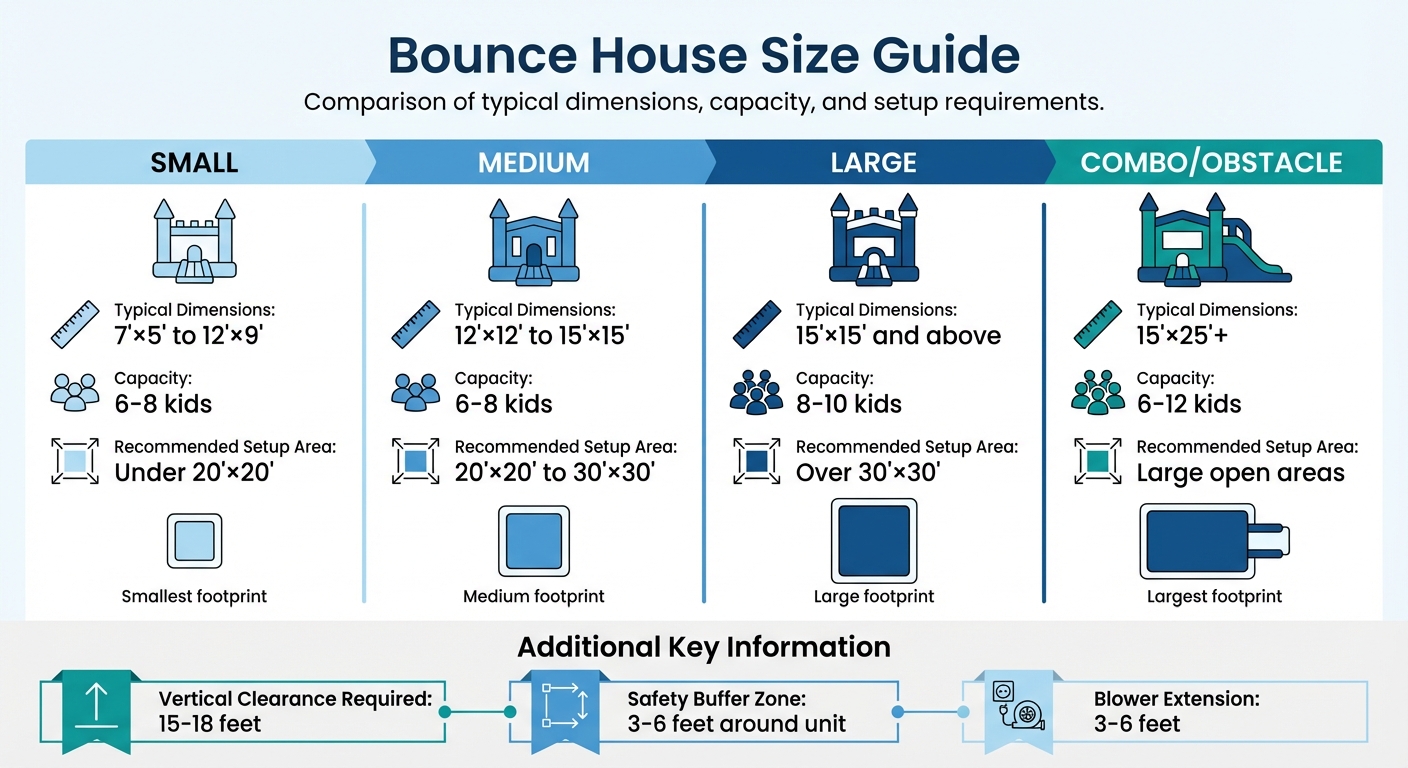
Bounce House Size Guide: Dimensions, Capacity, and Setup Requirements
Getting the logistics right starts with two key considerations: how many guests will be using the bounce house at the same time and whether your setup area can handle the inflatable safely.
Calculate Guest Numbers
Start by estimating how many kids will be bouncing during the event. For example, a small 11×11-foot bounce house typically accommodates 6 to 8 children under the age of 8. If your guest list includes more than 20 kids, it’s a good idea to rent multiple inflatables or opt for a larger obstacle course. This helps avoid long wait times, prevents overcrowding, and ensures everyone can enjoy the fun safely.
Next, confirm that your setup space can handle the inflatable you choose.
Measure Your Setup Area
Grab a tape measure and carefully check the dimensions of your available space. Measure the length, width, and height, and don’t forget to account for any overhead obstacles. You’ll also need a safety buffer of 3–6 feet around the inflatable to ensure proper clearance. Most bounce houses require 15 to 18 feet of vertical space. Look out for hazards like low-hanging tree branches, power lines, or building overhangs that could interfere with the installation.
This extra clearance not only prevents accidents but also provides a safe zone for supervising adults. Keep in mind that the blower unit typically extends 3–6 feet and needs unobstructed airflow. If you’re renting a combo unit with a slide, make sure to leave additional space for the slide’s exit area so kids can land safely.
| Bounce House Size | Typical Dimensions | Capacity | Recommended Setup Area |
|---|---|---|---|
| Small | 7’x5′ to 12’x9′ | 6–8 kids | Under 20’x20′ |
| Medium | 12’x12′ to 15’x15′ | 6–8 kids | 20’x20′ to 30’x30′ |
| Large | 15’x15′ and above | 8–10 kids | Over 30’x30′ |
| Combo/Obstacle | 15’x25’+ | 6–12 kids | Large open areas |
If your event is indoors, don’t forget to check the ceiling height. Many commercial inflatables are taller than standard room heights, so this is a critical detail to verify.
Select Based on Guest Ages
Choosing the right bounce house for your event isn’t just about size or style – it’s about ensuring both safety and fun for your guests. The age group of your attendees plays a huge role in determining the best option. A bounce house designed for toddlers might bore older kids, while high-intensity options can be risky for younger ones. Here’s how to make the right choice for each age group.
Options for Toddlers and Young Children
For the youngest guests, go for a small, enclosed bounce house with low walls and soft surfaces. These models, typically 8×8 to 10×10 feet, are perfect for 2–3 toddlers at a time. If you’re hosting slightly older children (under 8), a 13×13-foot model can accommodate 6–8 kids safely. These inflatables are quick to set up, taking just 3–5 minutes to inflate.
Look for commercial-grade materials like Dura-Lite™ Vinyl, which offer a lightweight yet durable design. Also, confirm that the rental company uses non-toxic, kid-safe cleaning products and ensures the unit is thoroughly dried to prevent mildew.
Options for Older Children and Teens
Older kids and teens often prefer inflatables with added features to keep things exciting. Combo units or interactive inflatables with climbing walls, basketball hoops, tunnels, and steep slides are great options. Obstacle courses are another big hit, introducing a competitive element as teens race through barriers and tunnels.
Keep in mind that these larger inflatables require more space. Some units may need up to 70′×20′ of ground area and a vertical clearance of up to 22 feet for proper setup. For safety, ensure the unit is made from industrial-grade materials like PVC tarpaulin or reinforced vinyl. Always deflate these units if wind speeds exceed 20 mph.
Options for Adults
Yes, even adults can join in the fun! For them, choose inflatables specifically designed with reinforced stitching and heavy-duty materials to support adult use. Be sure to follow the manufacturer’s weight limits and monitor the number of participants to prevent overcrowding.
Pick a Theme and Style
Once you’ve confirmed the size and age suitability of your bounce house, the next step is to match it to your event’s style. A well-chosen theme can elevate your event, tying together your decorations and creating an unforgettable atmosphere. Whether it’s a backyard birthday or a neighborhood gathering, selecting a bounce house that complements the event’s vibe can make all the difference.
Themed Designs
Themed bounce houses come with artwork and designs tailored to popular interests. For instance, a Princess Castle fits right into a royal-themed birthday, while Dinosaur Adventures or Superhero Training Camps are perfect for kids with specific passions. These designs are especially great for birthday parties where the guest of honor has a favorite character or theme.
For community events, themes like Firefighter or Police often appeal to families, while a Sports Mania design can energize youth tournaments or school field days. During summer, aquatic themes such as Shark, Mermaid, or Under the Sea pair naturally with water features to keep guests cool. Themed bounce houses can even double as the centerpiece of your décor. You can enhance the overall look by coordinating decorations with the bounce house theme. Seasonal options like Halloween Spooktacular or Winter Wonderland add a festive touch to holiday events.
If you’re looking to up the fun factor, combo units with multiple attractions are worth considering.
Combo Units and Interactive Features
Combo units bring extra excitement by incorporating features like slides, climbing walls, and interactive games. These inflatables combine bouncing areas with slides, basketball hoops, or even splash pools, making them ideal for mixed-age groups.
For larger gatherings, obstacle courses provide even more entertainment. These setups include tunnels, barriers, and slides, offering linear challenges that work well for events with a steady flow of participants. Interactive games like jousting arenas, bungee runs, or even mechanical bulls add a competitive twist to the fun. Keep in mind, though, that larger combo units and obstacle courses need to meet specific space requirements and at least 15–20 feet of overhead clearance to avoid hazards like power lines or tree branches.
To explore a wide range of themed designs and dynamic combo units, check out the options at Bouncy Rentals USA – they’re sure to have something that fits your event perfectly.
Check Safety Standards and Setup Needs
When it comes to bounce houses, safety is not something to take lightly. With over 10,000 bounce house-related emergency room visits each year, the risks are real. But here’s the encouraging part: 95% of these injuries can be avoided with proper precautions and supervision. Choosing a provider that prioritizes safety and preparing your space correctly can make all the difference.
Verify Safety Certifications
Start by ensuring the bounce house complies with ASTM standards, which cover everything from the materials used to the stitching quality and required safety features like enclosed sides. Additionally, check if the rental company is affiliated with SIOTO (Safe Inflatable Operators Training Organization). This certification indicates they adhere to strict safety and training protocols.
"Legitimate companies carry comprehensive liability insurance specifically designed for inflatable equipment. This insurance protects you as the renter if an accident occurs." – TJ’s House of Bounce
Always ask for proof of insurance. Reputable providers will have comprehensive liability insurance and won’t hesitate to share documentation. Look for bounce houses made from 18 oz commercial-grade vinyl with reinforced seams and features like safety netting and emergency exits. Also, confirm that the rental company follows CPSC (Consumer Product Safety Commission) guidelines for inflatable equipment.
Once certifications are squared away, it’s time to ensure your event space is ready for installation.
Plan for Installation Requirements
After verifying safety standards, turn your attention to the setup area. The space must be larger than the bounce house itself. For instance, a standard 15×15-foot bounce house requires a 20×20-foot area to set up a safety perimeter to allow for proper anchoring and a 6-foot safety zone around the unit. Ensure there’s also a 15–18-foot vertical clearance, free from obstacles like tree branches, power lines, or overhangs.
Before booking, inspect the site and remove hazards like rocks, sticks, pet waste, or anything sharp that could damage the vinyl. Determine the surface type – grass requires stakes, while hard surfaces like concrete or public parks need sandbags or water barrels weighing 200–300 lbs per anchor point. You’ll also need access to a 110-volt or 120-volt outlet on a 20-amp circuit within 50–100 feet of the setup area. Hosting at a public park? Check if a permit is required and whether you’ll need a generator.
Companies like Bouncy Rentals USA handle professional installation, providing the correct anchoring system for your surface type. Their team conducts on-site safety checks and ensures your space meets all requirements well before your event date.
Compare Rental Packages and Pricing
Once you’ve confirmed safety standards and space requirements, it’s time to match your budget to the right rental package. The national average cost for bounce house rentals is $312, with most prices falling between $240 and $406. Knowing what each package includes can help you avoid unexpected charges and ensures you’re getting good value for your event.
Basic, Premium, and Custom Packages
Basic packages, typically suited for smaller backyard parties, cost between $250 and $275 for a 6-hour rental. If you’re looking for more variety, combo units – which combine a bounce area with features like slides or climbing walls – range from $350 to $600. These offer more entertainment options, especially when you’re working with a limited budget. For larger gatherings, obstacle courses start at $375 for smaller setups and can go beyond $1,100 for more elaborate designs.
"A professional company’s daily rental earnings typically range from USD 150 to USD 400, and that price covers the use of durable, commercial-grade 18 oz vinyl for safety." – 512Jump
Make sure to confirm what’s included in the price. Some companies include delivery, setup, safety mats, and teardown, while others charge separately for these services. Many providers also offer bundled deals, such as adding popcorn or cotton candy machines to your inflatable rental, which can save money compared to renting items individually. For example, Bouncy Rentals USA provides transparent pricing that covers delivery, setup, and safety inspections within their service area.
Factor in Rental Duration and Add-Ons
Rental duration and additional services can significantly affect the total cost. Standard rentals usually last 6 hours, but it’s important to clarify whether this timeframe includes setup and teardown. Extending your rental typically costs about 10% more per extra hour. Overnight rentals add roughly 20% to the base price, while weekend-long rentals can increase costs by up to 50%.
Be aware of potential extra fees. Delivery is often free within the first 20 miles, but beyond that, companies may charge $15 to $30 or more. If your power outlet is far from the setup area (50–100 feet), you might need a generator, which typically costs $75 to $200. For setups on concrete or asphalt, heavy sandbags are required instead of stakes, which may result in additional surface setup fees. Water slides also come with extra costs – around $75 more than dry slides – due to the additional labor and cleaning involved.
Concessions like popcorn or snow cone machines cost between $45 and $175. If you’re hosting a larger event with a mix of age groups, renting two units – one for toddlers and one for older kids – can be safer and more engaging than a single large inflatable. Finally, always review weather policies carefully. Look for companies that allow rescheduling or offer credits if strong winds (15–20 mph) or heavy rain make it unsafe to proceed.
Conclusion
When choosing a bounce house, consider factors like available space, the ages of your guests, the event’s theme, safety certifications, and rental costs. As the 512Jump Team explains:
"A professional company will be completely transparent about its insurance, cleaning standards, and safety procedures".
This transparency ensures a fun and safe event where kids’ well-being takes center stage.
Before booking, double-check that you have enough space – typically 15–18 feet of vertical clearance and a 3–5-foot safety buffer. Also, book early, especially during peak seasons like spring and summer. Popular themed units often get reserved 4 to 6 weeks in advance. To avoid hiccups on delivery day, clear the setup area of rocks, sticks, and debris the day before.
With the market growing, there are more options than ever, but also higher demand during busy months. Whether you’re planning a small backyard party for toddlers or a large community event with obstacle courses, the "right" bounce house isn’t necessarily the biggest or flashiest. As Orbit Moonwalks puts it:
"The ‘right’ bounce house isn’t the biggest or flashiest – it’s the one that fits your space, suits your child’s age, and works with your budget".
With demand increasing, locking in the perfect bounce house early is key. Check out Bouncy Rentals USA at https://bouncyrentalsusa.com/ for a variety of inflatables, combo units, top inflatable water slides, and party add-ons. All rentals are sanitized, insured, and delivered on time, so you can focus on making memories instead of worrying about the details.
FAQs
How do I figure out the right bounce house size for my guest count?
When picking a bounce house, think about the number of children and their ages. For younger kids (ages 3–7) or small groups of 6–8, smaller units (11×11 to 13×13 feet) work well. If you’re hosting a larger party or have a mix of age groups, a bigger option (15×15 feet) can accommodate 8–10 kids comfortably. Just make sure your venue has enough room for the bounce house, safety zones, and proper supervision to keep things fun and secure.
What do I need if my event is on concrete or at a public park?
When placing a bounce house on concrete surfaces, it’s crucial to use impact-absorbing mats that extend at least 4 feet around the inflatable. To keep it securely anchored, use sandbags or water weights, with each anchor weighing at least 359 pounds.
Avoid setting up the bounce house during high winds or extreme heat, as these conditions can compromise safety.
If you’re planning to use a bounce house in a public park, there are a few extra steps to consider. You’ll need to obtain permits, which typically cost about $10, and ensure you have liability insurance covering at least $1,000,000. Choose a flat, hazard-free area for setup to minimize risks.
Lastly, always keep an eye on the weather, supervise the activity, and stick to the capacity limits to ensure everyone stays safe.
What should I ask a rental company to confirm the bounce house is safe?
To make sure a bounce house is safe, it’s important to ask the rental company a few key questions. Start by confirming if their equipment is safety-certified and if they have insurance for inflatable rentals. You can ask things like: "Are your bounce houses certified to meet ASTM safety standards?" and "Does your company carry full insurance for bounce house rentals?" These questions help ensure the equipment is up to safety standards and that you’re covered in case something goes wrong.