Inflatable blowers are essential for bounce houses and slides, but improper setup, electrical issues, or bad weather can lead to accidents. States enforce safety laws to reduce these risks, including registration, inspections, and insurance requirements. Here’s what you need to know:
- Federal Standards: ASTM F2374-22 ensures blower safety, focusing on airflow, electrical safety, and guarding moving parts.
- State Regulations:
- Oklahoma: $1 annual registration and inspection fee, $1M liability insurance, and strict inspection rules.
- California & Texas: Higher insurance minimums ($1.5M in Texas), local permits, and electrical code compliance.
- New York & Florida: Focus on electrical safety with annual inspections and fire marshal oversight.
- Weather Rules: Shut down inflatables if winds exceed 15-25 mph.
- Daily Checks: Follow an inflatable setup safety checklist to inspect blowers, anchors, and cords before use; keep logs for three years.
- Penalties: Non-compliance risks fines, insurance voids, and cease-and-desist orders.
Staying compliant protects your business and ensures guest safety. Always follow state-specific rules, maintain records, and monitor weather conditions.
Federal Safety Standards for Inflatable Blowers
The federal standard ASTM F2374-22 outlines the essential safety requirements for continuous air inflatable amusement devices. These inflatables rely on a steady stream of air from blowers to maintain their shape. If the airflow stops, the structure collapses. This standard acts as the baseline for further state-specific regulations discussed elsewhere.
Key provisions include protections against blower disconnections, mechanical breakdowns, and power interruptions. It also emphasizes measures to prevent electrical shocks and burns in outdoor environments. Additionally, blower units must have guards to block access to moving parts or electrical components that could pose a risk of injury. As ANSI highlights:
"Injuries or even fatalities can happen if inflatable amusement devices are incorrectly set up, anchored, operated, or supervised and not regularly tested and inspected." – ANSI
The National Electrical Code (NEC) and UL 705 standards require that temporary wiring and portable generators used for blower setups include GFCI protection and adhere to fire safety protocols. To enhance safety, operators must place a certified portable fire extinguisher near each generator.
For blowers with a fan shaft input of 1 horsepower or an electrical power of 0.89 kW or more, manufacturers are required to test and certify energy consumption. These regulations stress the need for thorough inspections and strict compliance to ensure the safe operation of inflatable blowers.
At Bouncy Rentals USA, we go the extra mile to ensure all our inflatable equipment not only meets but exceeds these federal safety standards, giving you confidence and security for every event.
State-Specific Blower Regulations
Each state has its own set of rules for inflatable blower safety, making it tricky for businesses operating across state lines. Knowing these regulations is a must to avoid penalties and ensure compliance.
Oklahoma: Registration and Inspection Rules
In Oklahoma, inflatables are categorized as amusement rides and fall under the jurisdiction of the Oklahoma Department of Labor (ODOL), which inspects around 3,600 devices annually. Every inflatable must pass an annual inspection by a certified ODOL inspector before it can be rented or used publicly. The registration and inspection fee is just $1.00 per device.
These inspections focus on blower equipment maintenance and electrical connections. Once approved, a current-year inspection sticker is placed on the device. The ODOL makes its stance clear:
"If it doesn’t have this sticker, it shouldn’t be in use. Every inflatable amusement device operating in Oklahoma must display a current inspection sticker issued by the Oklahoma Department of Labor."
Operators are required to schedule inspections at least 72 hours in advance and submit an annual application along with a Certificate of Liability Insurance that names ODOL as the certificate holder. Oklahoma mandates liability insurance coverage of at least $1,000,000, and inspections are valid for the calendar year, from January 1st to December 31st.
Some states, however, take a more detailed approach with certification requirements.
California and Texas: Certification and Permits
California and Texas go beyond Oklahoma’s straightforward system by adding extra layers of certification and permitting. In Texas, inflatable rental companies must carry state-mandated insurance and display inspection stickers on their equipment. The liability insurance minimum is higher than in Oklahoma, set at $1.5 million. Event organizers can check compliance through state-maintained lists.
Both states also require blower equipment to meet local electrical codes and often mandate permits for public events. Coordination with fire marshals and building departments is common, especially for larger gatherings, ensuring safety measures are in place before operations begin.
New York and Florida: Electrical Safety Inspections
New York enforces annual inspections under 12 CRR-NY 45-2.22 for air compressors and related equipment used with amusement devices. These inspections must be done by a qualified individual, and records must be available for review by the commissioner. Additionally, the maximum allowable working pressure must be clearly marked on all air equipment.
Florida focuses on fire marshal inspections to enforce NEC standards and GFCI requirements, aiming to minimize electrical hazards from blower systems. Both New York and Florida require thorough documentation of electrical safety checks, though the methods of enforcement vary between the two states.
Compliance Best Practices for Blower Operation
Staying compliant with state and local safety laws isn’t just about meeting inspection standards – it’s about creating safe environments for everyone at your events. Following the right procedures ensures both regulatory compliance and guest safety.
Setup and Anchoring Requirements
Blowers should be positioned between 4 and 4.6 feet away from inflatables to prevent overheating and maintain proper airflow. Before each setup, inspect critical components like the inlet/outlet guards, non-return valve, and impeller for any signs of damage.
When anchoring inflatables, follow ASTM F2374 standards or the manufacturer’s guidelines – whichever is stricter. Use stakes, weights, or sandbags to secure the inflatable, ensuring anchor points are set at the correct angles for stability. To prevent tripping hazards, cover front anchor points with safety mats. The Oklahoma Department of Labor emphasizes:
"The owner/operator has been instructed to use appropriate stakes to securely anchor the inflatable".
If a blower needs to be replaced during an event, the replacement must match the original design and power specifications approved during the state inspection. Additionally, ensure all electrical components undergo annual Portable Appliance Testing (PAT) to confirm their safety. These steps form the foundation for safe operations, leading into daily inspections and proper documentation.
Weather Protocols and Daily Checks
Weather conditions are a critical factor in inflatable safety. Most states require immediate shutdown and deflation when wind speeds hit 15 to 25 mph. Always have an anemometer on-site to monitor wind conditions throughout the event. Operations should also cease immediately during storms.
Daily pre-use inspections are mandatory. These checks should cover blowers, electrical cables, anchor points, blower functionality, cord integrity, and the presence of required safety signage. Keep detailed inspection logs for at least three years. These records help ensure ongoing safety and address the risks discussed earlier.
For inflatables taller than 8 feet, verify that deflation alerts and impact mats are properly installed before use. If there’s a significant injury, fatality, or mechanical failure, you must notify your state’s Department of Labor immediately. The inflatable must remain closed until it is cleared for operation.
Documentation and Insurance Requirements
After proper setup and daily checks, maintaining thorough records and adequate insurance is critical for compliance. Carry liability insurance with a minimum coverage of $1,000,000, and ensure your state’s regulatory body is listed as the certificate holder on your policy.
Store daily inspection logs in a dedicated binder to meet the three-year retention requirement. Make sure your inflatable displays a current state-issued inspection sticker as proof of compliance. This documentation reinforces the safety measures mentioned earlier.
Plan ahead for annual state inspections, scheduling them at least 72 hours in advance. Fees vary by state – for example, Oklahoma charges just $1 per device starting in 2025, while Iowa’s fees are $40 per blower and generator. Registration typically follows the calendar year, running from January 1st to December 31st.
State Compliance Comparison Table
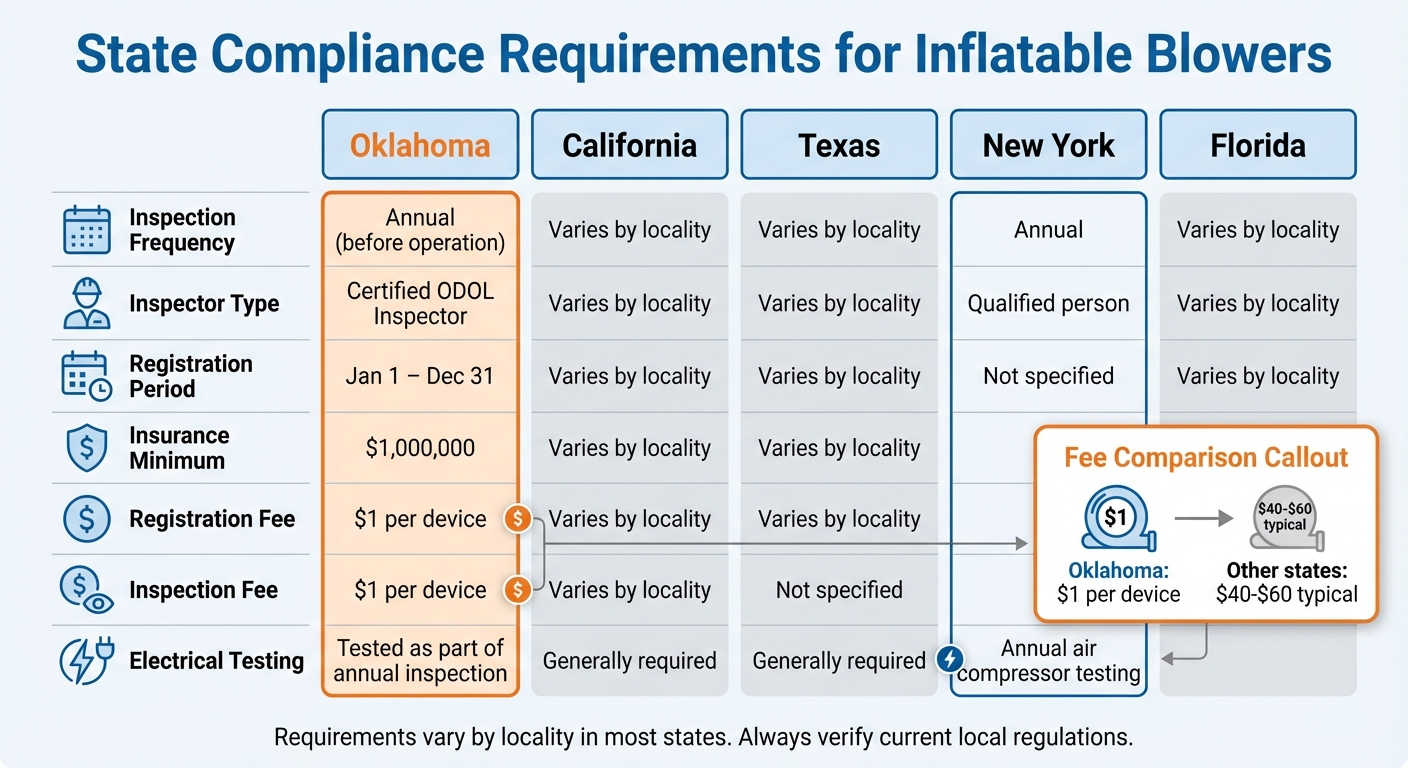
State-by-State Inflatable Blower Safety Compliance Requirements Comparison
Compliance Requirements by State
Here’s a breakdown of how compliance requirements differ across key states. While Oklahoma stands out with its detailed public documentation, states like California, Texas, New York, and Florida leave much of their oversight to local municipalities or private inspection companies. This approach often leads to less uniform standards.
| Requirement | Oklahoma | California | Texas | New York | Florida |
|---|---|---|---|---|---|
| Inspection Frequency | Annual (before operation) | Varies by locality | Varies by locality | Annual | Varies by locality |
| Inspector Type | Certified ODOL Inspector | State or private companies | State or private companies | Qualified person | State or private companies |
| Registration Period | Jan 1 – Dec 31 | Varies by locality | Varies by locality | Not specified | Varies by locality |
| Insurance Minimum | $1,000,000 | Varies by locality | Varies by locality | Not specified | Varies by locality |
| Registration Fee | $1 per device | Varies by locality | Varies by locality | Not specified | Varies by locality |
| Inspection Fee | $1 per device | Varies by locality | Varies by locality | Not specified | Varies by locality |
| Electrical Testing | Tested as part of annual inspection | Generally required | Generally required | Annual air compressor testing | Generally required |
Oklahoma’s straightforward fee structure – just $1 per device for both registration and inspection – offers a stark contrast to the $40 to $60 typically charged in other states. New York, on the other hand, emphasizes safety by mandating annual inspections and tests for air compressors and related equipment, with detailed records maintained for review by the commissioner. Oklahoma also prioritizes thoroughness with a 72-hour advance scheduling requirement for inspections.
This table highlights the diverse approaches states take toward inflatable blower safety compliance, underscoring the need to understand and follow local regulations carefully.
Conclusion
Keeping up with state-specific blower safety laws is a critical step in protecting both individuals and your business. Regulations can shift quickly – like Oklahoma’s adjustment to a $1 registration fee per device in 2025, or Maryland’s temporary emergency safety provisions running from March 4, 2026, to August 31, 2026. These changes highlight how important it is to stay informed and compliant.
As outlined earlier, following the rules isn’t just about avoiding fines – it’s about ensuring the safety of everyone involved. Non-compliance can lead to severe consequences, including cease-and-desist orders, escalating fines, and even losing liability insurance coverage when you need it most. The Oklahoma Department of Labor has stressed that unregistered rides may lack proper anchoring or maintenance , or fail to maintain a safe perimeter, putting operators at risk if an incident occurs.
Beyond inspections and registration, detailed record-keeping is another layer of protection for your business. Make sure your liability insurance meets state-specific requirements – like $1,000,000 in Oklahoma or $200,000 in Maryland – and confirm that the state Department of Labor is listed as a certificate holder, if necessary. Always monitor weather conditions and risks according to state guidelines, and never operate equipment without a valid inspection sticker clearly displayed. Increasingly, schools, municipalities, and professional event planners are asking for proof of compliance before they’ll work with you.
Maintaining compliance isn’t a one-time task – it’s an ongoing process. Stay proactive by joining industry associations, working with certified inspectors, and keeping track of regulatory updates in every state where you operate. Your reputation and your customers’ safety depend on it.
At Bouncy Rentals USA, we take these safety standards seriously, so every event we help create is not only fun but also safe and worry-free.
FAQs
Which agency enforces inflatable blower rules in my state?
In the United States, the enforcement of rules for inflatable blowers depends on the state you’re in. For instance, in Oklahoma, this responsibility falls under the Oklahoma Department of Labor, whereas in Maryland, it’s handled by the Maryland Department of Regulations. To stay compliant, make sure to check with your state’s specific regulatory agency regarding safety standards.
What proof of compliance do venues usually request?
To operate inflatable amusement devices in Oklahoma, venues typically need a current inspection sticker from the Oklahoma Department of Labor. This sticker serves as proof that the equipment complies with safety regulations. Ensure your devices are inspected and certified before putting them to use.
What should I do if my blower or generator stops working during an event?
If your blower or generator fails during an event, you need to act quickly. Disconnect the inflatable right away and allow it to deflate in a controlled manner. This step is especially critical during high winds or thunderstorms, as these conditions can increase the risk of accidents. Always put safety first and stick to proper procedures to minimize the chance of injuries.