ASTM F2374 is the safety standard for commercial inflatable devices like bounce houses, slides, and obstacle courses. It covers design, operation, and maintenance requirements to prevent hazards such as tip-overs, overcrowding, and power failures. Here’s why it matters:
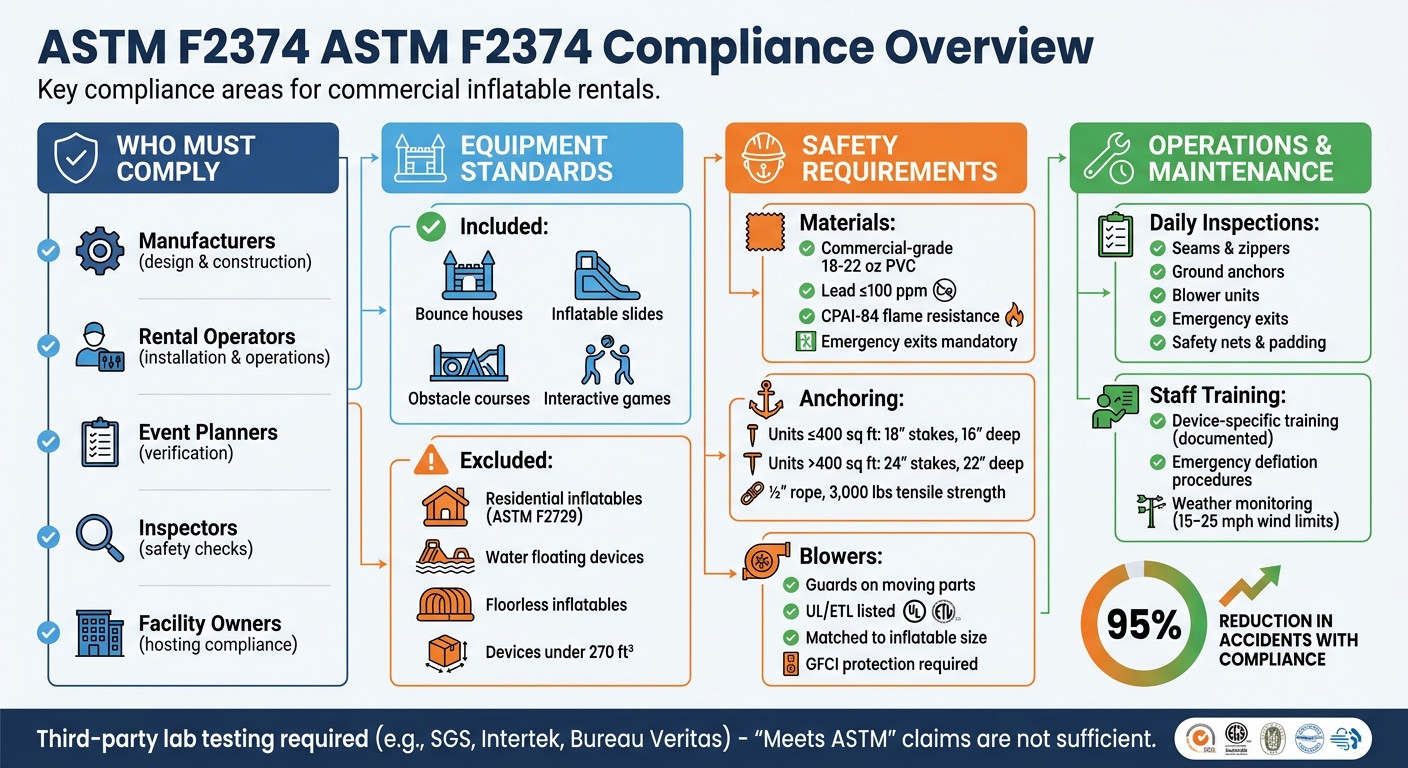
- Safety Compliance: Rental companies must follow ASTM F2374 to reduce accidents by up to 95%. It ensures inflatables are stable, properly anchored, within a safe perimeter, and made from durable materials.
- Liability Insurance: Compliance is often mandatory for insurance. Using uncertified equipment can void claims after an incident.
- Professional Standards: ASTM F2374 distinguishes commercial-grade inflatables from residential ones, which fall under a different, less rigorous standard (ASTM F2729).
The standard applies to manufacturers, rental operators, event planners, inspectors, and facility owners, ensuring shared accountability for safe usage. It also mandates staff training, daily inspections, and proper maintenance to keep inflatables in top condition. This helps rental businesses avoid legal issues, reduce repair costs, and protect users at events.
Key takeaway: ASTM F2374 compliance is critical for safety, insurance, and maintaining a trustworthy rental business.
ASTM F2374 Compliance Requirements for Commercial Inflatable Rentals
What ASTM F2374 Covers for Inflatable Rentals
Equipment Types Covered by ASTM F2374
ASTM F2374 sets the standard for commercial inflatable devices made from flexible fabric and maintained by air pressure. It includes equipment designed for activities like bouncing, climbing, sliding, running obstacle courses, and interactive play.
Examples of covered equipment include:
- Bounce houses
- Inflatable slides (dry, wet, or combination)
- Obstacle courses
- Bungee runs
- Interactive games
- Enclosed spaces for light shows or displays
The standard also identifies three inflation methods: continuous air supply (via blowers), sealed systems, and hybrid systems.
However, not all inflatables are covered. Specifically, ASTM F2374 excludes:
- Residential inflatables for home use (covered under ASTM F2729)
- Floating devices for water use
- Professional stunt equipment
- Floorless inflatables where the ground inside is exposed
- Small air-captured devices, like water walking balls under 270 ft³
In addition to equipment specifications, ASTM F2374 clearly outlines the responsibilities of all parties involved in the use and operation of these inflatables.
Who Must Follow ASTM F2374
Compliance with ASTM F2374 extends to various groups:
- Manufacturers are responsible for ensuring their designs and construction meet the standard, including using lead-free PVC materials.
- Rental operators and companies must adhere to guidelines for safe installation, proper anchoring, daily operations, maintenance, and staff training.
- Event planners and organizers need to verify that inflatables at events like festivals, fairs, or corporate gatherings meet certification requirements to mitigate liability.
- Inspectors rely on the standard for conducting safety inspections, as required by local regulations.
- Facility owners, such as amusement parks, schools, gyms, and municipal parks, must ensure compliance when hosting inflatable rentals.
This shared responsibility framework helps rental companies maintain safety and manage liability effectively.
"Meets ASTM is a self-declared claim – true ASTM F2374 compliance requires a third-party laboratory test report from an accredited lab such as SGS, Intertek, or Bureau Veritas." – Hero Kiddo
Be cautious of equipment that merely claims to "Meet ASTM" standards. Always request third-party lab test reports to confirm compliance with the latest version, such as ASTM F2374-24. Additionally, ensure the inflatable is rated for commercial use under F2374, as residential units pose serious safety and liability risks when used in rental fleets.
Safety and Design Requirements
Material and Construction Standards
Inflatables must be crafted from flexible fabric that maintains its shape under pressure, as outlined by ASTM F2374. The seams and fabric need to be strong enough to handle the stress of regular use. Additionally, materials must meet specific flammability standards to reduce fire risks. Emergency exits are a mandatory design feature to prevent entrapment. Regular inspections of seams, zippers, and fabric are essential for spotting wear and tear early on. Alongside sturdy materials, dependable inflation systems are a key component of safety.
Blower and Inflation System Requirements
Inflation systems fall into three categories: continuous air (requiring constant blower operation), captured air (maintaining pressure without continuous supply), and hybrid systems. For continuous air systems, the blower plays a critical role in keeping the structure intact. To comply with ASTM F2374, blowers must have guards to prevent access to moving parts. These systems should also be prepared for power outages or mechanical issues. Routine checks of power cords and blower connections are recommended to reduce the risk of electrical shocks.
Anchoring and Stability Requirements
Proper anchoring is crucial to keep inflatables stable and prevent them from being overturned by wind. Anchors must securely hold the inflatable in place while being positioned to minimize tripping hazards. Operators need to monitor weather conditions and ensure the setup area is suitable for the selected anchoring method, whether stakes or sandbags, as per ASTM F2374 guidelines. The ANSI emphasizes the importance of proper setup and maintenance:
"Injuries or even fatalities can happen if inflatable amusement devices are incorrectly set up, anchored, operated, or supervised and not regularly tested and inspected".
These design and safety requirements are the foundation for ensuring safe operation and maintenance of inflatable devices.
Operation and Maintenance Requirements
Effective daily operations, built on solid safety and design principles, are key to ensuring compliance and safe use over time.
Daily Inspection and Record Keeping
Before setting up, inspect all critical components like seams, zippers, ground anchors, and blower units to ensure they meet ASTM F2374 standards. Check for hazards like entrapment risks and ensure emergency exits are clear and accessible. Keep thorough records of inspections, audits, and operational activities to demonstrate ongoing safety compliance.
Staff Training and Emergency Response
According to ASTM F2374, all personnel involved in setting up or supervising inflatables must undergo documented, device-specific training. This training is crucial for minimizing risks and ensuring safe usage. For inflatables with elevated play areas exceeding 8 feet, staff must be trained in rapid deflation procedures and should test deflation alert systems before each use. Monitoring weather risks is another critical aspect – most manufacturers recommend shutting down operations when wind gusts reach 15 to 25 mph. Operators need to be familiar with the wind limits for each inflatable they manage. Regular training reinforces the importance of pre-use inspections and emergency readiness, forming the foundation of effective maintenance routines.
Repair Restrictions and Maintenance Guidelines
ASTM F2374-24 outlines clear repair protocols for commercial operators. Routine testing and inspections can identify early signs of fabric, seam, or zipper wear. Operators must distinguish between maintenance tasks they can handle and those requiring professional repairs, adhering to the standard’s guidelines. The requirements differ based on the type of inflatable: continuous air inflatables, which need constant blower power, and captured air devices, which hold inflation without a constant air supply. Proper maintenance, especially of anchoring systems, is essential to prevent accidents caused by environmental factors like wind, which can destabilize or overturn an inflatable if not properly secured.
How Bouncy Rentals USA Follows ASTM F2374
Safety and Quality Standards
At Bouncy Rentals USA, safety is a top priority, and we ensure all our inflatables are tested by trusted labs like SGS, Intertek, or Bureau Veritas. We don’t just take the manufacturer’s word for it. Each inflatable is made from commercial-grade 18–22 oz PVC, with lead content at or below 100 ppm, and meets CPAI-84 flame resistance standards. Every unit includes permanent labels with key details like manufacturer information, production date codes, and the ASTM F2374 edition year. To go the extra mile, we cross-check these details against the CPSC recall database to confirm there are no active safety recalls. For inflatables with play areas taller than 8 feet, we only use units that include mandatory deflation alert systems – whether audible or visual – so safe evacuation is always possible.
Professional Setup and Installation
Safety doesn’t stop with the product – it extends to how we set it up. We follow precise anchoring guidelines based on the size of the inflatable. For units up to 400 sq ft, we use 18-inch stakes buried 16 inches deep. Larger inflatables, over 400 sq ft, require 24-inch stakes buried 22 inches deep. To secure everything, we use ½-inch solid-braided polypropylene ropes with a tensile strength of at least 3,000 lbs.
Blowers are carefully matched to the inflatable’s size. For example, a 12′×12′ bounce house uses a 1 HP blower (800–900 CFM), while a larger 22′×22′ unit requires a 2 HP blower (1,000–2,000 CFM). We also ensure every setup includes impact-attenuating mats at entry and exit points, maintains 3–5 feet of side clearance, and provides 15–18 feet of overhead clearance. To prevent electrical hazards, all setups use GFCI protection on dedicated 20-amp circuits.
Inspection and Maintenance Procedures
Our commitment to safety continues with rigorous inspection and maintenance routines. Before each rental, we perform detailed pre-use inspections. These cover everything from seams and zippers to ground anchors, blower units, and safety features like nets and padding. We keep thorough logs of inspections and repairs, which helps cut down long-term repair expenses by up to 60%.
When it comes to maintenance, we take no shortcuts. Sliding areas and slide cover sheets are never patched; they’re replaced entirely if we spot wear, tears, or UV damage. This ensures smooth, hazard-free surfaces for users. Additionally, we verify that all blowers are UL or ETL listed and check manufacturer-specified wind limits before every event. These practices reflect our dedication to ASTM F2374 standards, giving our customers confidence and peace of mind at every event.
Conclusion
What Party Rental Operators Should Remember
Adhering to ASTM F2374 isn’t just a recommendation – it’s a critical step for ensuring safety and maintaining business integrity. This standard addresses every stage of a commercial inflatable’s lifecycle, from manufacturing and installation to daily operation and ongoing maintenance. It’s designed to prevent serious hazards that have caused injuries in the past, including wind-related blow-overs, seam failures, sudden air loss due to blower issues, and even user entrapment.
It’s also important to understand the difference between commercial and residential-grade inflatables. ASTM F2374 is tailored specifically for commercial use, while residential inflatables fall under the less stringent ASTM F2729 standard. Using residential equipment for commercial purposes doesn’t just breach safety standards – it can also void your liability insurance if an injury occurs. Studies show that following manufacturer guidelines and safety standards can reduce accidents by 95%. Compliance isn’t just about rules; it’s about protecting users and creating a trustworthy business.
Why Choose Bouncy Rentals USA
At Bouncy Rentals USA, we take ASTM F2374 compliance seriously. Every inflatable we offer undergoes rigorous third-party laboratory testing, and we keep detailed inspection records. Our team is trained in emergency response protocols, ensuring both safety and professionalism. By adhering to these standards, we’ve managed to lower repair costs over time while meeting key requirements for anchoring, blower systems, and proper clearance.
"Compliance not only protects your customers but also enhances your business’s reputation, helps you secure insurance, and sets you apart from competitors." – Titan Inflatables
Whether you’re hosting a small backyard celebration or a large community event, our ASTM F2374-compliant inflatables and professional setups prioritize safety and reliability. From GFCI-protected electrical connections to ensuring stakes are set to the proper depth, we handle the technicalities so you can focus on creating unforgettable moments for your guests.
FAQs
How can I verify an inflatable is truly ASTM F2374 compliant?
To ensure an inflatable complies with ASTM F2374 standards, request documentation or certification directly from the manufacturer or supplier. This paperwork should confirm that the inflatable meets the standard’s guidelines for design, manufacturing, operation, and maintenance of inflatable amusement devices. Be sure the documentation explicitly states compliance with ASTM F2374.
What wind speed should make me shut down an inflatable?
Inflatables must be turned off during windy conditions or when wind speeds go beyond safe levels. Powerful gusts can lift inflatables as high as 15 to 20 feet, creating dangerous situations that could lead to severe injuries or even fatalities. Keep a close eye on weather updates and stick to safety protocols to protect everyone involved.
What records should I keep to prove ASTM F2374 compliance?
To meet ASTM F2374 standards, it’s essential to keep thorough records covering every stage of your inflatable equipment’s lifecycle – design, manufacturing, installation, operation, and maintenance. Key documents to have on hand include inspection reports, testing results, training logs, and records of significant modifications. Staying organized not only helps ensure safety but also aligns with regulatory and insurance requirements.