Inflatable carnival games are a fun way to energize events like birthdays, school fairs, and corporate gatherings. They range from obstacle courses and dunk tanks to interactive games, catering to all age groups. Here’s what you need to know:
- Obstacle Courses: Great for competitive play, inflatable obstacle course rentals feature climbing walls, tunnels, and slides. They work well for kids, teens, and adults.
- Dunk Tanks: Popular at fundraisers, these combine humor with interactive fun. They also help raise event funds.
- Interactive Games: Options like jousting or bungee runs add variety and excitement, ideal for all ages.
Choosing Games: Match games to your guest count and venue size. For 20–50 guests, 1–2 games suffice; for 100+, aim for 4–5 games. Ensure the games fit the age groups attending and measure your venue to confirm enough space, including safety buffers.
Safety: Proper anchoring is key. Use stakes for grass or sandbags for hard surfaces, and always check stability during the event.
Vendors: Look for companies with clean, insured equipment and professional setup services. Expect rental costs to range from $200–$2,500 depending on the package.
Inflatable games can transform any event into a memorable experience when planned well.
Types of Inflatable Carnival Games
Inflatable carnival games come in a variety of styles, each catering to different events and audiences. Knowing what’s available can help you create a fun and engaging experience tailored to your crowd. From physical challenges to interactive entertainment, these games bring energy and excitement to any gathering.
Obstacle Courses
Obstacle courses are inflatable setups packed with climbing walls, tunnels, slides, and barriers designed for timed races. They’re typically 30–100 feet long and 10–20 feet wide, allowing 4 to 8 participants to compete at once. Many models feature dual-lane designs and themes like jungle adventures, boot camps, or sports arenas, often incorporating elements like rope swings, balance beams, or cargo nets.
These courses are ideal for kids 8 and up, teenagers, and even corporate team-building events. For instance, a 50-foot obstacle course with squeeze tunnels and climbing walls is perfect for school carnivals or company picnics, fostering teamwork and friendly competition. Most units accommodate participants up to 5’10" and 250 lbs, making them versatile for various events. It’s no surprise that 65% of rental companies rank obstacle courses as their most popular option for gatherings of 50 or more guests.
While obstacle courses focus on agility and teamwork, dunk tanks bring a splash of humor and interaction to the mix.
Dunk Tanks
Dunk tanks are crowd favorites, featuring a seat suspended 8 to 10 feet above a water-filled tank holding 500 to 1,000 gallons. Participants aim at a target 4–6 feet away, triggering a mechanism that drops the seated individual into 3–4 feet of water. Rentals often include safety features like padded seats, non-slip platforms, and bullseye targets, with weight limits between 300 and 500 lbs.
These attractions are especially popular at fundraisers and team-building events, as they combine fun with revenue generation. Tickets typically cost $3 to $5 per throw, and dunk tanks can boost event earnings by 20% to 30% through spectator donations and participation fees. They’re a staple at school fundraisers, charity events, and sports banquets, handling anywhere from 50 to 200 uses per event.
Interactive Games
Interactive inflatable games like jousting and bungee runs add a competitive edge to carnivals. In jousting, two players try to knock each other off padded platforms using foam poles, while bungee runs involve tethered players racing against elastic cords to place markers on a wall. These games typically measure 15×15 to 27×27 feet, accommodating 2 to 4 players per round and serving 20–30 participants per hour.
Designed for kids 7 and older, teens, and adults weighing up to 250 lbs, these games require quick reflexes, strength, and agility. With rounds lasting just 1 to 2 minutes, they’re perfect for events where participants want multiple turns. Demand for interactive games and obstacle courses tends to spike during summer carnivals, particularly between June and August, when outdoor events are at their peak.
Selecting a mix of these inflatable games ensures a variety of experiences that keep guests entertained and engaged throughout the event.
How to Choose the Right Games for Your Event
Inflatable Carnival Game Selection Guide by Event Size and Guest Count
Match Games to Event Size and Guest Ages
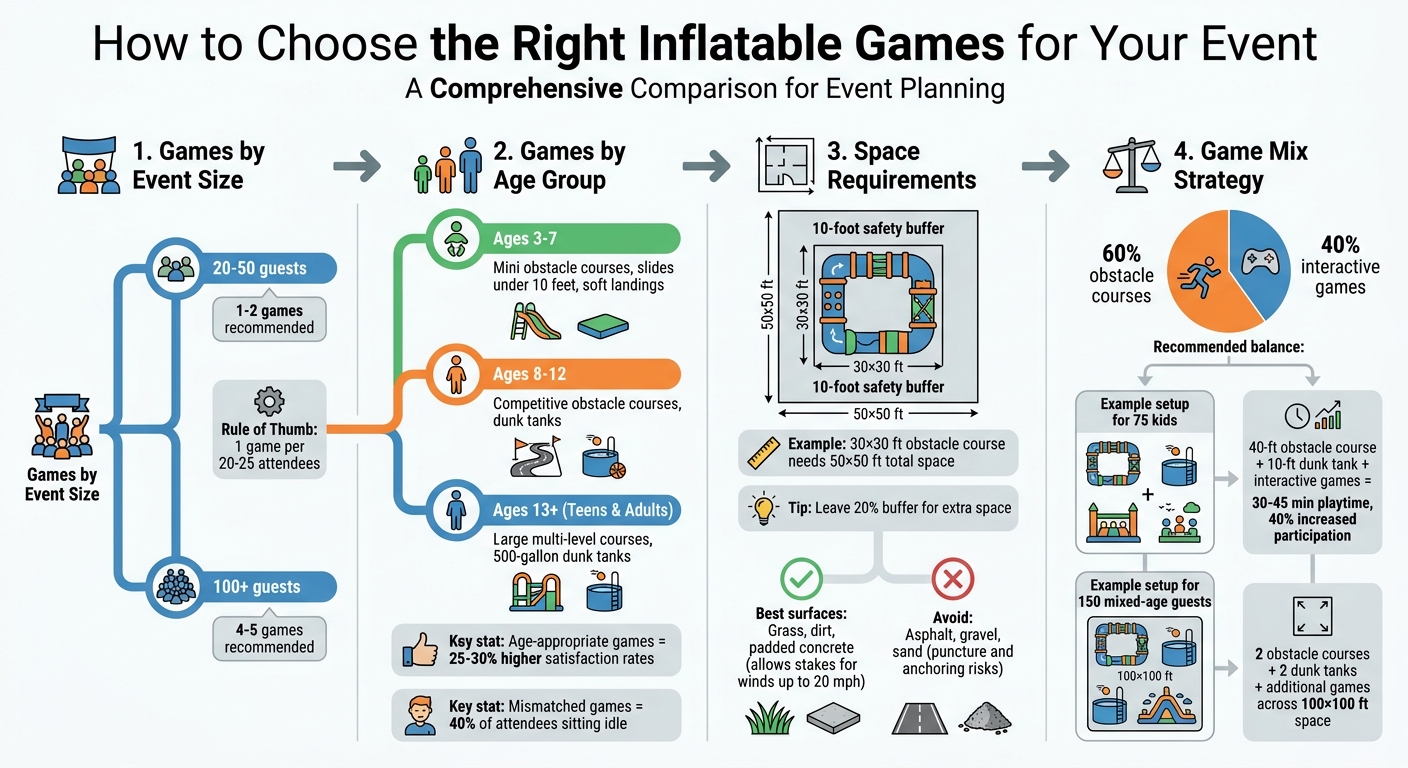
Start by figuring out how many guests you’ll have and their age groups. For events with 20 to 50 attendees, one or two games should suffice. For instance, a single obstacle course can entertain 4 to 6 kids at a time without causing long lines. If you’re expecting 100 or more guests, aim for 4 to 5 games to keep the crowd engaged and reduce waiting times. A good rule of thumb is one game per 20 to 25 attendees, as suggested by rental experts.
It’s also important to pick games that suit the ages of your guests. Kids aged 3 to 7 enjoy simpler activities like mini obstacle courses or slides under 10 feet tall with soft landings. Children aged 8 to 12 are better suited for more challenging options like competitive obstacle courses or dunk tanks. For teens and adults (13+), consider larger, multi-level courses or dunk tanks that hold up to 500 gallons. (Be sure to follow safety tips for dunk tanks to prevent accidents.) Data from rental companies shows that when games are age-appropriate, events experience 25% to 30% higher satisfaction rates and guests spend 15% more time playing. On the flip side, mismatched games can lead to 40% of attendees sitting idle.
Once you’ve matched games to your guest list, it’s time to evaluate your venue’s space and setup needs.
Plan for Space and Setup Requirements
Before reserving any games, measure your venue in feet and account for safety zones. For example, an obstacle course that’s 30×30 feet actually needs a total of 50×50 feet to include a 10-foot safety buffer around it. Make sure the ground is level; avoid slopes greater than 5% or soft soil that could cause instability.
The type of surface at your venue also matters. Grass, dirt, or padded concrete are ideal because they allow stakes to anchor the equipment securely, even in winds up to 20 mph. Surfaces like asphalt, gravel, or sand are less suitable due to risks like punctures and poor anchoring. Misjudging space can lead to last-minute cancellations, so use vendor calculators and schedule a site visit at least two weeks in advance. It’s also a good idea to leave a 20% buffer for extra space.
Once your venue’s space is sorted out, focus on mixing game types to keep the energy up.
Combine Different Game Types
To keep guests entertained and engaged, select a mix of games. Pairing high-energy obstacle courses with interactive options like dunk tanks ensures there’s something for everyone. For example, at a school carnival with 75 kids, offering a 40-foot obstacle course, a 10-foot dunk tank, and some interactive games can provide 30–45 minutes of varied playtime, increasing participation by 40%.
A good balance is a 60% focus on obstacle courses and 40% on interactive games, which helps manage lines and keeps things moving. At a neighborhood block party with 150 mixed-age guests, a setup featuring two obstacle courses, two dunk tanks, and additional games across a 100×100-foot space allowed for smooth rotations and repeat play. Companies like Bouncy Rentals USA offer equipment tailored to events of all sizes, ensuring options that fit your needs.
Safety and Setup Requirements
Anchoring and Stability
Securing inflatables properly is crucial to avoid accidents. According to the Consumer Product Safety Commission (CPSC), injuries from poorly anchored inflatables are reported every year. The method you choose to anchor depends on the type of surface you’re working with.
For grass surfaces, use heavy-duty steel stakes that are 18 to 30 inches long. Drive them into the ground at a 45-degree angle away from the inflatable. This positioning improves grip and reduces the chance of stakes being pulled out by wind or intense activity. On hard surfaces like concrete, anchor inflatables with 40-pound sandbags or water barrels, attaching them firmly with ratchet straps. Always use all the anchor points provided and verify that the ground or surface is stable.
These methods have been tested and proven effective. For instance, at a March 2023 event in Springfield, IL, a bounce house was secured on grass using heavy-duty stakes, resulting in a completely incident-free day. Similarly, a Dallas, TX, rental company achieved a perfect safety record during the summer by using sandbags and water barrels to secure inflatables on concrete.
To maintain safety throughout an event, check all anchor points during setup and recheck them every few hours or after periods of heavy use. If strong winds or storms arise, deflate the inflatable immediately to ensure stability and prevent accidents. Regular vigilance is key to a safe experience.
How to Select a Rental Vendor
Sanitation and Maintenance
Clean equipment is non-negotiable when it comes to safety. Shared inflatables can quickly become a breeding ground for bacteria if not properly sanitized – especially when used by dozens of children. In fact, a 2023 survey of event planners found that 85% reported poor vendor sanitation as a major reason for event cancellations or negative reviews.
To ensure your vendor meets hygiene standards, ask about their cleaning routines. Reputable companies use commercial-grade disinfectants after each use and perform regular inspections to spot damage or wear. You can request proof, such as cleaning checklists, inspection photos, or certifications showing compliance with safety guidelines. Experts also recommend choosing vendors that use UV sanitation techniques and maintain daily cleaning logs, which can lower liability risks by up to 40%.
If possible, visit the vendor’s facility or read online reviews that highlight cleanliness. Look for a "sanitation guarantee" policy – a promise that equipment is cleaned and maintained to high standards. For example, companies like Bouncy Rentals USA emphasize thorough sanitization and carry full insurance, demonstrating their focus on safety and reliability.
Once you’re confident in a vendor’s sanitation practices, it’s time to assess their delivery and setup services to make your event planning even smoother.
Delivery and Setup Services
A professional delivery and setup service can save you hours of hassle. According to rental industry data, professional setup teams can cut installation time by 60% compared to doing it yourself. These trained staff members ensure inflatables are anchored securely, identify potential safety risks, and confirm everything is operating correctly before your event begins.
Full-service vendors manage delivery, setup, and takedown, typically saving you 2–4 hours per event. It’s a good idea to ask vendors to arrive 1–2 hours before your event starts to ensure everything is ready on time. Be sure to discuss how long setup will take (for example, obstacle courses often need 30–60 minutes) and confirm that the staff has proper training certifications. It’s also wise to talk about weather contingency plans and check if takedown services are included in the rental price.
For instance, Bouncy Rentals USA is known for their on-time delivery and trained staff, allowing you to focus on your guests instead of worrying about logistics.
With delivery and setup sorted, the next step is finding a rental plan or package that fits your budget and event needs.
Rental Plans and Custom Packages
Flexible rental plans make it easier to stay on budget while ensuring your event is a hit. Standard options include daily rentals, which typically range from $200–$500 per game, weekend packages priced between $300–$700, and multi-day rentals for extended events. Many vendors also offer discounts of 20–30% when you bundle multiple games. For example, you could combine an obstacle course with a dunk tank for about $800.
Custom packages let you tailor rentals to your specific event. A school carnival might include interactive games and a water slide for an 8-hour event costing around $1,200. Meanwhile, a birthday party could feature a bounce house and a cotton candy machine for approximately $400. At Bouncy Rentals USA, bounce houses start at $299 a day, and you can ask about extras like popcorn or snow cone machines when you request a quote.
Keep in mind that pricing can vary based on factors like travel fees (usually $50–$100 for locations beyond a 20-mile radius), peak season surcharges (summer rates can rise by 15%), and group discounts for multiple rentals. Always request written quotes that clearly outline what’s included – such as delivery, setup, insurance, and add-ons – so you can compare vendors fairly.
| Rental Plan | Price Range | What’s Included | Best For |
|---|---|---|---|
| Daily Rental | $200–$500 | Single game, delivery, setup | Birthday parties, small gatherings |
| Weekend Package | $300–$700 | Single game, Friday–Sunday use | Multi-day celebrations |
| Custom Bundle | $800–$2,500 | 3–5 games, concessions, full service | School carnivals, block parties, corporate events |
When comparing vendors, prioritize those with at least five years of experience, full liability insurance (typically $1 million or more), and strong customer ratings. Be cautious of vendors who don’t provide written contracts, offer vague sanitation details, or fail to clarify power requirements (most inflatables need 20-amp outlets). Vendors offering 24/7 support and setup troubleshooting can also improve event success rates by 25%.
Choosing the right rental plan and vendor will keep your event running smoothly while maximizing fun for your guests.
Conclusion
Inflatable carnival games have a way of transforming any gathering into an unforgettable experience. Whether it’s a backyard celebration or a corporate event, attractions like bounce houses, obstacle courses, and interactive inflatable games keep guests entertained and engaged. With the inflatable rental market growing at 5.81% annually and expected to hit $6.2 billion by 2034, it’s clear these games have become a staple for successful events. This growth highlights the importance of thoughtful planning when choosing the right inflatable games for families.
Getting the most out of your rental starts with smart preparation. Consider your guest list and venue size to pick games that suit both the crowd and the space. Look for vendors who prioritize cleanliness, provide full insurance coverage, and offer packages that align with your budget. Professional delivery and setup not only simplify your event planning but also ensure everything is securely anchored and functioning properly.
For a stress-free experience, Bouncy Rentals USA provides commercial-grade equipment that’s fully insured, thoroughly sanitized, and professionally set up – so you can focus on enjoying your event.
FAQs
Do I need a generator for inflatable games?
Yes, inflatable games like bounce houses usually require a generator, especially for outdoor events where access to electricity might be limited. To power the blowers effectively, you’ll need a generator with enough wattage to handle both the continuous power demand and the initial startup surge. Typically, generators with starting wattage between 6,000 and 11,500 watts work well for this purpose.
However, if there’s a reliable power source nearby, you might not need a generator at all. Always ensure the power setup is adequate and safe to avoid any interruptions or risks during operation. Proper planning makes all the difference!
What happens if the weather turns bad on the event day?
If the weather takes a turn for the worse – like rain or strong winds – stop using the inflatable right away and ensure everyone exits safely. Operating inflatables in bad weather increases the risk of accidents and potential damage. Check your rental agreement, as you might have the option to reschedule or request a refund. Safety should always come first, so avoid setting up in unsafe conditions.
How many attendants should I have per game?
To ensure safety and keep things running smoothly, it’s generally recommended to have 1-2 attendants per inflatable game. This helps with managing lines, overseeing gameplay, and assisting with operations. However, larger or more intricate inflatables might need extra supervision. Always assign enough attendants based on the game’s size and complexity to ensure everything stays safe and enjoyable for guests.