Planning a sports-themed party? Here’s the quick answer: Bounce houses are best for younger kids (ages 2–7) and smaller gatherings, while obstacle courses are ideal for older kids (ages 8+), teens, and large events. Both options bring fun, but their appeal, capacity, and space needs differ.
- Bounce Houses: Great for toddlers and young children. Perfect for backyards and smaller parties. Handles ~36 kids per hour. Simple jumping fun with minimal supervision required.
- Obstacle Courses: Designed for older kids, teens, and even adults. In fact, there are many reasons obstacle courses are perfect for adults and corporate events. Adds a competitive edge with features like tunnels, slides, and climbing walls. Accommodates 200+ participants per hour. Requires more space and is suited for bigger events.
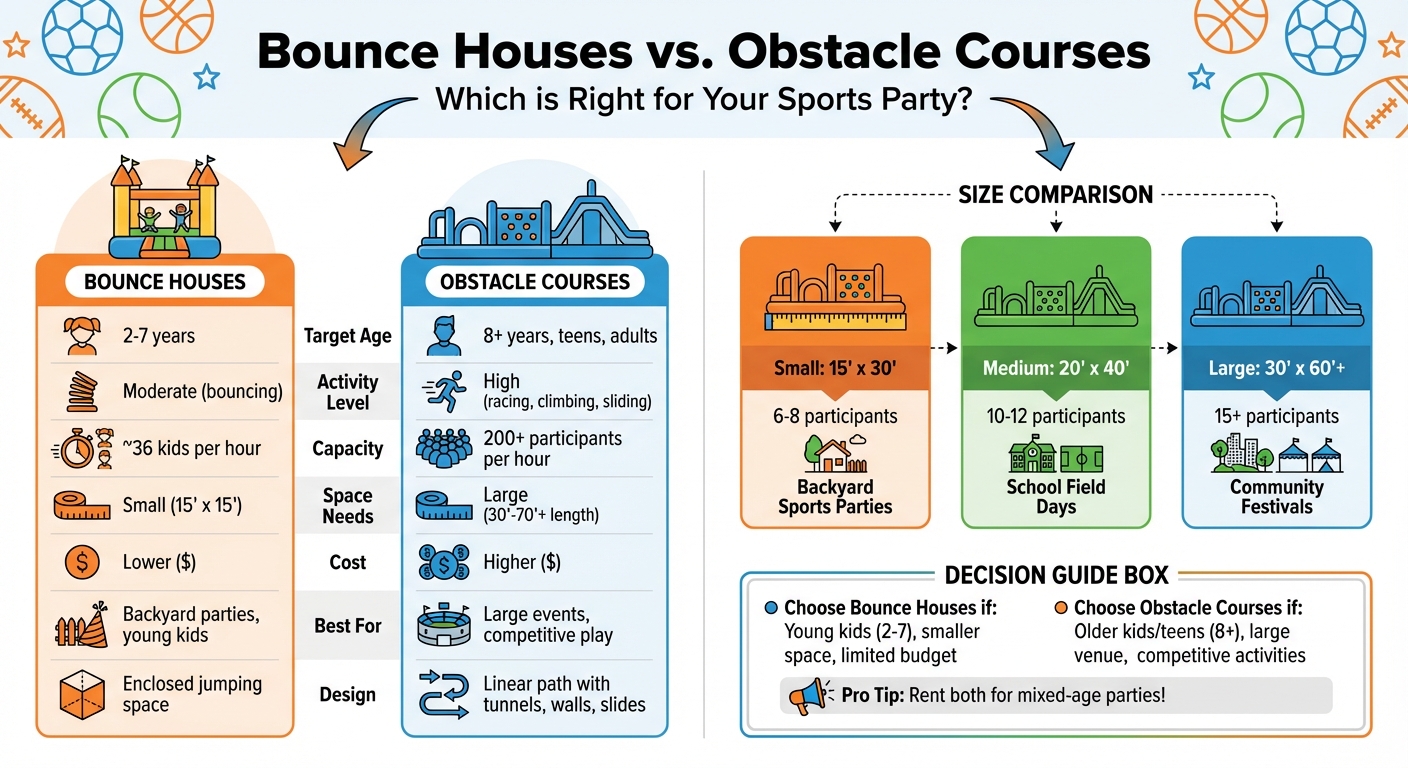
Quick Comparison
| Factor | Bounce Houses | Obstacle Courses |
|---|---|---|
| Target Age | 2–7 years | 8+ years, teens, and adults |
| Activity Level | Moderate (bouncing) | High (racing, climbing, sliding) |
| Capacity | ~36 kids per hour | 200+ participants per hour |
| Space Needs | Small (15′ x 15′) | Large (30’–70’+ in length) |
| Best For | Backyard parties, young kids | Large events, competitive play |
| Cost | Lower | Higher |
For mixed-age parties, consider renting both to ensure everyone has fun. The right choice depends on your guest list, space, and event size.
Bounce Houses vs Obstacle Courses: Complete Comparison Guide for Sports Parties
What Are Bounce Houses?
Bounce houses were the original inflatable party rentals, offering a simple yet exciting way to entertain kids. These structures typically feature a square design with a padded jumping surface, creating a safe and fun environment for play. Standard models measure about 15 feet by 15 feet and stand between 10 and 14 feet tall, making them a great fit for most residential backyards where space might be limited.
The design includes padded walls and safety netting to keep kids secure while they jump. Many newer bounce houses also come with extra features like basketball hoops, pop-up obstacles, or sports-themed designs, adding even more excitement to the experience. These elements explain why bounce houses remain a favorite for kids’ parties. Knowing what makes bounce houses special is key to understanding how they compare to other inflatables, like obstacle courses.
Main Features of Bounce Houses
Bounce houses come with a cushioned jumping surface that ensures soft landings, while their enclosed design adds an extra layer of safety. Air Fun Games highlights their universal appeal:
"Bounce houses are the go-to choice for those looking to entertain the youngest of party guests." – Air Fun Games
Sports themes are especially popular, with designs like "Adrenaline Rush Sports" or "Tiger Belly" catering to specific party themes. While their design is simple, bounce houses are efficient, handling up to 36 kids per hour. They’re also one of the most budget-friendly inflatable rental options available.
Why Young Kids Love Bounce Houses
Bounce houses are a hit with kids aged 2 to 12, with those between 3 and 7 showing the most enthusiasm. Their straightforward design allows children to jump right in – no complicated rules, no obstacles to figure out.
But it’s not just about fun. Jumping helps younger children improve coordination, balance, and social skills as they interact with others. Orange County Jumpers sums it up well:
"The bounce house with a slide is easy to set up and keeps kids entertained for hours. It’s perfect for younger children or events where you want a fun but simple activity." – Orange County Jumpers
Best Party Settings for Bounce Houses
Bounce houses are ideal for smaller gatherings, like backyard birthday parties, especially when the guest list includes mostly younger children. They’re perfect for limited spaces, offering a central play area that doesn’t require much adult involvement beyond basic supervision.
For sports-themed parties aimed at preschoolers and young elementary-aged kids, a bounce house strikes the perfect balance of physical activity without the stress of competition. Just make sure there’s always an adult keeping an eye on things. Following essential safety tips ensures everyone has a great time.
What Are Inflatable Obstacle Courses?
Inflatable obstacle courses are fun-filled, continuous paths packed with climbing walls, tunnels, hurdles, and steep slides. They’re designed to test speed, agility, and strength, often featuring dual racing lanes to add a competitive edge – perfect for older kids and teens. Thanks to their clever design, these courses have gained immense popularity in the party rental industry. They’re quick to set up, usually taking just 15 to 30 minutes with the help of electric blowers, and have seen a 25% growth in the past year.
Main Features of Obstacle Courses
These courses are packed with physical challenges to keep participants engaged. Climbing walls demand strength from both the upper and lower body, while tunnels and hurdles encourage crawling, jumping, and core engagement. Slides, often the grand finale, provide a thrilling end to the course.
Some advanced designs go even further, incorporating elements like "Warrior Jump" pillars for leaping between platforms, hoops for jumping through, and sports-themed hurdles in "Adrenaline Rush" sections. Many obstacle courses are modular, meaning you can connect them with other inflatables to create even longer and more elaborate setups – perfect for large-scale events. Safety is also a top priority, with features like ASTM-approved netting, safety pads, reinforced anchoring, and clear exits. To ensure safe use, keep at least 5 feet of extra space around the course.
| Course Size | Dimensions | Capacity | Best Setting |
|---|---|---|---|
| Small | 15′ x 30′ | 6–8 participants | Backyard Sports Parties |
| Medium | 20′ x 40′ | 10–12 participants | School Field Days |
| Large | 30′ x 60’+ | 15+ participants | Community Festivals / Corporate Events |
Why Older Kids and Teens Prefer Obstacle Courses
Obstacle courses are a magnet for older kids and teens, offering the perfect mix of physical challenge and competitive excitement. Their high-energy design encourages movement and keeps participants engaged, making them ideal for kids aged 8–12 and teens. Unlike simple bounce houses, these courses let participants race through climbing walls, tunnels, and slides, adding an extra layer of excitement.
As noted by the Editor at Air Fun Games:
"Modern obstacle courses provide challenges and entertainment for teens and adults – not only the participants, but the people who gather around to watch teams compete."
To cater to this age group, courses should include features like vertical climbs, speedy slides, and dedicated racing lanes. While these designs are geared toward older participants, adult supervision is still essential at entry and exit points to ensure safety and avoid overcrowding.
Best Party Settings for Obstacle Courses
Inflatable obstacle courses shine at events where there’s plenty of space and a crowd ready for some physical fun. They’re perfect for team competitions, school field days, and larger gatherings where competitive racing can take center stage.
For smaller settings, a compact 15′ x 30′ course works well, accommodating 6–8 kids in a backyard. Medium and large courses, however, are better suited for bigger events with 10–15+ participants. The setup area should be flat, clean, and free of overhead hazards like power lines or tree branches.
These courses are also great for mixed-age parties. While older kids and teens tackle the obstacle course, younger children can enjoy a separate bounce house, ensuring everyone has a blast.
Bounce Houses vs. Obstacle Courses: Direct Comparison
Let’s break down the key differences between bounce houses and obstacle courses to help you decide which one fits your sports party needs.
Comparison Table
Here’s a side-by-side look at how these inflatables compare:
| Factor | Bounce Houses | Obstacle Courses |
|---|---|---|
| Primary Design | Enclosed space for jumping | Linear path with tunnels, walls, and slides |
| Activity Level | Moderate (bouncing and tumbling) | High (racing, climbing, and agility) |
| Target Age | Younger kids (ages 2–7) | Older kids, teens, and adults (ages 8+) |
| Space Needs | Small to medium (about 15′ x 15′) | Large to extra large (30′ to 70’+ in length) |
| Capacity | Handles ~36 kids per hour | Accommodates 200+ participants per hour |
| Cost | Lower cost | Higher cost due to size and complexity |
One standout difference is capacity. Bounce houses are great for smaller gatherings, handling around 36 kids per hour. On the other hand, obstacle courses can accommodate over 200 participants per hour, making them a better choice for larger events with a lot of guests to entertain. They are also among the best inflatable games for team building due to their competitive nature.
Safety Features and Requirements
Both bounce houses and obstacle courses focus on safety but address it in different ways. Bounce houses feature enclosed, padded designs, making them an excellent choice for younger kids who need a contained space to play safely. Obstacle courses, however, use a linear layout with separate entry and exit points, which helps manage high traffic and minimizes collisions compared to the free-for-all movement in a bounce house.
Bounce houses typically have one main entrance/exit ramp, while obstacle courses include multiple emergency exits due to their extended and more complex layouts. Both types are built with durable materials, often meeting CPAI-84 flame-retardant standards. Additionally, obstacle courses prioritize "finger-safe" netting to prevent injuries during climbing and crawling, as required by ASTM standards.
Supervision is also key. Bounce houses require one attendant per 12 children, while obstacle courses may need one to three operators depending on their size. According to data from 2023, inflatable-related injuries led to 11,200 emergency room visits, with 75% involving children under 12. However, professional supervision and proper safety rules can reduce incidents by up to 80%.
Space and Setup Needs
Both inflatables require level ground, with no more than a 2-inch grade variation. You’ll also need to clear a 20-foot radius of debris and leave at least 6 feet of clearance on all sides, along with 3 feet of overhead space above the unit’s height.
Bounce houses typically need around 15′ x 15′ of space, while obstacle courses demand much more room – anywhere from 30′ to over 70′ in length. Ground stakes should penetrate at least 18 inches, or you can use water-filled barriers weighing at least 40 pounds per anchor point for installations on hard surfaces. Wind safety is critical; operations should stop immediately if sustained winds exceed 20 mph or gusts hit 25 mph.
Both options require access to standard electrical outlets to power the blowers. Obstacle courses usually take about 15 to 30 minutes to set up. Be mindful of overhead utility lines and tree branches, especially for bounce houses, which can reach up to 14 feet in height. Proper setup not only ensures safety but also keeps the party running smoothly.
How to Choose the Right Inflatable for Your Sports Party
Match the Age and Interests of Your Guests
When choosing an inflatable, it’s essential to consider the age and interests of your guests. For younger children, typically ages 2–7, a classic bounce house is a great option. It provides a safe and simple space for jumping and playing. On the other hand, older kids, teens, and adults often enjoy the challenge of obstacle courses, which add an element of adventure and competition. If your party includes a mix of ages, you might want to schedule separate playtimes to avoid any accidental collisions between younger and older participants. Also, don’t forget to check the manufacturer’s weight limits – this is especially important if you’re hosting heavier guests, as the durability of the inflatable’s vinyl and seams is key.
Evaluate Your Space and Budget
The size of your party space plays a major role in determining the right inflatable. Bounce houses are perfect for smaller backyards since they don’t require much room. If you’re looking for something more elaborate, obstacle courses are a fantastic choice, but keep in mind their larger, linear designs demand significantly more space. For those working with a tighter area but still wanting some variety, consider compact combo inflatables like "6-in-1" or "Xtreme Park" options, which include climbing walls and tunnels in a smaller layout.
Budget is another critical factor. Rental costs usually include delivery, setup, and takedown, which simplifies the process. However, larger obstacle courses may require two or three operators to ensure safety, compared to just one for a standard bounce house. Operating costs are generally low – around $5–$10 per event – but obstacle courses, while more expensive upfront, can accommodate over 200 participants per hour. In contrast, a bounce house typically handles about 36 kids per hour, making obstacle courses a more economical choice for larger gatherings. Once you’ve evaluated your space and budget, ensure your inflatable fits seamlessly into your party’s activities.
Match Your Sports Party Activities
Think about how the inflatable will fit into your sports-themed party. Bounce houses are great for unstructured free play, while obstacle courses are ideal for organized activities like relay races or timed challenges. If you want to add a competitive edge, look for dual-lane designs that let guests race side-by-side. For events focusing on specific sports skills, inflatable sports games like Soccer Dart, Quarterback Challenge, or Basketball Shootouts can bring an exciting twist. A longer, multi-player obstacle course can also help reduce wait times by keeping guests moving efficiently.
Bouncy Rentals USA offers inflatables designed to suit different age groups, space sizes, and activity styles, ensuring your sports party is both entertaining and safe.
Conclusion
When planning your sports-themed party, think about your guest list, available space, and the kind of experience you want to create. For younger kids (ages 2–7), bounce houses are a hit – they provide a secure, enclosed area for simple, carefree fun. On the other hand, obstacle courses are perfect for older kids, teens, and adults, delivering a more competitive and physically engaging experience that fits seamlessly into a sports party vibe.
Space and budget play a big role in your decision. Bounce houses are ideal for smaller backyards and tend to be easier on the wallet. Obstacle courses, while requiring more room and a bigger budget, shine at larger events where their high capacity and competitive elements keep everyone entertained.
If your guest list spans different age groups, consider a 6-in-1 combo unit. These inflatables combine bounce zones, climbing walls, tunnels, and slides into one compact setup. They’re versatile enough to support free play for younger kids while also offering structured activities like relay races or timed challenges for older guests. Dual-lane obstacle courses are also a great choice, letting guests race side-by-side and adding an extra layer of excitement.
Bouncy Rentals USA has you covered with a range of bounce houses and obstacle courses designed for all ages, party sizes, and activity levels. Our inflatables are sanitized, insured, and delivered on time, so you can relax and enjoy the day. Whether it’s a backyard birthday or a large school event, we’ll help you create an unforgettable sports party experience.
FAQs
Do I need permits for an inflatable in my yard?
Permits are often necessary if you’re setting up inflatables in public places, like parks. However, for private yard setups, they typically aren’t required. That said, it’s always a good idea to double-check your local rules and regulations to avoid any surprises.
What power outlet does an inflatable blower need?
Inflatable blowers usually need a standard 115-volt household outlet to function. To ensure safety and optimal performance, it’s recommended to use a dedicated 20-amp circuit. Also, make sure the outlet is located within 50 feet of the inflatable for proper operation.
How do I handle rain or high winds on party day?
To keep everyone safe during rain or strong winds, it’s best to cancel or delay inflatable activities if severe weather is on the horizon. If unexpected weather hits, act quickly to deflate and secure the inflatables to avoid accidents or damage. Stay on top of weather updates, have a backup plan to store inflatables in a sheltered spot, and make sure all equipment is securely anchored when in use.