Running an inflatable rental business in New York involves strict insurance and safety requirements. Without proper coverage, you risk financial losses, legal issues, and missed opportunities with high-profile clients like schools or municipalities. Here’s what you need to know:
- Insurance is essential: General liability insurance (minimum $1M coverage) protects against injuries or property damage. Inland marine insurance covers equipment loss or damage.
- Legal compliance: New York State requires an annual permit, liability insurance, safety inspections, and adherence to ASTM standards. NYC adds extra steps like DOB inspections and Certificates of Competency.
- Costs: General liability averages $1,057/year, but claims can increase premiums significantly. Participant Accident Insurance starts at $350/year.
- Documentation: Certificates of Insurance (COIs) are mandatory for most venues, and additional insured endorsements are often required.
Prioritize insurance and compliance to protect your business, equipment, and customers while meeting legal and venue-specific requirements.
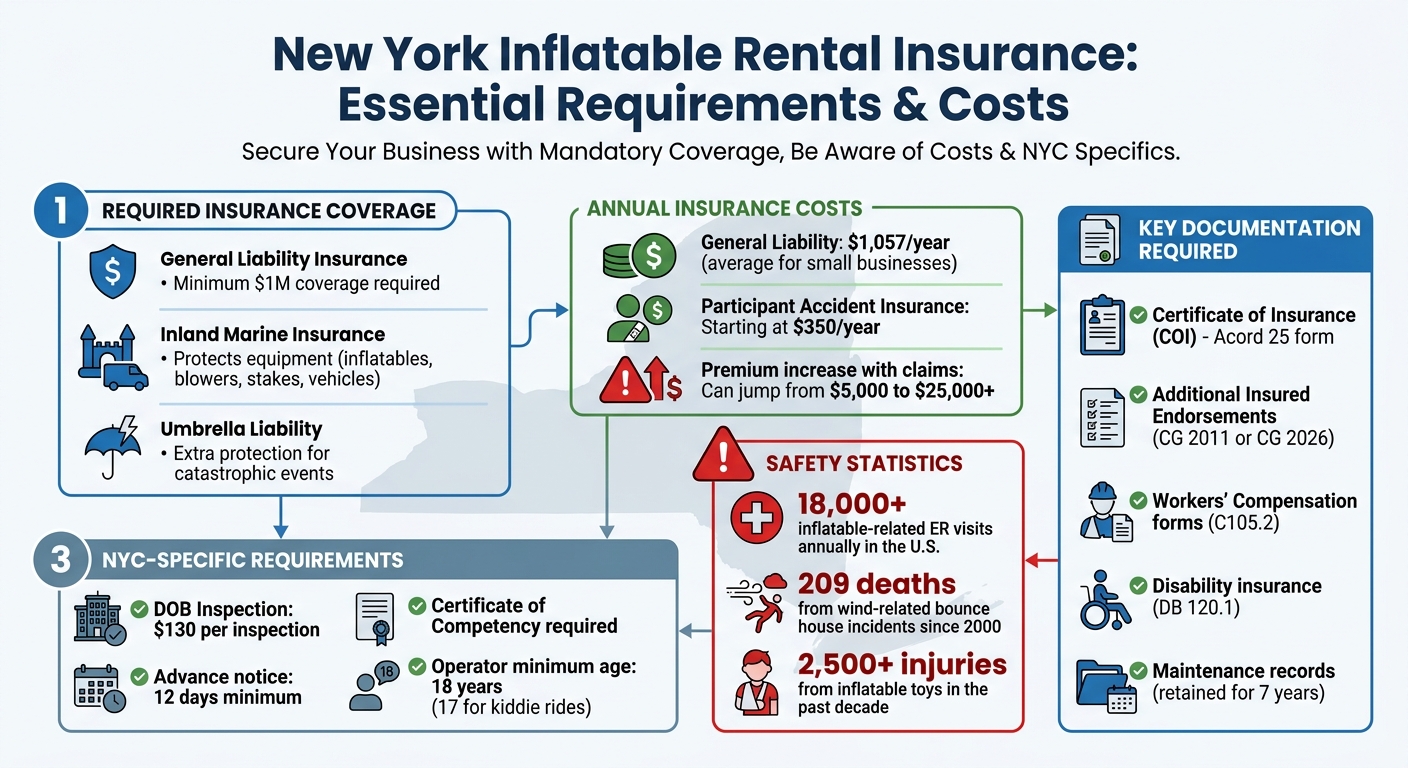
New York Inflatable Rental Insurance Requirements and Costs Overview
New York’s Legal Requirements for Inflatable Rentals
State-Level Regulations and Licensing
In New York State, inflatable rental businesses are required to obtain an annual permit from the Commissioner of Labor. To do so, they must submit several key documents: proof of liability insurance or a bond, a valid safety inspection report, and certification that their equipment meets flame resistance standards. Additionally, businesses must adhere to ASTM International standards, conduct mandatory safety inspections, and ensure employees receive proper training and supervision.
New York City-Specific Rules
Operating in New York City comes with extra layers of regulation. The city employs a dual-agency system where the Department of Buildings (DOB) oversees safety inspections, and the Department of Consumer and Worker Protection (DCWP) manages licensing. If an inflatable is used for fewer than 14 days, a new DOB inspection is required for each setup. Once the inspection is complete, operators receive a "Green Card" confirming the ride’s safety, and each inspection costs $130. Applications and inspection requests must be submitted at least 12 days in advance.
Operators in NYC must also obtain a Certificate of Competency, which involves proving to the DOB that they can safely set up and operate the inflatable at a specific site. To qualify, operators must meet the following criteria: they must be at least 18 years old (17 for kiddie rides), have a working knowledge of English, and comply with ASTM F770 training standards. Additionally, all equipment manuals, inspection records, and maintenance logs must be kept on-site and available for review. Maintenance records must also be retained for seven years. These comprehensive requirements are designed to ensure safety and reinforce the insurance coverage needed for operations.
Types of Insurance Coverage for Inflatable Rentals
When operating an inflatable rental business in New York, understanding the required insurance coverages is crucial for protecting your operations and complying with legal requirements.
General Liability Insurance
General liability insurance is essential for inflatable rental businesses, especially since New York venues, schools, and municipalities often require it. This coverage helps protect against third-party claims for bodily injuries or property damage. For instance, if a child is injured while playing on a bounce house or if equipment damages a client’s property during setup, general liability can cover medical expenses, legal fees, and settlements. Proper supervision and setup are also key to minimizing these risks. Alex Cossio explains:
"General liability insurance protects against bodily injury and property damage claims, but coverage typically requires proof of negligence, often through a lawsuit."
Most clients, especially corporate and municipal ones, demand at least $1 million in liability coverage. On average, small inflatable rental businesses spend about $1,057 annually on this insurance. However, a single open claim could drastically increase premiums, potentially jumping from $5,000 to over $25,000. Additionally, many venues require being listed as an "additional insured" on your policy, which is usually free of charge. This type of insurance is a cornerstone for maintaining safety and compliance in your operations.
Property Damage and Equipment Coverage
Inland marine insurance is designed to protect your physical assets, including inflatables, blowers, stakes, extension cords, and transport vehicles. Unlike general liability, which addresses damage to others, this coverage safeguards your equipment from risks like theft, vandalism, fire, and weather damage – whether in storage, transit, or at event locations. Alex Cossio highlights its importance:
"Inland marine insurance protects mobile equipment like bounce houses, not just in storage but also in transit or at event sites, covering risks like theft or catastrophic losses."
For newer equipment (under five years old), coverage is typically based on replacement cost, while older items are insured at their depreciated value. It’s essential to regularly update your inventory after major purchases to ensure your policy reflects the current value of your assets. This type of insurance is vital for recovering quickly from equipment-related incidents.
Umbrella Liability Policies
Umbrella liability insurance provides an extra layer of protection by extending coverage limits and addressing gaps in your primary liability policies. This type of policy is especially important for high-value claims or catastrophic events. As XINSURANCE explains:
"Umbrella coverage is customized to fit your unique needs by filling the gaps and covering the exclusions in your primary policy."
Wind-related incidents involving bounce houses have resulted in approximately 209 deaths in the United States since the start of the 21st century. Given these risks, umbrella policies are critical for financial protection in worst-case scenarios. Reviewing your policy exclusions is essential to ensure this additional coverage addresses any gaps, completing your insurance framework for inflatable rental businesses.
Compliance Steps for Event Organizers and Rental Companies
For anyone organizing events or running rental businesses in New York, following regulatory requirements is just as important as securing proper insurance. Vendor verification and equipment safety checks are key steps to ensure smooth and compliant operations.
Verifying Vendor Insurance and Certificates
If you’re organizing an event in New York, you’ll need to request a Certificate of Insurance (COI) from rental companies before any equipment setup begins. The standard form for this is the Acord 25, particularly versions 2013/04, 2014/01, or 2016/03. This document confirms that the vendor has active General Liability insurance with at least $1 million in coverage per occurrence, which is a requirement in New York City.
Pay close attention to the details on the COI. The business name, address, and phone number must match exactly with the records in the Department of Buildings (DOB) database. You can verify this information through the DOB NOW portal or the Buildings Information System (BIS). Handwritten certificates should never be accepted, as New York regulations require all details to be typed for the certificate to be valid.
Another critical step is ensuring the event venue is listed as an "additional insured" on the vendor’s policy. This is typically done through endorsements like CG 2011 or CG 2026, which provide legal protection in case a lawsuit arises due to the rental company’s negligence. Additionally, Workers’ Compensation and Disability insurance must be documented separately on state-approved forms, such as C105.2 and DB 120.1. These cannot be included on the General Liability Acord 25 form.
For official compliance in New York City, the "Certificate Holder" section should include the following details:
NYC Department of Buildings, Attn: Licensing & Exams Unit, 280 Broadway, New York, NY 10007.
By following these steps, you can ensure that all vendors meet the city’s insurance and liability requirements.
Safety Standards and Equipment Inspections
To maintain safety and compliance, rental companies must prioritize the quality and condition of their equipment. Only commercial-grade inflatables should be used, made from heavy-duty PVC vinyl with a thickness of 16–18 ounces. These units should feature double stitching and reinforced stress points, which are far more durable than residential-grade alternatives.
Before renting out any equipment, conduct thorough inspections to check for wear and tear, structural issues, and overall integrity. Units must also be fully dried before storage to prevent mold or mildew, which can weaken the material over time.
Safety doesn’t stop at inspections. Establish strict wind-speed limits for operating inflatables to avoid accidents. Additionally, ensure that all inflatables are licensed and branded to steer clear of potential trademark violation penalties.
How Bouncy Rentals USA Meets Safety and Insurance Standards
Bouncy Rentals USA goes above and beyond what the law requires by providing full insurance coverage for all its inflatable equipment. This proactive approach ensures that both event organizers and customers can feel secure, knowing they’re protected. Their comprehensive insurance policy is the backbone of their commitment to safety and operational excellence.
The company offers extensive commercial, equipment, and personal liability coverage, safeguarding against third-party injuries and property damage during setup and events. Their standard policies typically provide $1 million in coverage.
In addition to insurance, Bouncy Rentals USA follows strict safety protocols to ensure the best possible conditions for every event. They use commercial-grade inflatables designed with reinforced construction. Every unit is professionally set up, taken down, and cleaned after each rental. To minimize risks, they enforce weather-related policies, canceling rentals during rain or high winds. This is crucial, considering over 18,000 inflatable-related emergency room visits occur annually in the U.S..
Specific installation practices further enhance safety. Setup areas are meticulously cleared of debris, and inflatables are placed on appropriate surfaces to prevent damage and ensure stability. Customers receive clear instructions, such as keeping blowers plugged in at all times and turning off units immediately in high winds. Additionally, equipment is carefully dried before storage to prevent mold or mildew, which could weaken the material.
For public events, Bouncy Rentals USA provides all necessary insurance documentation, including Certificates of Insurance (COIs) that name venues as additional insured parties. By adhering to New York’s rigorous standards, they ensure compliance while maintaining a high level of safety for all involved.
Conclusion
As highlighted earlier, following insurance guidelines is crucial for both rental companies and event organizers. These rules are in place to protect everyone involved. While New York is one of the few states without regulations requiring mandatory inspections and insurance for inflatable rentals, the risks of operating without proper coverage far outweigh any perceived savings.
Titan Inflatables puts it best:
"Insurance is an essential component of operating a successful and responsible inflatable rental business. It protects you from liability claims, property damage, and unforeseen events that could otherwise jeopardize your operations."
The numbers are sobering: over the past decade, more than 2,500 people across the country have been injured by inflatable toys, and since 2000, wind-related bounce house incidents have caused approximately 209 deaths in the United States. Without insurance, a single lawsuit could financially devastate a rental company or place event organizers at significant risk.
Even though state law doesn’t require insurance, many municipalities, schools, and parks in New York still demand Certificates of Insurance before allowing equipment to be set up. For small businesses, the average cost of general liability coverage is around $1,057 per year – a small price to pay compared to the potential financial fallout from claims or equipment replacement.
Whether you’re planning a backyard birthday party or a large community event, it’s essential to confirm that your vendor has proper insurance and adheres to strict safety standards. Taking these steps ensures not only peace of mind but also financial protection.
FAQs
Do I need insurance to rent inflatables in New York?
Yes, insurance is generally a must when renting inflatables in New York. It provides protection against potential liability claims, property damage, and injuries, ensuring your business operates responsibly and within legal guidelines. Make sure to check the specific coverage requirements to comply with local regulations.
What extra rules apply in New York City?
In New York City, companies offering inflatable rentals face specific regulations to ensure safety and accountability. Among these are mandatory insurance and indemnification requirements, as detailed in § 101-08. This section outlines the required insurance coverage and legal responsibilities operators must meet to legally run their businesses within the city.
What should I check on a COI before approving a setup?
Before giving the green light to a setup, make sure the Certificate of Insurance (COI) includes the following: sufficient liability coverage, the insured party’s name, coverage limits, and any necessary endorsements or additional insureds. Double-checking these details ensures everything aligns with the required insurance standards.