Bounce houses are a fun highlight at events, but they require active supervision to keep kids safe. Each year, over 10,000 injuries in the U.S. are linked to these inflatables, with most caused by overcrowding, rough play, or weather issues. The good news? About 95% of these incidents can be avoided with proper precautions.
Here’s how to ensure safety:
- Assign dedicated supervisors: Adults (18+) should monitor each bounce house, enforce rules, and respond quickly to unsafe behavior. Use one supervisor per inflatable or more for larger setups.
- Control capacity: Stick to posted limits on weight, age, and the number of participants. Group kids by size and age to avoid collisions.
- Set clear rules: No flips, roughhousing, or climbing walls. Supervisors should enforce these rules consistently.
- Inspect equipment often: Check stakes, tie-downs, and blowers every 15–30 minutes. Stop activity at the first sign of damage or deflation.
- Monitor weather: Shut down inflatables if winds exceed 15 mph, or rain or lightning is present.
- Prepare for emergencies: Keep a first-aid kit nearby and ensure someone on-site knows CPR.
Partnering with professional rental companies like Bouncy Rentals USA can make the process easier, as they provide insured, sanitized equipment and detailed safety guidelines. With the right planning and vigilant supervision, bounce houses can be a safe, enjoyable addition to any event.
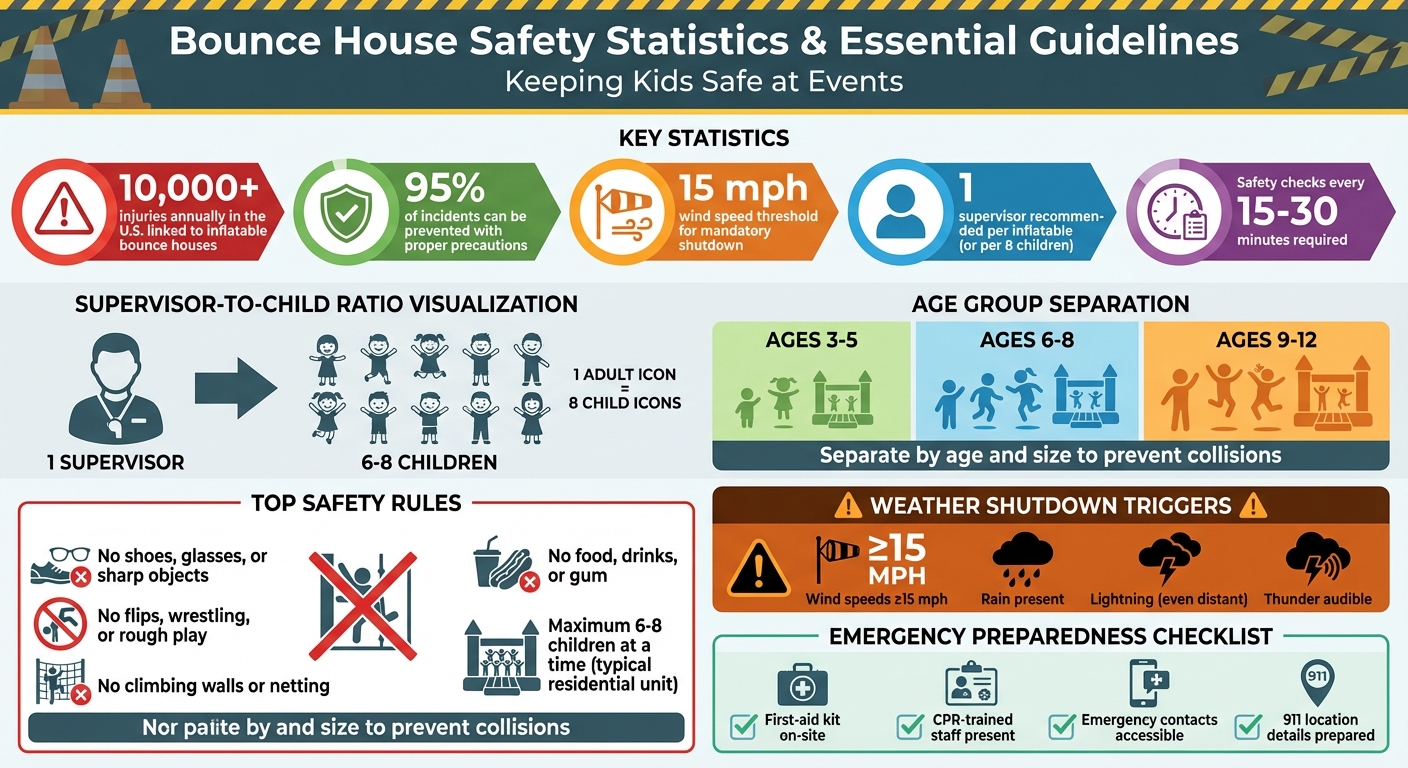
Bounce House Safety Statistics and Key Supervision Guidelines
Preparing for Safe Supervision Before the Event
Read Safety Instructions and Guidelines
Before supervising a bounce house, it’s essential to understand the safety rules. Start by reviewing the manufacturer’s manual for each inflatable. This manual outlines critical details such as capacity, weight limits, age restrictions, and prohibited activities. For example, if the manual states "maximum 6 children ages 3–7", treat that as a strict rule, not a suggestion.
Rental companies also provide a safety sheet or training guide that simplifies these technical details into practical steps. These guides often cover where supervisors should stand, how to group children by size, and what to do in case of an issue. For instance, Bouncy Rentals USA includes written instructions with every rental, addressing everything from setup to emergency procedures.
In the U.S., bounce houses must comply with ASTM F2374 standards, which cover safe setup, anchoring, and operation. Depending on your location, you may also need permits or inspections for public events, so it’s important to check local regulations well in advance. All these materials form the basis for managing entry lines, adapting to weather changes, and addressing injuries.
To make supervision easier, create a one-page checklist summarizing key rules: maximum capacity, age group limits, "no rough play" policies, wind speed thresholds (usually around 15 mph), and emergency contacts. Before the event begins, hold a 5–10 minute briefing with all supervisors to review this checklist and assign responsibilities. Posting clear rule signs at each entrance – such as "No shoes", "No flips", or "Ages 3–7 only" – helps reinforce these expectations.
Once the safety guidelines are in place, the next step is choosing the right supervisors.
Choose Responsible Supervisors
The right supervisor plays a key role in preventing injuries. Select responsible adults (18 or older) who are attentive, quick to act, and confident in enforcing rules. Supervisors must remain sober and drug-free throughout their shift – alcohol or any substance that impairs judgment is strictly off-limits.
Avoid assigning anyone who might get distracted by their phone, other tasks, or personal obligations. Think of the role like that of a lifeguard: the supervisor’s sole focus should be monitoring the inflatable, enforcing rules, and responding immediately to unsafe conditions.
Plan for at least one dedicated adult per inflatable, with a general guideline of one adult for every eight children actively using the bounce house. Larger inflatables, such as obstacle courses or units with multiple entry points, may require two supervisors – one at the entrance and another monitoring the interior or exit. If your event includes several inflatables, appoint a lead safety coordinator to oversee operations, manage weather-related decisions, and assist with crowd control.
Before the event, ensure each supervisor is committed to staying in position with a clear view of both the entrance and the interior. Supervisors should actively scan for overcrowding, rough play, or signs of distress rather than standing idly. Be ready to pause activity immediately if high winds arise, equipment issues occur (like loosening stakes or sagging walls), or an injury happens. Always follow the event’s emergency protocol in such cases.
Once your supervisors are selected, ensure the event layout supports their ability to maintain safety.
Plan the Event Layout and Equipment
A well-thought-out layout is critical for safe supervision. Choose a level, open area far from streets, parking lots, and traffic. Create a safety buffer zone around each inflatable where vehicles are prohibited. Bounce houses work best on grass or other soft surfaces, but if you must set up on pavement, place safety mats at entry and exit points to reduce the risk of falls.
Keep inflatables away from hazards like pools, trees, and power lines. Arrange power cords so they don’t cross walkways or high-traffic areas; if they must, cover and secure them to prevent tripping. Position the blower and generator outside crowd pathways, using cones or barriers for protection, and connect them to properly grounded outlets. Never place electrical equipment near standing water.
Design the layout to give supervisors clear sightlines. Each inflatable should have enough space for an attendant to monitor the entrance and observe the entire bouncing area. If multiple inflatables are in use, space them far enough apart to prevent kids exiting one unit from immediately running into another.
Match inflatables to the ages and abilities of your guests. For younger children, opt for smaller, simpler bounce houses, while older kids or teens might enjoy obstacle courses or tall slides. Always check the manufacturer’s listed age, height, and weight limits for each inflatable. Reputable companies like Bouncy Rentals USA can help you choose the right options based on your guest list and ensure realistic capacities for each unit.
Before the event, confirm that your provider installs and secures each inflatable according to ASTM standards. Make sure safety rules and capacity limits are posted on each unit or at the entrances. Request a brief on-site training for supervisors during setup, covering safe entry and exit, how to check for proper pressure and tension, and how to shut down the blower in an emergency. Finally, ensure you have the provider’s contact information and support hours in case of equipment or weather-related issues during the event.
With the layout finalized, you’ll be ready to focus on active supervision during the event.
Supervising Bounce Houses During the Event
Place Supervisors in the Right Spots
Assign one attentive adult to each bounce house entrance, ensuring they face inward for a clear view of the activity inside. This positioning helps them quickly detect rough play, overcrowding, or falls. Supervisors must remain focused – no turning away, sitting with their back to the unit, or getting distracted by phones or conversations.
Every supervisor should be familiar with the location and operation of the blower and power shutoff for emergencies like entrapment, sudden weather changes, or deflation. Keep the area around the entrance free of obstacles like chairs or coolers to ensure immediate access if needed.
For larger inflatables, assign two supervisors: one at the main entrance and another overseeing less visible areas such as exits or interior sections. If the event includes multiple bounce houses, each unit should have its own designated adult, positioned and ready before play begins.
Strategically placed supervisors can also manage the number of participants and separate children by age group effectively.
Control Capacity and Separate Age Groups
Supervisors must strictly enforce the posted limits for maximum riders, total weight, and age restrictions. For most residential inflatables, this usually means no more than six to eight children at a time.
To minimize the risk of injuries, group children by age and size. Keep kids under six off larger inflatables or those shared with older children. Organize groups by similar ages, such as three to five, six to eight, and nine to twelve. Rotate these groups every three to five minutes to avoid overcrowding. If collisions or bumping persist, reduce the number of riders immediately.
Use cones or ropes to create a clear waiting line, allowing only the next group to enter once the previous group has exited. Simple instructions like "Next six kids only" or "Small kids’ turn" can help maintain order. Address any disruptive behavior immediately to ensure safety remains the top priority.
These on-site measures complement earlier planning and training, maintaining a safe environment throughout the event.
Conduct Regular Safety Checks
In addition to proper supervision and capacity control, regular safety checks are essential. Every 15–30 minutes, walk around the bounce house to inspect stakes, sandbags, tie-downs, walls, floors, netting, and seams for security and damage. If any anchoring comes loose or shifts, stop play immediately, clear the area, and fix the issue before resuming.
Ensure the blower is providing steady airflow, and check that the power cord is intact and safely out of the way. At least one supervisor should always know the location of the on/off switch and be prepared to shut down the unit if there are signs of smoke, strange noises, or overheating.
Document these safety checks using a simple checklist. If you notice any damage, unexpected deflation, or equipment problems, stop using the bounce house immediately and contact the rental provider for assistance or a replacement unit.
Enforcing Rules and Managing Risks in Real Time
Set and Enforce Clear Safety Rules
Before kids step into the bounce house, it’s essential to lay down the ground rules in simple, direct terms like: "No shoes, no flips, no roughhousing, stay off the walls, and listen to the supervisor." To ensure everyone understands, follow up with a quick verbal check. For added clarity, post a large, easy-to-read sign at the entrance. Include icons or pictures for younger children who might not yet read. The key rules to highlight are:
- No flips, wrestling, or rough play
- No shoes, glasses, or sharp objects
- No climbing or hanging on walls or netting
- No food, drinks, or gum
These rules address the most common causes of bounce house injuries, which result in over 10,000 children visiting U.S. emergency rooms each year.
If unsafe behavior occurs, respond firmly but calmly with clear instructions like: "No flips, feet only," or "Down from the wall now." Make eye contact to ensure they’re paying attention. If the behavior continues, pause the activity by announcing: "Everyone sit down, bouncing is paused!" Remove the child for a short break, explain the broken rule, and outline what needs to change before they can return. Stay composed and focus on the behavior, not the child. For repeat issues, involve the parent and explain that further violations could mean the child won’t be allowed back in.
Once the ground rules are set, stay vigilant for any signs of unsafe behavior.
Watch for Warning Signs and Respond Quickly
Supervisors should position themselves at the entrance, facing inward, and keep their attention on the activity without distractions like phones or side conversations. Look for warning signs such as rough play (wrestling or tackling), repeated attempts at flips, or children who seem distressed or pinned by others. If you spot any of these, stop the activity immediately, clear the bounce house, and address the issue. This approach works hand-in-hand with earlier strategies like controlling capacity and thoughtful layout planning.
Crowding is another red flag. If kids are pressed together, struggling to move, or if the bounce house exceeds its recommended capacity, stop new entries, clear the space, and allow only the appropriate number of participants back in.
To maintain sharp supervision during long events, rotate supervisors every 20–30 minutes. This helps prevent fatigue – especially in hot weather – and ensures everyone stays focused on safety.
Use Simple Signals to Manage Crowds
In noisy environments, verbal commands might not always get through. That’s where nonverbal signals come in handy. A quick whistle or clap, paired with a clear instruction like "Stop bouncing – everybody sit!" can grab attention effectively. Combine this with hand signals: an open palm raised at the entrance to mean "wait/do not enter" and a sweeping motion toward the door to signal "exit now."
A countdown, like "3-2-1-SIT!" can also help communicate that bouncing needs to stop immediately. For larger events, tools like color-coded wristbands or stickers can help organize groups and manage rotations efficiently. Make sure all supervisors agree on the signals and phrases ahead of time so kids receive consistent instructions.
Handling Weather, Equipment Problems, and Emergencies
Watch the Weather and Shut Down When Necessary
Weather can turn a bounce house from a fun activity into a dangerous situation in no time. To stay ahead, have someone check a reliable weather app every 15–30 minutes. If winds hit 15 mph or more, or if steady rain, thunder, or lightning appear – even in the distance – stop operations immediately. Move everyone at least 10–20 feet away from the inflatable to ensure safety.
When shutting down, stop admitting new riders and calmly explain to those inside that the activity is being paused due to weather. Help younger children exit safely, and wait until the bounce house is completely empty before turning off the blower. Leave all stakes, sandbags, and tie-downs in place to secure the inflatable. For further instructions – such as whether to deflate it completely – contact your rental company (e.g., Bouncy Rentals USA).
Respond to Equipment Failures
After weather-related shutdowns, equipment issues can sometimes crop up. If the blower stops working, the walls start sagging, or the motor cycles on and off, close the entrance and guide all riders out immediately. Have an adult stay at the doorway to assist children, especially younger ones, as they exit. Keep everyone clear of deflating walls, blower tubes, and power cords.
Once the bounce house is empty, check for common issues like tripped breakers, unplugged cords, kinked air tubes, or tears. Don’t restart the inflatable until you’ve resolved the problem or consulted your rental provider. Make sure to document the incident, noting the time and any warning signs you observed.
Be Ready for Emergencies
Even with weather and equipment precautions, injuries can still happen. Keep a well-stocked first-aid kit nearby, including essentials like bandages, antiseptic wipes, cold packs, gloves, and a CPR face shield. At least one person on-site should be trained in basic first aid and CPR for children. Also, have critical location details – like the event address, cross-streets, and the best ambulance access point – written down and stored with the first-aid kit.
If a serious injury occurs, such as a head injury, suspected fracture, breathing trouble, or unconsciousness, stop all activity immediately. Call 911, give a clear description of the incident and location, and follow the dispatcher’s instructions. Avoid moving the injured person unless it’s absolutely necessary to prevent further harm. Afterward, document everything – date, time, weather, what happened, who was involved, and the actions taken. Notify your rental provider and, if applicable, your organization’s risk manager or insurer.
Working with Your Rental Provider for Safety
Review Guidelines and Training with the Provider
After your initial event planning, teaming up with your rental provider is key to ensuring safety. Before the big day, meet with them to iron out details like who will handle on-site supervision, the capacity limits for each inflatable, and how to group participants by age and size. A common recommendation is to have one trained adult supervising every six to eight children. Request written safety instructions, checklists, and any training materials they provide – these can be valuable tools for your pre-event briefing. Collaborating with your provider helps reinforce critical safety rules, such as banning shoes, sharp objects, food, and roughhousing. It’s also essential to agree on when to shut down inflatables due to bad weather – like high winds (over 15 mph), lightning, or heavy rain – and how to report any damage or safety concerns. For instance, Bouncy Rentals USA offers a "Rules & Safety" section and an "Inflatable Setup Safety Checklist" on their website, making it easier to train your team with ready-to-use materials.
Ask Questions About Equipment and Support
Don’t hesitate to ask your provider about their equipment maintenance and support. Confirm their inspection schedule for wear and anchor stability, and check if they follow recognized standards like ASTM F2374. You’ll also want to know about their cleaning and inspection routines between events. Make sure they carry commercial general liability insurance and can provide a certificate naming your event or venue as an additional insured if needed. It’s also a good idea to verify if they offer 24/7 on-call support for equipment issues – keep their contact details handy for your supervisors. This level of preparation ensures you’re covered and adds another layer of safety to your event.
Use Provider Expertise
Your rental provider’s expertise can make a big difference in running a safe event. They can guide you in choosing the right number and type of inflatables based on factors like your expected crowd size, event length, available space, and surface conditions. For example, they might suggest allowing one child per 35 to 50 square feet of bounce area, depending on the inflatable’s design and the children’s ages. They’ll also advise on maintaining safety buffer zones around each inflatable to minimize collisions and manage crowds better. If you’re hosting a large or complex event, ask if they can provide trained attendants. These professionals can handle tasks like monitoring capacity limits, deciding when to shut down due to weather, and managing emergencies. This extra support not only lightens your workload but also boosts overall safety. Companies like Bouncy Rentals USA offer professional setup and helpful advice on staffing and safety, showing how working with a knowledgeable provider can let you focus more on your guests while they handle the logistics.
Conclusion
Keeping a bounce house safe boils down to four key steps: pre-event preparation, constant supervision, enforcing rules, and having clear emergency protocols. Studies indicate that around 95% of bounce house injuries can be avoided when these basics are followed by adults.
Before kids start jumping, make sure to appoint responsible supervisors, go over safety guidelines, securely anchor the equipment, and have a plan in place for first aid or contacting emergency services. Once the fun begins, have an adult stationed at the entrance to monitor the number of participants and stop roughhousing. If winds exceed 15 mph, storms roll in, or the equipment shows signs of damage, clear the bounce house immediately.
Working with a dependable provider like Bouncy Rentals USA makes the process much easier. They offer sanitized, insured equipment and handle professional setup for you. Plus, their resources, like the "Inflatable Setup Safety Checklist" and "Rules & Safety" section, provide straightforward advice for managing capacity, weather conditions, and emergencies. This teamwork ensures you’re well-prepared from start to finish.
Customers frequently highlight the difference professional service makes. Families often praise Bouncy Rentals USA for their efficient setup, clean equipment, and excellent service, with many reporting hours of safe, unforgettable fun.
With a bit of planning, clear rules, and active oversight, bounce houses can be transformed into safe, high-energy play zones. Thanks to vigilant supervision and the expert support of Bouncy Rentals USA, your event can wrap up with nothing but smiles and happy memories.
FAQs
What steps should I take if a child gets hurt in a bounce house?
If a child gets injured in a bounce house, the first step is to calmly guide them out of the inflatable and into a safe area. Check the injury carefully and offer basic first aid if necessary. For more severe injuries, call emergency services right away or head to a medical professional for assistance.
Make sure to inform the event organizer about the incident and keep a record of what occurred, including any steps you took afterward. To minimize the risk of injuries, always stick to bounce house safety rules and keep a close eye on children while they play.
What should I do to keep a bounce house safe during bad weather?
If bad weather hits – like high winds, thunderstorms, or severe conditions – it’s crucial to stop using the bounce house right away. Deflate it immediately, secure it to keep it from blowing away, and, if possible, move it to a protected spot. Wait until the weather clears and it’s safe before setting it up again. Safety should always come first when dealing with sudden weather changes.
What should a bounce house supervisor do to ensure safety during events?
A bounce house supervisor is essential for maintaining a safe and fun environment. Their job involves keeping a close eye on participants, enforcing rules such as no roughhousing, flips, or overcrowding, and ensuring everyone gets a fair turn.
In addition to monitoring behavior, supervisors need to routinely check the bounce house for any damage or wear and address any issues immediately. By staying vigilant and ready to act, they help ensure everyone has a safe and enjoyable time.