Inflatable rentals are fun but come with risks. Injuries from inflatables surged 1,500%, with over 18,000 reported in 2012 alone – most involving children under 14. These accidents often stem from avoidable issues like poor setup, weak anchoring, lack of supervision, and ignoring weather conditions. Proper staff training is critical to reduce these risks, meet insurance requirements, and avoid costly lawsuits.
Key takeaways:
- Common causes of accidents: Improper anchoring, unsafe site selection, lack of supervision, and weather-related issues.
- Insurance essentials: General liability insurance of at least $1,000,000 per occurrence is mandatory in most states. Workers’ compensation and commercial auto insurance may also be required.
- Training benefits: Certifications (e.g., SIOTO) lower liability risks, reduce insurance premiums, and meet client and regulatory demands.
- Best practices: Use wind gauges, enforce age/size limits, conduct regular inspections, and maintain safety logs.
Investing in training and certifications like BISOC or AISOC not only ensures safer operations but also protects your business from legal and financial fallout.
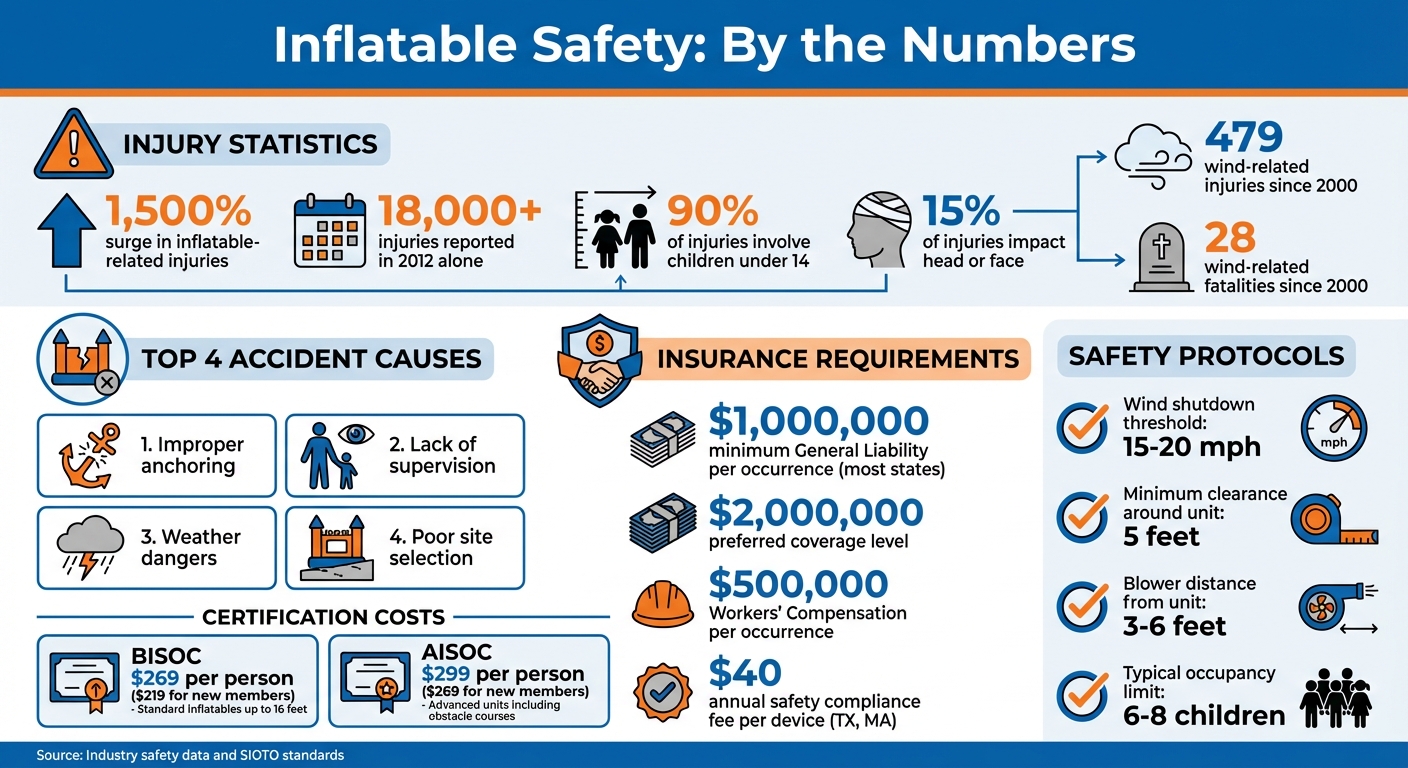
Inflatable Safety Statistics and Insurance Requirements for Rental Operators
Liability Risks in Inflatable Rentals
What Causes Most Inflatable Accidents
Most inflatable accidents happen because of four avoidable issues: improper anchoring, lack of supervision, weather dangers, and poor site selection. When staff aren’t properly trained, they might skip essential tie-downs or misuse weights like sandbags, leading to inflatables tipping over or being carried off by the wind. They may also overlook safety rules, such as enforcing capacity limits or grouping kids by size, which can lead to collisions and injuries. Setting up inflatables in risky spots – like near power lines, fences, or on uneven ground – can increase the chances of electrocution, punctures, or impact injuries. Additionally, equipment failures, like undetected leaks, can lead to sudden deflation and entrapment if thorough inspections aren’t done beforehand. These issues not only put guests at risk but also create serious legal and financial problems for operators.
"Most injuries can be attributed to incorrect set-up, improper use, or unsupervised play." – Trisha Sirju, Vice President, Senior Risk Consultant, Marsh Advisory
Legal and Financial Consequences
The consequences of these preventable mistakes can be severe, both legally and financially. Operators may face expensive personal injury lawsuits covering medical costs, pain, and long-term disability. Even worse, insurance companies might deny claims, leaving operators to handle settlements out of pocket. Beyond these immediate costs, accidents can lead to higher insurance premiums and regulatory penalties, such as fines or even the loss of operating licenses if inspections and permits aren’t up to date.
Many venues also require operators to sign indemnification agreements, which could make you responsible for covering a client’s legal defense costs if an accident occurs.
"Liability is the legal responsibility for any losses or damage caused to another person or business as a result of your work." – Jungle Jumps
There’s a silver lining, though. Certifications, like those provided by SIOTO, show insurers that you’re taking safety seriously, which can help lower premiums and shield your business from liability claims. Keeping detailed records – such as daily inspection logs, staff training documentation, and signed liability waivers – can further protect your business and strengthen your defense if an incident does occur.
Insurance Requirements for Inflatable Operators
Standard Insurance Coverage Levels
If you’re running an inflatable rental business, having the right insurance is non-negotiable. At a minimum, you’ll need General Liability (GL) Insurance with coverage of at least $1,000,000 per occurrence – a requirement in most states and by many large organizations. Some states, like Texas, add extra layers, mandating $1,000,000 in bodily injury coverage and $500,000 in property damage coverage per occurrence for Class B amusement rides, which include inflatables.
For businesses with employees, Workers’ Compensation Insurance is essential, typically requiring a $500,000 limit per occurrence for bodily injury. If your operations involve transporting equipment, Commercial Auto Insurance is another must-have. Additionally, many clients – such as schools, churches, and universities – will insist on being listed as an "Additional Insured" on your policy before agreeing to work with you.
"The certificate must show evidence of general liability insurance of at least $1,000,000 (preferably $2,000,000) per occurrence and workers’ compensation insurance of $500,000 per occurrence for bodily injury." – RCAB Office of Risk Management
In states like Texas and Massachusetts, you’ll also need to pay an annual safety compliance fee of $40 per inflatable device. Texas further requires that inspections for these compliance stickers be conducted by inspectors approved by your insurance provider. Some jurisdictions even demand that your Certificate of Insurance (COI) include the specific serial numbers of each insured inflatable for permit validation.
These regulations highlight the importance of combining proper insurance coverage with effective risk management practices, like thorough staff training.
How Training Affects Insurance Costs
Proper training doesn’t just keep your team safe – it can also save you money on insurance premiums. Professional safety certifications are seen as evidence of due diligence and can help reduce your liability risks. For example, certifications from SIOTO, such as BISOC and AISOC, are widely recognized by insurers and can lead to lower premiums.
"Major insurance companies recognize our certifications as evidence of professional competence and commitment to safety protocols. This recognition can lead to premium reductions for your bounce house business." – SIOTO
Investing in training has a dual benefit: it demonstrates compliance with industry best practices and provides a defense against liability claims. Certifications like BISOC ($269 per person, with a discounted rate of $219 for new members) and AISOC ($299, or $269 for new members) show that your staff is equipped to prevent issues like improper setup, anchoring failures, or wind-related accidents. Many municipalities and corporate clients now require proof of safety certification before allowing operators on-site, making training not just a cost-saving measure but also a key to securing lucrative contracts.
How Safety Training Lowers Liability Risks
What Staff Need to Learn
Your staff must know how to choose flat, hazard-free areas for setup – avoiding fences, trees, or power lines – and maintain at least 5 feet of clearance around each inflatable. Clearing debris to prevent punctures and ensuring electrical blowers are GFCI-protected and positioned 3–6 feet from the unit are also essential steps.
They should enforce occupancy limits, group participants by size and age, and prohibit risky behaviors like flips or climbing. Monitoring internal pressure, inspecting for structural damage, and knowing how to evacuate during emergencies are equally important. With nearly 90% of inflatable-related injuries involving children 14 or younger – and about 15% impacting the head or face – proper training in crowd control and emergency procedures can significantly reduce these risks.
SIOTO certifications are an excellent way to reinforce these safety practices. The Basic Inflatable Safety Operations Certification (BISOC) costs $269 per person ($219 for new members) and covers setup, anchoring, and weather monitoring for standard inflatables like moonwalks and slides up to 16 feet. For $299 per person ($269 for new members), the Advanced Inflatable Safety Operations Certification (AISOC) adds training for more complex units, including obstacle courses, water inflatables, and safety padding protocols.
These skills not only minimize accidents but also demonstrate your compliance with industry standards, insurers, and regulators.
Proving Responsibility to Insurers and Regulators
Training and certifications provide tangible evidence of your safety commitment. Certifications can serve as proof of due diligence when insurers or regulators evaluate your operations. Proper training ensures compliance with ASTM F2374, the national safety standard for inflatable amusement devices, which is often required for permits and licenses in many jurisdictions. Keeping detailed records – like inspection logs, weather data, and signed rental agreements – further proves your ongoing compliance.
"Major insurance companies recognize our certifications as evidence of professional competence and commitment to safety protocols. This recognition can lead to premium reductions for your bounce house business."
- SIOTO
Third-party certification databases allow insurers and venue managers to verify your qualifications instantly. This transparency builds trust and can help secure contracts with schools, churches, and corporate clients who often require proof of training before booking. Additionally, showing regulators that your staff uses precise tools like handheld anemometers for wind monitoring – rather than less reliable smartphone apps – demonstrates a serious approach to localized safety measures.
Safety Training Programs at Bouncy Rentals USA
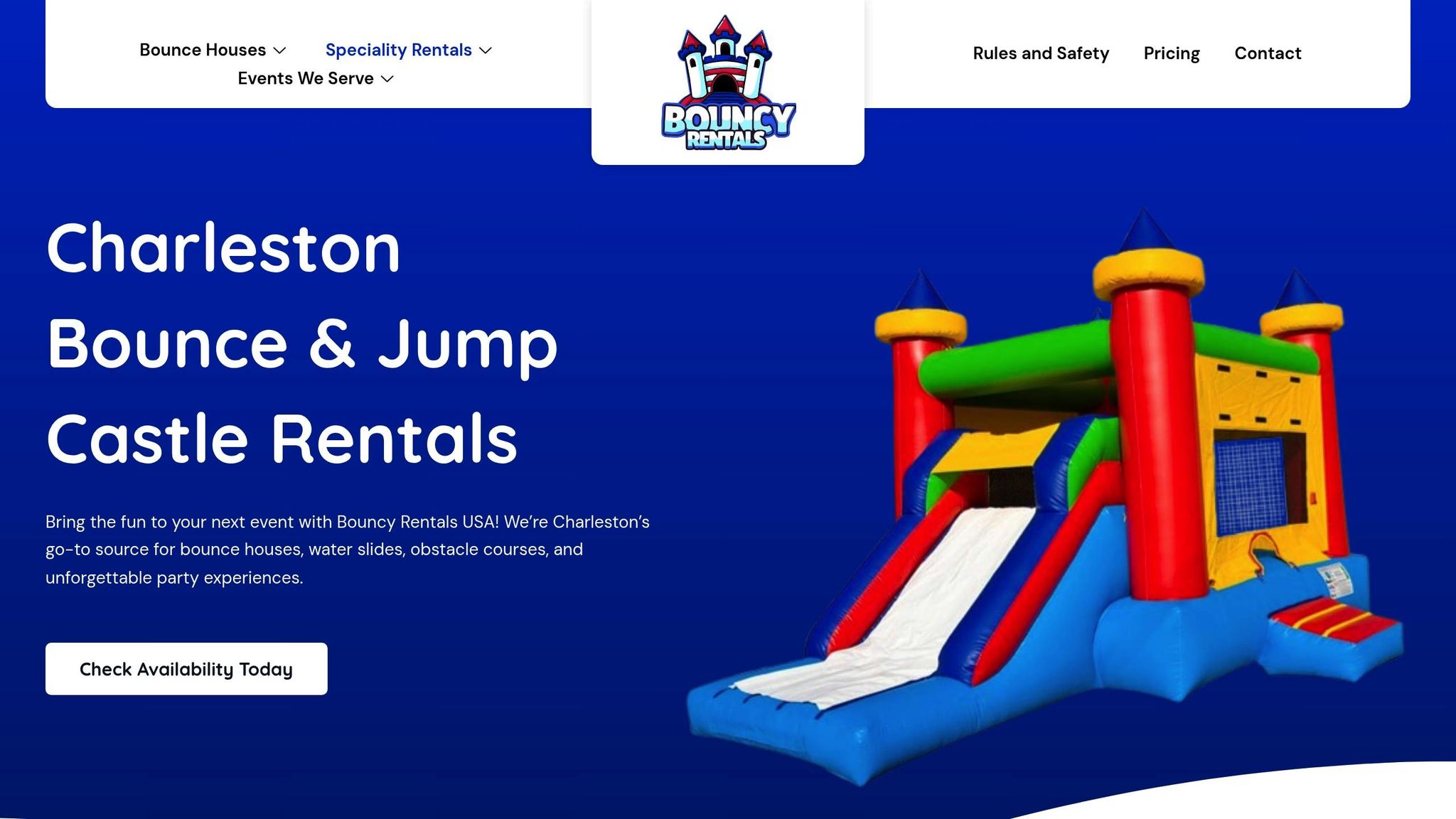
Bouncy Rentals USA takes safety seriously, implementing a thorough training program designed to reduce risks and ensure smooth operations.
What Our Training Program Covers
Every team member at Bouncy Rentals USA undergoes detailed training before handling any equipment. The program covers all aspects of inflatable operations, from delivery and setup to supervision and takedown, ensuring strict compliance with manufacturer instructions.
Staff are trained in a three-stage inspection process to check for issues like tears, loose seams, or faulty blowers before, during, and after each rental. They also learn proper anchoring techniques, using heavy-duty stakes for grass setups and weighted sandbags for concrete or asphalt surfaces. Training on blower operations highlights the importance of using GFCI outlets and keeping electrical connections dry.
Environmental awareness and emergency response are key components of the program. Team members use handheld wind gauges to monitor conditions and are instructed to secure equipment immediately if wind speeds exceed 15–20 mph or if lightning is detected. They are also trained in rapid deflation procedures, handling power outages, and identifying emergency exits in enclosed units. Considering that wind-related incidents have caused 479 injuries and 28 fatalities since 2000, this level of vigilance is crucial.
Staff enforce occupancy limits – typically 6–8 children for standard units – and ensure rules like no shoes, jewelry, food, drinks, or rough play inside inflatables are followed. They also implement age segregation strategies to prevent accidents between participants of different sizes. Between events, sanitization protocols are followed to maintain cleanliness and hygiene for every customer.
Certification and Continued Learning
To uphold high safety standards, Bouncy Rentals USA ensures its training aligns with industry-recognized programs from the Safe Inflatable Operators Training Organization (SIOTO). Staff members earn certifications such as the Basic Inflatable Safety Operations Certification (BISOC) for standard units under 16 feet and the Advanced Inflatable Safety Operations Certification (AISOC) for complex equipment like obstacle courses and water slides. These certifications, costing $269 and $299 per person respectively, reinforce compliance with ASTM F2374 standards.
Certifications are renewed annually to keep staff updated on the latest safety protocols. Team members have access to webinars, updated training resources, and renewal exams to reinforce best practices. This ongoing education ensures that operations meet both insurer requirements and regulatory standards.
SIOTO certifications are widely recognized by major insurance companies as proof of professional competence. With fully insured operations and highly trained staff, Bouncy Rentals USA provides customers with the confidence that their events are in safe hands.
Conclusion: Safety Training Protects Customers and Your Business
Investing in safety training is a smart move for protecting both your customers and your business. When your team is well-versed in anchoring, weather monitoring, and supervision, they can address the leading causes of accidents before they happen. This proactive mindset reduces the risk of injuries that could lead to expensive legal claims and tarnished reputations.
Earning professional certifications through SIOTO shows insurers that you’re serious about managing risks. Many major insurance companies view these certifications as proof of expertise, which often leads to lower premiums and stronger liability coverage. Plus, having documented training demonstrates due diligence to both insurers and regulators.
"Certification protects your business from liability claims by ensuring you follow industry best practices for every setup and event." – SIOTO
With injury rates high in some industries, proper training isn’t just a smart business decision – it’s also a moral responsibility.
At Bouncy Rentals USA, we’ve made certified, ongoing training a cornerstone of our operations. This commitment ensures every event we handle meets the highest safety standards while staying fully compliant with insurance requirements. By prioritizing safety, we protect our customers, empower our team, and earn the trust of families who return to us for safe, unforgettable celebrations.
FAQs
What insurance coverage is necessary for inflatable rental businesses?
Inflatable rental businesses must have general liability insurance with at least $1,000,000 per occurrence and $2,000,000 aggregate coverage. This protects your business from potential claims related to accidents or property damage. Additionally, make sure vendors carry adequate insurance and can list your business as an additional insured on their policy.
To minimize risks, stick to the safety guidelines provided by the vendor, carefully review all contracts, and ensure your team is trained to properly set up and monitor inflatable equipment. These precautions not only help you meet insurance requirements but also contribute to a safer environment for everyone.
How can staff training help reduce liability and lower insurance costs for inflatable rentals?
Training your staff properly is a smart move when it comes to reducing liability risks and keeping insurance expenses under control. When your team knows how to set up, operate, and supervise inflatables safely, you’re not just preventing accidents – you’re protecting your customers and showing that your business follows safety standards.
This attention to safety doesn’t just benefit your customers. Insurance providers often view well-trained teams as a lower risk, which can potentially lead to reduced premiums. Plus, by taking these steps, you’re creating a safer environment and earning the trust of your customers. Investing in staff training isn’t just about compliance; it’s about protecting your business and reputation.
What are the main safety concerns with inflatables, and how can they be avoided?
Inflatables can be a lot of fun, but they come with risks if not handled correctly. The most frequent issues stem from improper setup, overcrowding, and lack of supervision. For instance, failing to anchor an inflatable securely, placing it in an unsafe spot, or overlooking bad weather can lead to serious accidents. Overcrowding or letting kids of all ages and sizes play together often results in injuries like sprains or falls. And when there’s no one keeping an eye on things, unsafe behavior tends to follow.
How to Minimize Risks
The key to avoiding these problems lies in training and supervision. Staff should be well-versed in setup procedures, including anchoring and knowing capacity limits. Keeping an eye on weather conditions and choosing a safe location for the inflatable is just as important. To make play safer:
- Limit the number of participants at one time.
- Group children by age or size to prevent collisions.
- Enforce rules with constant adult supervision.
Rental companies also play a big role. They should provide clear safety guidelines and regularly inspect their equipment to meet local safety standards. These steps go a long way in keeping inflatable fun safe for everyone.